
Tyre Couplings (Fenaflex Type)
Highly elastic tyre-type couplings for shock and vibration control - tyre replaceable without moving the machines, standard and FRAS tyres.
Tyre Couplings (Fenaflex Type)
Highly elastic, lubrication-free tyre-type couplings for shock and vibration control - large misalignment capacity and tyre replacement without disturbing the motor or driven machine. Selection, replacement and RFQ support by MECHATRIC.
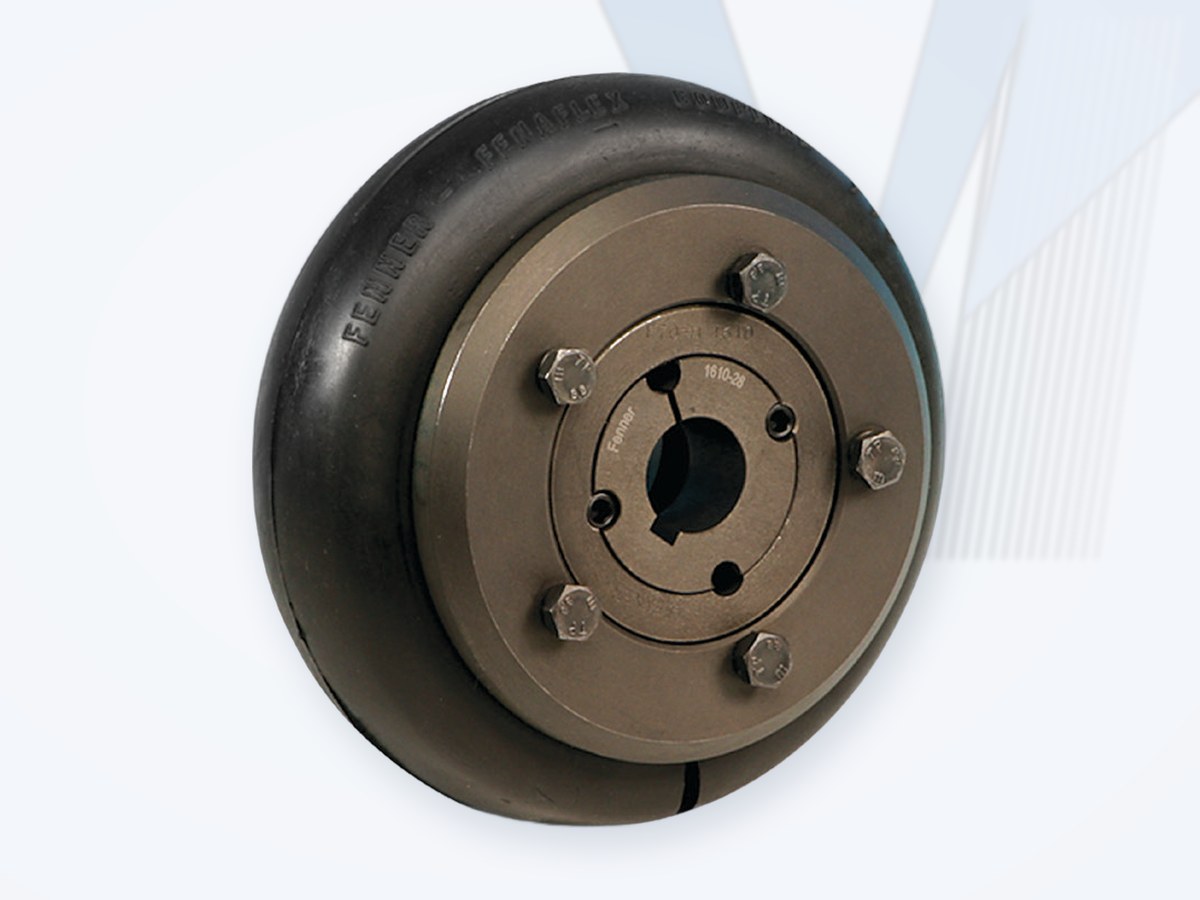
What is a tyre coupling?
A tyre coupling uses a flexible reinforced rubber tyre element between two hubs or flanges. It accommodates shaft misalignment, absorbs shock, and reduces transmission of vibration and torsional oscillations. The Fenner Fenaflex reference highlights replacement of the tyre without disturbing motor and driven-machine positions.
Configurations and Features
- Split / replaceable tyre elements (as applicable to the design) - inspection and replacement without moving the machines.
- Taper Lock and pilot-bore flanges; pump spacer and flywheel fixing variants.
- Standard and FRAS (fire-resistant, anti-static) tyre constructions in the Fenner range.
- Reinforcing cords wound in both directions support reversing-drive duty in the cited Fenaflex design.
- Lubrication-free; simple visual inspection.
Manufacturer Reference: Misalignment and Sizes
The Fenner Fenaflex data sheet quotes up to 4° angular, 6 mm parallel and 8 mm axial misalignment; these are manufacturer-family maxima and must not be applied simultaneously or to every size without OEM confirmation.
Fenner reference sizes: F40, F50, F60, F70, F80, F90, F100, F110, F120, F140, F160, F180, F200, F220, F250. Maximum bores (Taper Lock and bored) are size-specific - confirmed with the quotation.
Applications
Pumps, blowers, conveyors, agitators, fans and other equipment requiring shock absorption and tolerance of shaft movement, subject to torque and speed limits.
Replacement cautions
Check tyre outer diameter, flange type, clamping geometry, split construction, cord reinforcement, compound, bore / bush arrangement and spacer requirements. A tyre with a similar diameter may have different torque and misalignment ratings.
How to Select the Right Coupling
Identify the driver and driven equipment, rated power (kW), operating speed (rpm) and duty cycle.
Calculate nominal torque: T (Nm) = 9550 × P (kW) / n (rpm).
Apply the manufacturer-specific service factor and review starting, stopping, reversing, braking and peak torque.
Verify catalogue torque rating, maximum speed, bore / keyway or bushing, shaft spacing and envelope dimensions.
Evaluate angular, parallel and axial misalignment together, including thermal growth.
Check temperature, chemical exposure, fire / antistatic requirements and installation access.
Obtain the current manufacturer drawing and engineering approval before ordering.
Replacement and Interchange Methodology
Compare the original and proposed coupling at assembly level: rated / peak torque; speed; shaft bore, keyway and taper-bush details; shaft gap or DBSE; outside diameter and axial envelope; misalignment and reaction loads; torsional stiffness and damping; element compound; service temperature; maintenance method; and safety requirements. A similar shape or nominal size is not evidence of direct interchange.
| Classification | Meaning |
|---|---|
| Direct Interchange | Fully verified |
| Dimensionally Compatible | Dimensional checks passed, performance still to verify |
| Functionally Equivalent | Different design meeting validated application requirements |
| Engineering Review Required | Insufficient evidence or modifications needed |
Information Required for RFQ
Application and industry; driver / driven machine; motor kW and rpm; rated and peak torque if known; start / stop frequency; reversing or braking duty; shaft diameters and fits; keyway or taper bush; shaft gap / DBSE; allowable installation space; ambient temperature and contaminants; existing brand / series / size; photos, nameplate and drawings; quantity; requested documentation; delivery location.
Need tyre couplings or replacement tyres?
Send the existing coupling data and drive details - MECHATRIC checks the selection or replacement and prepares the RFQ.
Source: Fenner Fenaflex Tyre Coupling Data Sheet, Rev 001/05.19 (user-supplied, one page). Educational MECHATRIC landing page, not a certified product datasheet: ratings, limits, fire classifications, standards and equivalence must be verified against current OEM documentation. Brand names identify technical references and do not imply authorised representation.
Frequently Asked Questions
Can the element be changed without moving the machines?
The Fenaflex reference describes this benefit; verify access and the supplied configuration.
Is a tyre coupling lubrication-free?
The Fenaflex elastomer assembly is described as lubrication-free.
Can it handle reversing duty?
The cited Fenaflex tyre has bidirectional reinforcing cords.