
Sure-Flex Plus Elastomeric Couplings
TB Wood's Sure-Flex Plus elastomeric sleeve couplings - sleeve materials, flange types, sizing, installation and replacement.
Sure-Flex Plus® Elastomeric Couplings
TB Wood’s Sure-Flex Plus® is a flexible, torsionally compliant shaft coupling using an elastomeric sleeve between mating flanges. It is a practical choice for motor-driven pumps, fans and general industrial machinery where vibration damping, shock absorption and simplified maintenance matter.
Product family: Flexible Elastomeric Couplings | Type: elastomeric sleeve / shear-flexing coupling | Brand: TB Wood’s (Regal Rexnord).
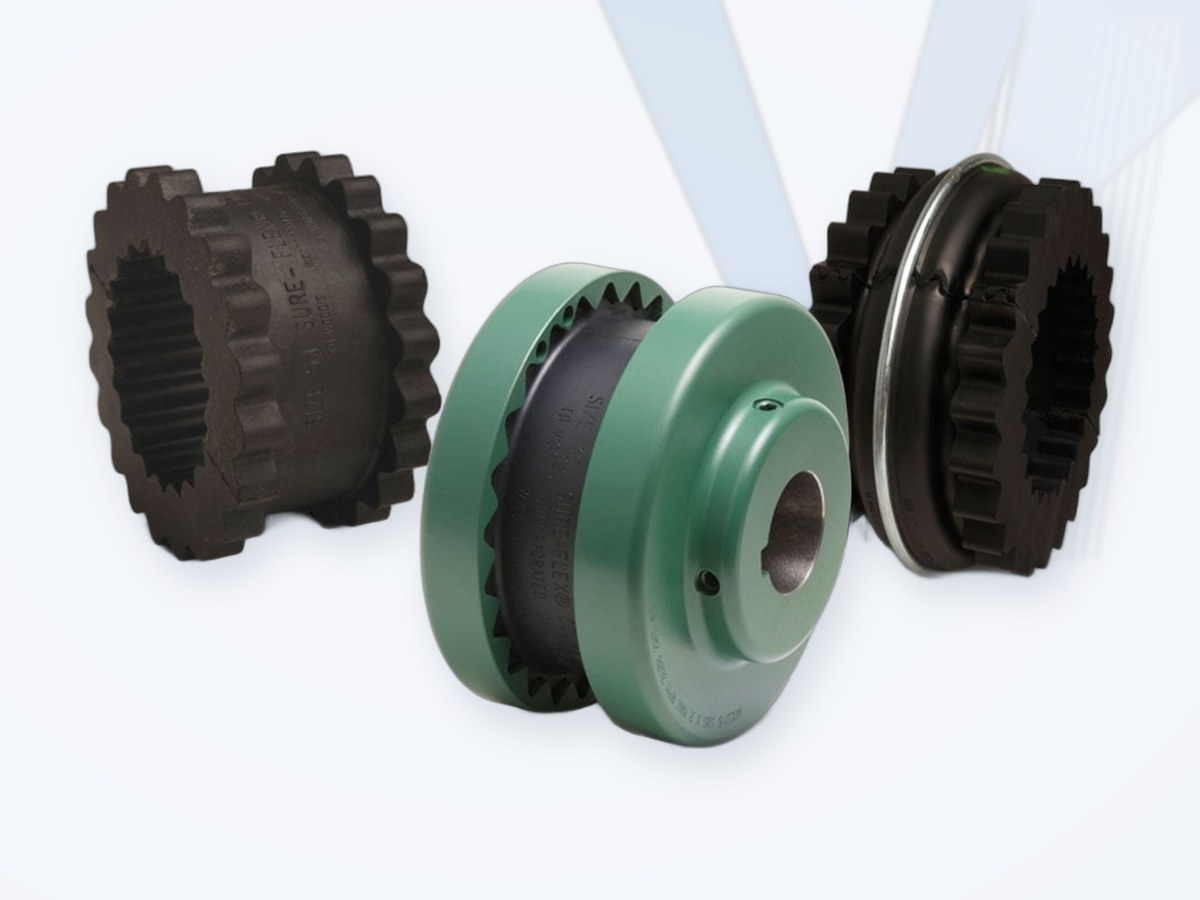
What is a Sure-Flex coupling?
A Sure-Flex coupling connects two rotating shafts through interlocking flanges and a resilient sleeve. Its four-way flexing action helps accommodate angular and parallel misalignment, axial end float, torsional shock and vibration. Unlike lubricated gear or grid designs, the elastomeric sleeve does not require routine coupling lubrication.
Key Benefits and Features
- Four-way flexing action for misalignment, shock, vibration and end float.
- EPDM and Neoprene sleeves: manufacturer literature reports 30% higher torque ratings versus its previous design.
- Manufacturer reports 7°–21° torsional wind-up, depending on configuration.
- Available configurations include spacer, bushed-hub and clamping-hub designs.
- Quick installation and reduced routine service; correct alignment and periodic inspection remain essential.
- Manufacturer promotional literature reports a maximum 8.20 kN·m (72,480 in·lbf) with a Hytrel sleeve; this is not a universal rating across sizes.
Coupling Construction and Components
The coupling assembly comprises two shaft-mounted flanges or hubs and a replaceable flexible sleeve. Sleeve selection and flange configuration must match the selected coupling size, speed, shaft bores and duty.
Flange and hub arrangements
The installation guide identifies flange types J, S, SC, B and C. SC is a spacer arrangement; Type B uses Sure-Grip bushings. Determine the correct hub, flange and sleeve combination from the manufacturer’s dimensional and selection data.
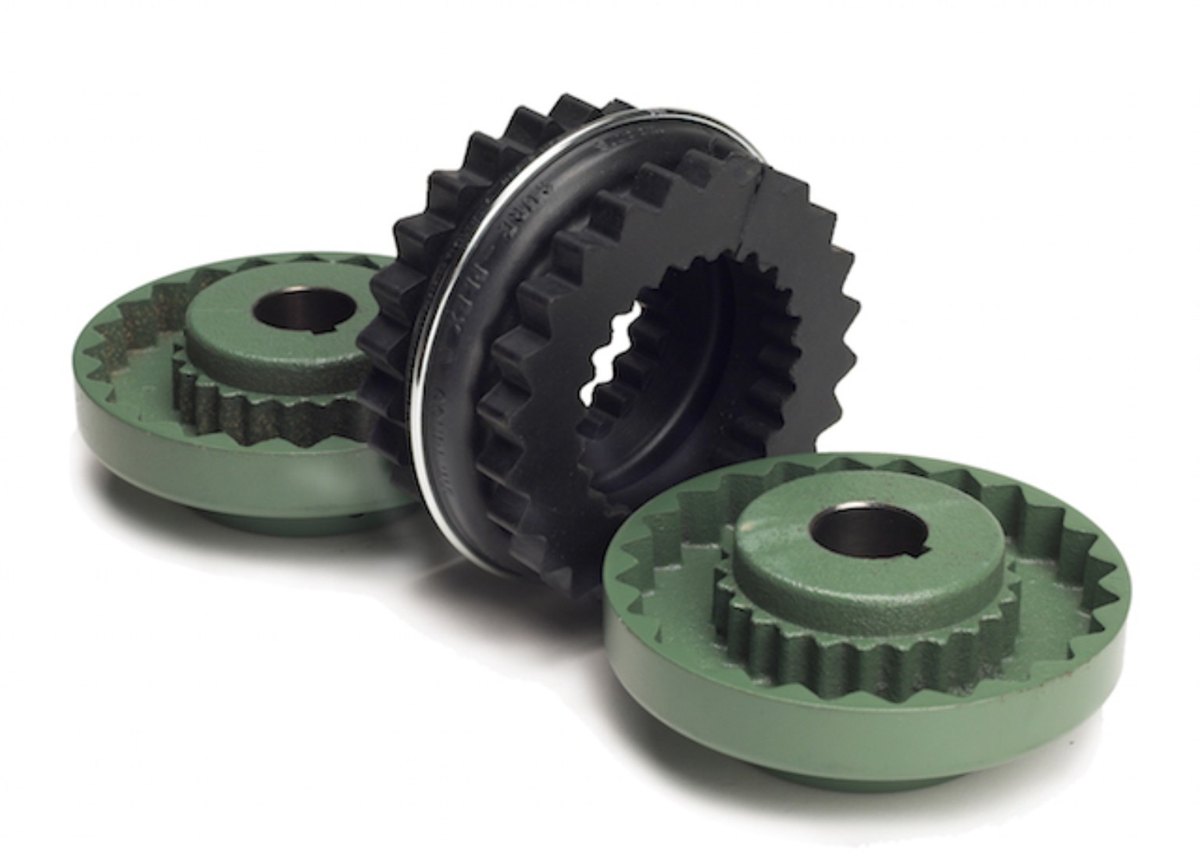
Sleeve Materials: EPDM, Neoprene and Hytrel
| Sleeve / material | Selection consideration |
|---|---|
| EPDM / Neoprene (rubber) | General flexible drive options; select using the manufacturer's torque, temperature and environment ratings. |
| Hytrel (thermoplastic elastomer) | Different torque and misalignment limits from rubber sleeves; confirm suitability for operating duty. |
Important: TB Wood’s explicitly warns that rubber (EPDM / Neoprene) and Hytrel sleeves have different ratings and must not be interchanged without re-selection. H / HS sleeves are not direct replacements for EPDM / Neoprene sleeves.
Typical Industrial Applications
- Centrifugal pumps and water systems
- HVAC and process fans
- Blowers and auxiliary drives
- General-purpose motor-to-machine drives
- Selected conveyors and industrial equipment, subject to service-factor and shock-load checks
Engineering Selection: How to Size Sure-Flex Plus
- Confirm transmitted power (kW / hp), operating speed (rpm) and peak / start-up torque.
- Calculate nominal torque: T (N·m) = 9550 × P (kW) / n (rpm).
- Apply the manufacturer’s application / service factor and check start-stop frequency and shock duty.
- Select the sleeve material and coupling size from current manufacturer torque and speed tables.
- Verify both shaft diameters, keyways, hub style, axial space and any spacer requirement.
- Check permissible parallel / angular misalignment, installation gap and environmental constraints.
- Confirm guarding, installation fastener torque and any special VFD / pump / fan restrictions.
Installation and Alignment Essentials
Lock out / tag out the drive before installation. Clean mating surfaces, remove burrs, mount keyed flanges as specified and seat the sleeve without compression. The installation guide specifies minimum shaft engagement of 0.85 × shaft diameter. Measure parallel and angular alignment and tighten fasteners to the size-specific manufacturer values. Install a protective guard and recheck alignment periodically.
Special note: for a VFD-driven centrifugal pump or fan, the manufacturer installation document instructs users to reduce allowable parallel and angular misalignment values by half.
Selected Manufacturer Maximum Speeds (Reference Only)
| Sleeve size | Maximum rpm |
|---|---|
| 3 | 9,200 |
| 6 | 6,000 |
| 8 | 4,500 |
| 10 | 3,600 |
| 12 | 2,800 |
| 14 | 2,200 |
| 16 | 1,500 |
Excerpted from TB Wood’s installation instruction P-7888-TBW, Table 1. Confirm the current size-specific limits and all applicable ratings before ordering.
Replacement, Interchange and Equivalent Coupling Assessment
When replacing an existing flexible coupling, compare actual application torque, speed, bore diameters, envelope dimensions, axial separation, misalignment capacity, sleeve material and hub mounting. An interchange reference is only a starting point: do not assume drop-in interchangeability based on nominal size alone.
The TB Wood’s brochure provides indicative cross-reference examples against Falk Steelflex grid and Dodge Para-Flex tire couplings for selected motor powers. Such comparisons are application-specific and do not establish universal mechanical equivalence.
Sure-Flex Plus vs. other flexible coupling designs
| Criterion | Sure-Flex Plus | Grid coupling | Tire coupling |
|---|---|---|---|
| Flexible element | Elastomer sleeve | Metal grid | Elastomer tire |
| Routine lubrication | Not required | Typically required | Typically not required |
| Shock / vibration | Good damping | Application dependent | Good damping |
| Replacement check | Sleeve + flange | Grid + cover + seals | Tire + clamping hardware |
Manufacturer promotional data include a comparative start-stop fatigue test: Sure-Flex Plus 39,600 cycles, competitor A 13,100 and competitor B 7,100 average cycles. These are results of the described accelerated test, not guaranteed field life or a prediction for every operating environment.
Information Required for an RFQ
Motor power and rated speed; driven equipment and application; duty cycle / starts per hour; service factor or load profile; shaft diameters and keyways; existing coupling make / model; sleeve material; flange / hub configuration; DBSE / spacer requirement; ambient temperature and chemical exposure; installation dimensions and photographs.
Request a Quote
Share your operating data and existing coupling details for engineering review, selection assistance and replacement assessment.
Manufacturer source documents: TB Wood’s P-7888-TBW (09/2022) Sure-Flex Plus Installation Instructions, flange types J / S / SC / B / C, Tables 1 and 2; P-1937-2-TBW (03/2018) Sure-Flex Plus value and interchange brochure; P-1937-TBW (04/2022) Sure-Flex Plus fatigue test and product features. Performance claims are attributed to the manufacturer and require verification against current data.
Frequently Asked Questions
Does Sure-Flex Plus require grease?
No routine lubrication of the flexible sleeve is required; installation inspection and correct alignment are still necessary.
Can an EPDM sleeve be replaced by Hytrel?
Not as a direct material swap. Their torque, speed and misalignment limits differ; reselect against manufacturer data.
Can Sure-Flex replace a grid or tire coupling?
Potentially, after checking torque, speed, geometry, shaft interfaces, alignment and application duty. The brand comparison chart is not a universal interchange guarantee.
What documents should be supplied for an equivalent?
Send the existing nameplate / part number, shaft details, dimensions, duty conditions and clear photographs.