
Drive Regulation & Instruments
Belt tension meters, motor bases, tensioners and laser alignment tools for correct belt-drive installation.
Drive Regulation & Instruments
Components and instruments to install, tension and align belt drives correctly: motor bases, tensioners, belt tension meters and laser alignment tools.
Drive Regulation & Instruments
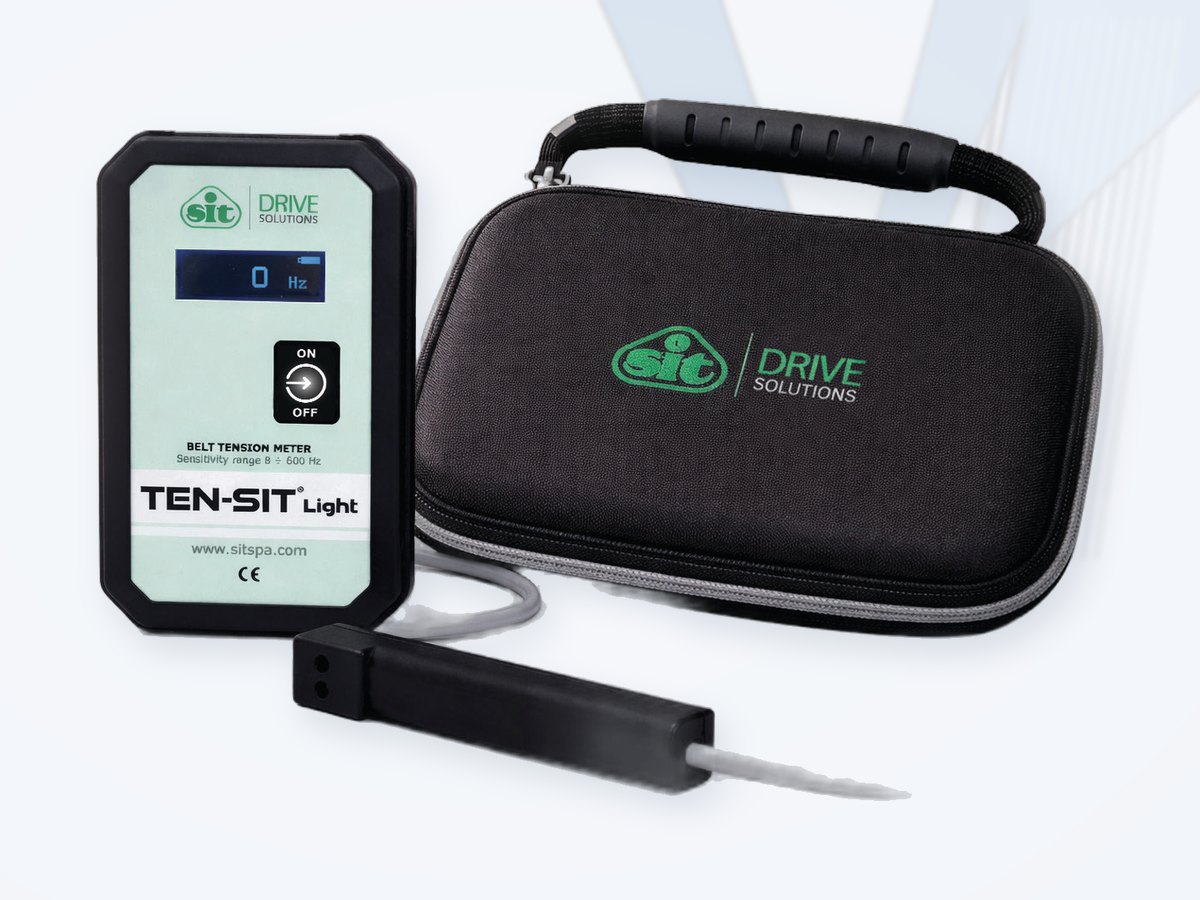
TEN-SIT Light Belt Tension Meter
Electronic gauge with optical sensor; measures belt span frequency 8-600 Hz; 90 cm cable for hard-to-reach drives; suitable for any belt type.
Request a Quote →LINE-LASER Pulley Alignment Tool
Laser device for quick pulley alignment; corrects axial and angular misalignment; centre distance up to 2 m; max. error 1 mm per metre.
Request a Quote →Motor Bases
Adjustable motor bases to set and maintain belt tension and centre distance.
Request a Quote →Belt Tensioners
Tensioners and idlers to keep correct belt tension in service.
Request a Quote →What are drive regulation products and instruments?
Most belt-drive problems come from incorrect tension or poor pulley alignment. Drive regulation products - such as adjustable motor bases and belt tensioners - make it possible to set and keep the correct belt tension and centre distance. Measuring instruments - such as belt tension meters and laser pulley-alignment tools - verify the installation.
Correct tension and alignment extend belt and bearing life, reduce noise, vibration and energy loss, and shorten maintenance time.
Tension values and alignment tolerances are taken from the belt manufacturer's data for the selected belt and drive.
Most belt failures start with wrong tension or poor alignment - measure, do not guess.
Measuring Belt Tension by Frequency
A belt span vibrates at a natural frequency that depends on its tension, its mass per metre and the span length. Measuring this frequency gives the static belt tension without touching the belt load path:
T = 4 x M x Lf² x f² and f = (1 / 2Lf) x √(T / M)
T = static belt tension (N), M = belt linear mass (kg/m), Lf = free span length (m), f = span vibration frequency (Hz). If the measured frequency is lower than the calculated value the belt needs more tension; if higher, it should be loosened.
TEN-SIT Light - Key Features
- Optical sensor - no contact with the belt.
- Frequency range 8 to 600 Hz.
- Suitable for any belt type: V-belts, timing, Poly-V, banded and PU belts.
- 90 cm cable for hard-to-reach measuring points.
- Light, compact and easy to use.
How to Measure - Procedure
Stop the drive
Measurements are taken with the drive stationary.
Calculate the target frequency
From the required static tension, belt linear mass (manufacturer's table) and free span length.
Position the sensor
Close to the belt back without touching it, centred on the free span and perpendicular to the belt.
Excite the belt
Tap the span with a rigid object away from the light beam and read the frequency after the beep.
Repeat and average
Take several readings and use the average; adjust tension and measure again.
Re-check after running
Run the drive for one to two minutes, then re-check and correct the tension.
Calculation Example (SIT)
| Item | Value |
|---|---|
| Belt | 3150 Hi-PERFORMANCE Pd Plus 14M, 55 mm wide |
| Linear mass M | (0.412 / 40) x 55 = 0.566 kg/m |
| Required tension T | 2150 N |
| Free span Lf | 0.65 m |
| Target frequency f | about 47.4 Hz |
Pulley Alignment
Pulleys can be misaligned in two ways: offset, when the pulleys are not in the same plane on parallel shafts, and angular, when the shafts are not parallel (horizontally and/or vertically). Any misalignment reduces belt life, causes edge wear, uneven load sharing, vibration and higher energy loss.
Synchronous belts are especially sensitive. According to SIT, misalignment on timing belt drives should be limited to 1/4 degree, or 4.3 mm per metre of centre distance. Belt contact with opposite flanges of two pulleys indicates misalignment and should be avoided.
LINE-LASER - Key Data
- Corrects axial and angular misalignment.
- Suitable for any pulley type; three control references.
- Max. recommended centre distance 2 m.
- Max. error 1 mm per metre.
- Check the tool periodically on a reference surface, especially after a drop.
Information Required for Selection / RFQ
| Data group | Information to provide |
|---|---|
| Instrument | Tension meter, alignment tool or both; quantity. |
| Drives | Belt types and sizes in use, typical span lengths. |
| Motor bases / tensioners | Motor frame size or power, belt type, required adjustment range. |
Leading Manufacturers Worldwide
Well-known European, American and Asian (Japanese and Korean) manufacturers of drive regulation & instruments.
| Manufacturer | Country | Product focus |
|---|---|---|
| SIT S.p.A. | Italy | Flexible, disc, gear and zero-backlash couplings; pulleys, belts, SIT-LOCK, taper bushes |
| Optibelt | Germany | V-belts, timing belts, pulleys |
| PRUFTECHNIK | Germany | Laser alignment systems |
| SKF | Sweden | Bearings, seals, alignment and belt tools |
| Fenner Drives | United Kingdom | Taper-Lock bushes, pulleys, couplings, keyless bushings |
| Gates | USA | V-belts, synchronous belts, pulleys, tension meters |
Listed for market information only. Brand names belong to their owners; their mention does not imply that MECHATRIC represents, distributes for or is authorized by these manufacturers. Product availability and equivalents are confirmed per enquiry.
Need belt tension or alignment tools?
MECHATRIC supplies drive regulation products and instruments and supports correct belt-drive installation.
Engineering reference: SIT S.p.A. TEN-SIT Light leaflet (07/26), LINE-LASER data sheet and SIT belt catalogues. Required tension values come from the belt manufacturer's data for the selected belt. Brand names are used for technical identification and do not by themselves imply representation, authorization or commercial partnership.
Frequently Asked Questions
How does a frequency belt tension meter work?
It measures the natural vibration frequency of a free belt span; with the belt mass and span length this gives the static belt tension.
Which belts can TEN-SIT Light measure?
Any belt type, including V-belts, timing belts, Poly-V, banded and polyurethane belts, within 8 to 600 Hz.
Where do I find the belt linear mass?
In the belt manufacturer's table; for other widths scale by width, for banded or Poly-V multiply by the number of ribs.
When should tension be re-checked?
After one to two minutes of running and again after the running-in period.
How much misalignment is acceptable on a timing belt drive?
SIT recommends limiting misalignment to 1/4 degree, or 4.3 mm per metre of centre distance. Check with a laser alignment tool.