
Industrial Gearboxes
Engineering selection, replacement, retrofit & application-specific drive solutions.
Industrial Gearboxes
Engineering selection, replacement, retrofit and application-specific drive solutions - from helical and bevel-helical units to planetary gearboxes and complete conveyor and bucket-elevator drive trains.
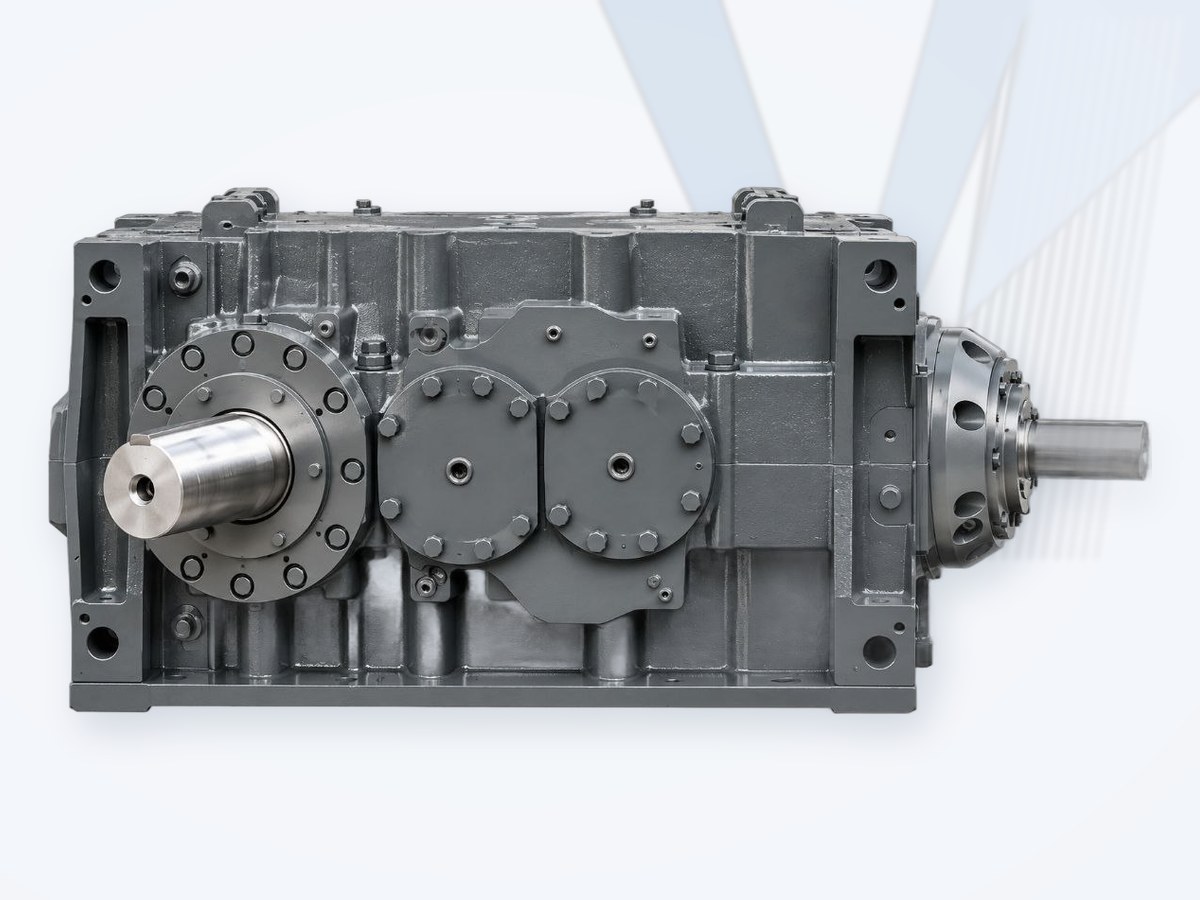
Industrial Gearboxes
Bevel-Helical Industrial Gearboxes
Heavy-duty bevel-helical gearbox family for industrial drive systems.
Planetary Industrial Gearboxes
Planetary gearbox family for high-torque industrial applications.
What is an industrial gearbox?
An industrial gearbox is a mechanical power-transmission unit that changes rotational speed and torque between a driver - typically an electric motor, turbine or engine - and the driven machine. Depending on the gear arrangement, it can reduce speed, increase available output torque subject to efficiency, change shaft direction and provide a robust mechanical interface to process equipment.
Correct selection is not based on motor power alone. Output torque, ratio, service factor, peak and starting loads, duty cycle, thermal capacity, external shaft loads, mounting position, lubrication, ambient conditions, backstop/brake requirements and the characteristics of the driven machine must all be evaluated.
MECHATRIC approach: understand the application → define the duty → select the gearbox architecture → verify mechanical and thermal limits → review the complete drive train → evaluate replacement/retrofit interfaces → prepare a technically controlled RFQ.
How Does a Gearbox Work?
A gearbox transmits power through meshing gears. Multi-stage arrangements combine gear meshes to obtain the required speed ratio within a practical package. A useful first relationship is gear ratio i = n1 / n2, where n1 = input speed and n2 = output speed.
Main Industrial Gearbox Families
| Gearbox / drive type | Key characteristics | Typical applications |
|---|---|---|
| Helical gear unit | Parallel-axis gearing; high efficiency; smooth continuous operation; flexible ratios. | Conveyors, fans, pumps, mixers, process machinery. |
| Bevel-helical gear unit | Right-angle power transmission using bevel and helical stages. | Conveyors, material handling, process lines, restricted layouts. |
| Planetary gear unit | High torque density, compact architecture and planetary load sharing. | Mills, mining, steel and large heavy-duty drives. |
| Application-specific gear unit | Configured around machine duty, environment, interfaces and accessories. | Kilns, cranes, extruders, paper machines and special drives. |
| Conveyor drive system | Integrated motor/gearbox/coupling/backstop or brake package rather than gearbox-only selection. | Mining, cement, steel, ports and bulk handling. |
| Bucket elevator drive | Vertical material-handling drive engineered for demanding starts and prevention of reverse movement. | Cement, minerals and bulk material handling. |
Helical, Bevel-Helical & Planetary Gear Units
Helical gear units are widely used for efficient continuous-duty applications. Bevel-helical gear units are valuable where the plant layout requires a right-angle drive. Planetary gear units are particularly attractive when high torque must be transmitted within a compact envelope.
The final choice depends on much more than ratio: torque, service duty, shaft arrangement, external loads, thermal conditions, mounting, maintenance philosophy, required accessories and the manufacturer's rating method all influence selection.
Application-Specific Gear Units
Some machines require more than a standard catalog gearbox. Application-specific solutions may incorporate dedicated shaft arrangements, auxiliary drives, lubrication and cooling systems, backstops, special housings, sensors, condition-monitoring interfaces or custom mechanical connections.
Conveyor Drive Systems - Complete Drive-Train Engineering
For belt conveyors, MECHATRIC evaluates the complete drive train rather than treating the gearbox as an isolated component. A conveyor drive may include the electric motor, flexible or fluid coupling, gearbox, backstop, brake, base or swing-base, cooling/lubrication equipment, sensors and driven pulley interface.
System matching becomes especially important for long conveyors, high starting torque, variable loading, continuous-duty bulk handling, confined installation spaces and severe mining or cement environments.
Engineering objective: maximize availability, reduce unplanned downtime and ensure that the motor, coupling, gearbox, backstop/brake and driven machine operate as one compatible system.
| Drive concept | Engineering focus |
|---|---|
| Modular conveyor gear unit | Broad project flexibility for power, torque, ratio, shaft arrangement and installation requirements. |
| Severe-environment conveyor gearbox | Reliability and maintainability under dust, heat, remote operation and harsh mining/bulk-handling conditions. |
| Ready-assembled conveyor drive system | Reduced site assembly and interface risk where compact installation and pre-engineered integration are priorities. |
| Complete drive-train review | Motor starting behavior, coupling, gearbox, backstop/brake, base, pulley interface, cooling, lubrication and monitoring considered together. |
Bucket Elevator Drive Engineering
Bucket elevator drives operate in vertical material-handling systems where reliable starting and safe prevention of reverse movement can be critical. Depending on the duty, the system may require a bevel-helical gearbox, fluid coupling for soft starting, backstop, brake, auxiliary or maintenance drive, and suitable lubrication/cooling provisions.
How to Select an Industrial Gearbox
| Step | Engineering check |
|---|---|
| 1 | Define the driven machine and actual operating duty. |
| 2 | Confirm motor/driver power, actual input speed and required output speed. |
| 3 | Calculate the required ratio and verify the resulting machine speed. |
| 4 | Determine continuous output torque; do not select from installed kW alone. |
| 5 | Evaluate operating hours, starts per hour, load classification, shock, reversals and duty cycle. |
| 6 | Check starting, peak, jam, emergency and transient torque. |
| 7 | Check radial and axial shaft loads from couplings, pulleys, sprockets and the driven machine. |
| 8 | Verify thermal capacity using ambient temperature, altitude, ventilation, cooling and heat dissipation. |
| 9 | Define mounting position, shaft orientation, solid/hollow shaft, keyed/shrink-disc connection and rotation. |
| 10 | Define lubrication, backstop, brake, auxiliary drive, heaters, filters, sensors and condition monitoring. |
| 11 | Verify noise, vibration, sealing, corrosion protection and hazardous-area/project requirements where relevant. |
| 12 | Check the final size against the current manufacturer's rating method and technical limits. |
Important: a simple kW-to-kW comparison is not sufficient for critical industrial drives. Final selection must be verified against the current technical documentation of the proposed manufacturer.
Gearbox + Coupling Compatibility
For critical equipment and replacement projects, the gearbox and coupling should be reviewed as part of the complete drive train. A gearbox change can alter shaft diameter, shaft position, coupling distance, starting behavior, torsional response and alignment requirements.
| Coupling / interface parameter | Why it matters to gearbox selection or retrofit |
|---|---|
| Rated and peak torque | Must be compatible with normal, starting, transient and upset loads. |
| Shaft and bore dimensions | Controls hub/interface compatibility and may drive shaft or coupling modifications. |
| Misalignment capability | Affects allowable installation/alignment error and loads transmitted to gearbox bearings. |
| Torsional behavior | Flexible, fluid, grid, gear, elastomeric or disc couplings can change dynamic response and starting behavior. |
| Spacer / DBSE requirement | Can change overall shaft-line geometry, maintenance access and base arrangement. |
| Balance and speed | Critical for high-speed or sensitive rotating machinery. |
| External radial/axial loads | Pulley/sprocket or shaft-mounted arrangements must remain within gearbox bearing/shaft limits. |
Equivalent Gearbox, Replacement & Retrofit
An equivalent gearbox is not simply a unit with the same nominal power and ratio. A technically valid replacement must reproduce the required mechanical function while satisfying operating loads, installation constraints and drive-train interfaces.
- Nominal, continuous, starting and peak output torque.
- Exact or acceptable ratio and resulting machine speed.
- Input/output shaft arrangement, dimensions and direction of rotation.
- Center height, mounting feet, flange positions and installation envelope.
- Radial and axial load capacity.
- Thermal rating, cooling and lubrication arrangement.
- Backstop, brake, auxiliary drive and accessories.
- Coupling interface, motor connection and base/foundation arrangement.
- Duty cycle, service factor and application-specific requirements.
Replacement does not always mean a drop-in replacement. For obsolete gearboxes, a controlled retrofit involving the base frame, coupling, shaft connection, guards or accessories can be more practical than searching indefinitely for an identical legacy model.
MECHATRIC Interchange Classification
- Direct Interchange: verified replacement for the specified application and interfaces.
- Dimensionally Compatible: principal installation dimensions match, but duty and technical limits still require verification.
- Functionally Equivalent: satisfies the required function but may require dimensional/interface modifications.
- Engineering Review Required: candidate identified, but final technical approval is pending.
Industrial Applications
| Industry | Typical gearbox applications |
|---|---|
| Cement | Belt conveyors, bucket elevators, crushers, mills, rotary kilns and fans. |
| Mining & Minerals | Long conveyors, crushers, apron conveyors, preparation and bulk-handling equipment. |
| Steel & Metals | Conveyors, rolling/process equipment and heavy material handling. |
| Oil, Gas & Petrochemical | Pumps, compressors, fans, cooling and process equipment. |
| Power Generation | Fans, cooling systems, auxiliary drives and process equipment. |
| Water & Wastewater | Water screws, aerators, pumps and process drives. |
| Pulp & Paper | Process lines, pulpers, rolls, winders and machine drives. |
| Ports & Bulk Handling | Conveyors, hoists, cranes and material-handling systems. |
Information Required for a Gearbox RFQ
| Data group | Information to provide |
|---|---|
| Existing gearbox | Manufacturer, type/model, serial number, nameplate photo, drawings and service history. |
| Driver | Motor power, speed, frequency, starting method, motor frame and VFD data where applicable. |
| Driven machine | Machine type, required output speed, normal load, starting/peak load and process duty. |
| Duty | Operating hours, starts per hour, continuous/intermittent operation, reversals and load variation. |
| Installation | Mounting position, shaft orientation, direction of rotation, center height and dimensional restrictions. |
| Environment | Ambient temperature, altitude, dust, humidity, indoor/outdoor and hazardous-area requirements. |
| Connections | Shaft dimensions, coupling type, pulley/sprocket data and external radial/axial loads. |
| Accessories | Backstop, brake, auxiliary drive, cooling, forced lubrication, heaters, filters and monitoring. |
| Retrofit evidence | Photos of gearbox, base/foundation, motor/coupling interfaces, guards and dimensional drawings. |
Why MECHATRIC?
MECHATRIC works as an engineering-driven power transmission and motion solutions partner. The objective is not simply to match a model number, but to understand the application and identify a technically suitable and commercially practical drive solution.
- Engineering-oriented gearbox selection and technical review.
- Support for new projects, replacement and controlled retrofit.
- Evaluation of gearbox, coupling and complete drive-train compatibility.
- Strong focus on conveyor, bucket-elevator and material-handling applications.
- Support for RFQs, datasheet review, technical equivalency and replacement evaluation.
Leading Manufacturers Worldwide
Well-known European, American and Asian (Japanese and Korean) manufacturers of industrial gearboxes.
| Manufacturer | Country | Product focus |
|---|---|---|
| FLENDER | Germany | N-EUPEX, RUPEX, ELPEX, ARPEX, ZAPEX, FLUDEX couplings; industrial gear units |
| SEW-EURODRIVE | Germany | Gearmotors, industrial gear units, motors |
| NORD Drivesystems | Germany | Gearmotors and industrial gear units |
| Bonfiglioli | Italy | Gearmotors, planetary and industrial gearboxes |
| Brevini (Dana) | Italy | Planetary gearboxes |
| Hansen Industrial Transmissions | Belgium | Industrial gear units |
| David Brown Santasalo | United Kingdom / Finland | Heavy-duty industrial gearboxes |
| Regal Rexnord (Falk, Kop-Flex, Thomas, Rexnord) | USA | Grid, gear and disc couplings; gear drives; backstops; roller chain |
| Dodge (RBC) | USA | Gear reducers, bushings, couplings |
| Sumitomo Drive Technologies | Japan | Cyclo, gearmotors, industrial gearboxes |
Listed for market information only. Brand names belong to their owners; their mention does not imply that MECHATRIC represents, distributes for or is authorized by these manufacturers. Product availability and equivalents are confirmed per enquiry.
Need to Select, Replace or Retrofit an Industrial Gearbox?
Send MECHATRIC the gearbox nameplate, application data, operating conditions, drawings and installation photographs. The duty can then be reviewed and the required gearbox configuration and replacement/retrofit path can be evaluated.
Technical note: Final selection must always be checked against current technical documentation for the proposed manufacturer, series, size and configuration. Ratings, allowable loads, thermal limits, lubrication and accessory requirements vary by manufacturer and application. Brand or series references are engineering reference families unless representation or authorization is independently documented; equivalent/interchange claims require technical evidence.
Frequently Asked Questions
How do I select an industrial gearbox?
Start with the driven-machine duty, input/output speeds, continuous and peak torque, operating cycle, external loads, thermal conditions, mounting and required accessories; then apply the current manufacturer's rating method.
Can a gearbox be replaced only by matching kW and ratio?
No. Torque, thermal capacity, shaft loads, mounting, shaft interfaces, center height, accessories, lubrication and the complete drive-train arrangement must also be checked.
What is a gearbox retrofit?
A controlled retrofit uses a technically suitable alternative gearbox while engineering any required changes to base, coupling, shaft connection, guards or accessories.
Should the coupling be reviewed when replacing a gearbox?
Yes, especially when shaft size, shaft position, DBSE, starting behavior or dynamic response changes.