
Low-Voltage Electric Motors
Engineering definition, selection, efficiency, VFD, hazardous area, replacement & RFQ guide.
Industrial Electric Motors
Engineering definition, selection, efficiency, VFD duty, hazardous-area requirements, replacement and RFQ support for IEC industrial electric motors.
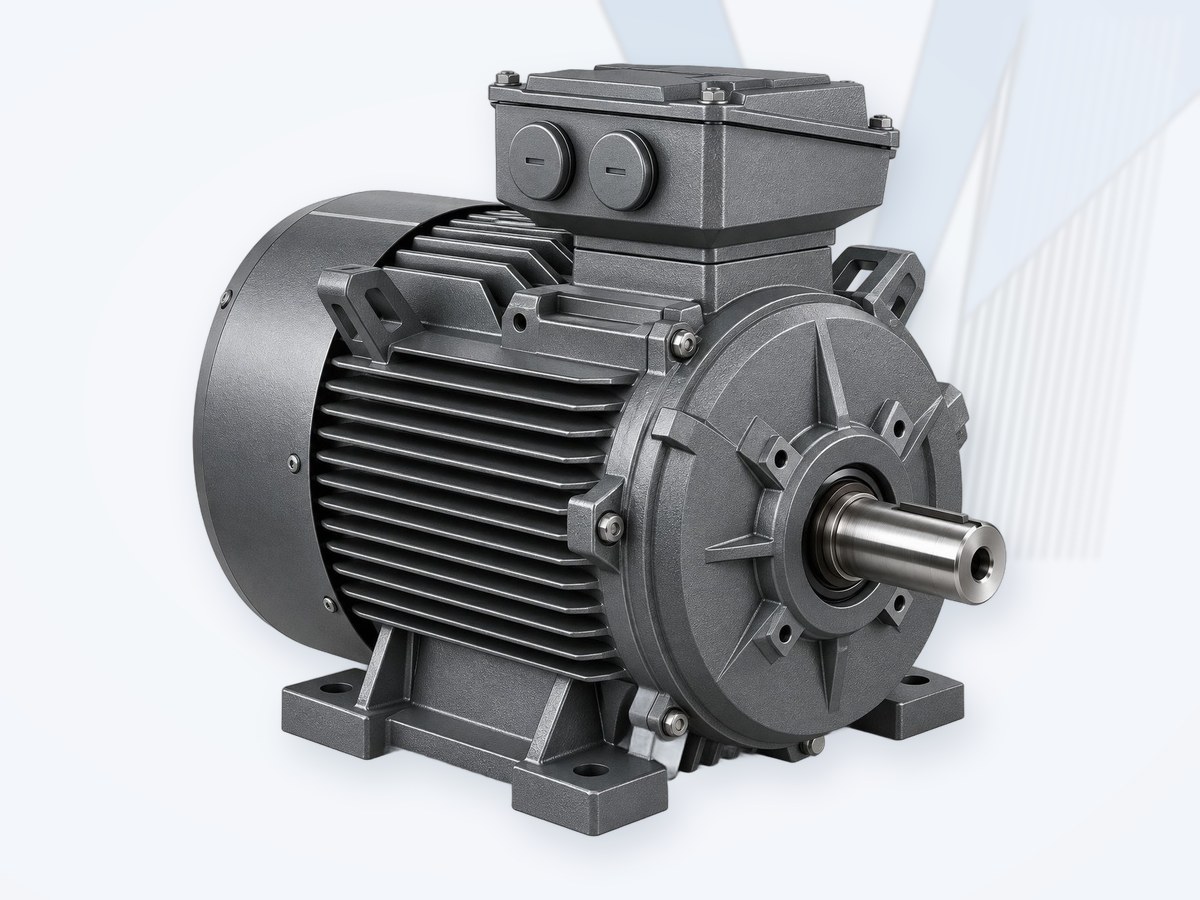
Reference Motor Families
Innomotics GP / SD / XP
General Purpose, Severe Duty, Explosion Proof and converter-optimized synchronous motors (former Siemens SIMOTICS lines).
Request a Quote →SEW-EURODRIVE DR..
DRN/EDRN IE3, DRU IE4 and DR2C IE5 AC motors plus Ex, synchronous and geared-motor configurations.
Request a Quote →ABB IEC Low Voltage
General Performance, Process Performance, hazardous-area and SynRM IE5/IE6 motor portfolios.
Request a Quote →Siemens SIMOTICS (legacy)
GP, SD, XP documentation for installed-base identification and replacement engineering.
Request a Quote →What is an industrial electric motor?
An industrial electric motor converts electrical energy into controlled mechanical torque and rotational speed for pumps, fans, compressors, conveyors, crushers, mixers, gearboxes, mills, process equipment and OEM machinery. For most industrial power-transmission applications, the motor must be selected as part of the complete drive system rather than as an isolated component.
The most common IEC industrial motors are three-phase AC induction motors. Modern portfolios also include synchronous reluctance (SynRM), permanent-magnet and application-specific technologies for higher system efficiency, compactness, dynamic performance or variable-speed operation.
MECHATRIC selection principle: match the motor to the load, supply, starting method, speed-control strategy, environment, mounting/interface and lifecycle requirements - not only to kW and rpm.
Main Industrial Motor Technologies
| Technology | Typical strength | Selection note |
|---|---|---|
| Three-phase induction / squirrel-cage | Robust, widely standardized, DOL or VFD-capable depending on design, broad industrial availability. | Check starting torque/current, efficiency class, VFD suitability, insulation and bearing requirements. |
| Synchronous reluctance (SynRM) | High efficiency, strong partial-load performance, magnet-free rotor, attractive motor-drive system efficiency. | Normally paired with a suitable VFD; verify motor-drive compatibility and IEC efficiency basis. |
| Permanent magnet synchronous | High efficiency and power density; useful where compactness and controlled-speed performance matter. | Requires compatible converter/control strategy; rotor magnet technology affects service approach. |
| Explosion-protected motor | Certified construction for gas or dust hazardous areas. | Zone, gas/dust group, temperature class, protection concept and certificate must match the installation. |
| Severe-duty / process motor | Rugged construction for harsh, critical or continuously loaded industrial service. | Review enclosure, bearings, sealing, corrosion system, ambient and process-specific options. |
How to Select an Industrial Electric Motor
| Step | Engineering check | Required information |
|---|---|---|
| 1 | Define driven equipment | Pump, fan, compressor, conveyor, crusher, mill, mixer, gearbox, elevator, machine or other load. |
| 2 | Determine power and torque | Required shaft kW, continuous torque, breakaway torque, overload/peak torque and service margin. |
| 3 | Define speed | Required rpm, number of poles, fixed or variable speed, minimum/maximum VFD speed. |
| 4 | Check electrical supply | Voltage, frequency, phases, network tolerances and available short-circuit/start capacity. |
| 5 | Choose starting/control method | DOL, star-delta, soft starter or VFD; consider acceleration time, current and load inertia. |
| 6 | Select efficiency class | IE3/IE4/IE5 or project/regulatory requirement; evaluate operating hours and lifecycle energy cost. |
| 7 | Define duty and thermal conditions | IEC duty type, starts per hour, load cycle, ambient temperature, altitude and cooling. |
| 8 | Define mechanical interface | IEC frame, shaft diameter/extension, key, flange/foot arrangement, mounting position and driven coupling. |
| 9 | Define enclosure/environment | IP degree, humidity, dust, washdown, corrosion, outdoor duty and special coatings. |
| 10 | Check hazardous-area requirements | Safe area or Ex zone; protection concept, gas/dust group, temperature class, ATEX/IECEx or project certificate. |
| 11 | Check VFD-specific requirements | Insulation system, dv/dt, bearing currents, insulated bearing, encoder, forced ventilation, minimum speed and cable length. |
| 12 | Validate complete system | Motor + starter/VFD + gearbox/coupling + driven machine + process duty + protection + instrumentation. |
Core Motor Relationships
Torque: T (Nm) = 9550 x P (kW) / n (rpm)
Synchronous speed: ns (rpm) = 120 x f (Hz) / number of poles
An induction motor runs below synchronous speed because of slip. Therefore, replacement must compare the actual rated speed and torque - not only the nominal pole count.
Efficiency Classes & Lifecycle Cost
IEC efficiency classes provide a structured way to compare motor losses, but the applicable standard, supply method and regulatory scope must be verified for the exact motor. ABB currently offers IEC low-voltage portfolios extending through IE5 and IE6 SynRM technologies, while Innomotics and SEW-EURODRIVE offer industrial portfolios spanning multiple IE classes and motor technologies.
ABB states that its IE5 SynRM technology can reduce motor losses by up to 40% versus comparable IE3 motors in specified applications. Innomotics highlights IE4 induction and IE4/IE5 converter-optimized synchronous technologies, while SEW-EURODRIVE identifies DRN/EDRN as IE3, DRU as IE4 and DR2C variants as IE5 in its current technical information.
Engineering rule: do not select a motor solely because it has the highest IE class. Evaluate annual operating hours, load profile, VFD losses, process control, power factor, purchase cost, maintainability and payback.
Direct-on-Line, Soft Starter or Variable-Speed Drive?
| Method | Best fit | Key checks |
|---|---|---|
| DOL | Simple fixed-speed loads where the network and machine can tolerate starting current/torque. | Starting current, starting torque, voltage dip, acceleration time and mechanical shock. |
| Star-delta | Reduced-current start for suitable motors/loads with compatible winding connection. | Available torque during star connection and transition behavior. |
| Soft starter | Fixed-speed duty requiring controlled acceleration/deceleration and reduced mechanical/electrical stress. | Starting torque, current limit, bypass strategy, starts/hour and thermal duty. |
| VFD | Variable-flow/variable-speed process control, energy optimization, controlled starting and wide operating range. | Motor insulation, cooling at low speed, bearing currents, harmonics, cable length, torque envelope and drive sizing. |
VFD-Optimized Motor Systems
Current manufacturer portfolios increasingly treat the motor and converter as a coordinated system. Innomotics distinguishes grid-optimized induction motors from converter-optimized synchronous reluctance and permanent-magnet motors. ABB similarly positions SynRM motors as motor-drive packages for high efficiency and controllability. SEW-EURODRIVE provides both stand-alone motors and motors integrated with geared-drive systems.
For VFD duty, confirm the complete operating envelope: base speed, constant-torque region, field-weakening region, minimum continuous speed, overload, motor cooling, switching frequency, encoder requirement, insulation stress and bearing-current mitigation.
General Purpose vs Severe Duty vs Process Performance
- General Purpose: optimized for broad standard industrial duties such as pumps, fans, compressors, HVAC and water/wastewater; Innomotics GP uses lightweight aluminum construction in key ranges.
- Severe Duty: robust cast-iron platforms for harsher industrial environments; Innomotics SD emphasizes rugged construction, broad IE4 coverage and line/converter variants.
- Process Performance: configurable motors for critical process industries; ABB describes its process-performance induction motors as flexible solutions for demanding reliability, availability and efficiency requirements.
Hazardous Area / Explosion-Protected Motors
Motor selection in hazardous locations starts with the classified area, not with motor power. Typical IEC protection concepts include flameproof Ex db, increased safety Ex eb / Ex ec and dust protection Ex tb / Ex tc, depending on the applicable zone and certification. Innomotics publishes explosion-protected low-voltage ranges for Zones 1, 2, 21 and 22 with multiple protection concepts, while ABB offers flameproof, increased-safety and dust-ignition-proof motor families with ATEX/IECEx options.
Never substitute an Ex motor based only on kW, rpm and frame size. The certificate, zone, EPL/category, gas or dust group, temperature class, ambient range, VFD conditions and installation requirements must be verified for the exact motor.
Mechanical Construction & IEC Data
| Parameter | Why it matters |
|---|---|
| Rated power / torque / speed | Defines the mechanical duty point and replacement capability. |
| Voltage / frequency / connection | Must match the electrical system and starting/control method. |
| Efficiency / power factor | Affects energy use, current, losses and lifecycle economics. |
| Poles / rated speed / slip | Determines operating speed and torque relationship. |
| IEC frame / shaft height | Primary mechanical interchange reference, but not sufficient alone. |
| Mounting - IM B3/B5/B35/B14 etc. | Determines foot/flange interface and installation orientation. |
| Protection degree - IP | Defines ingress protection; environmental suitability still needs full review. |
| Cooling - IC code | Critical to thermal performance, especially with VFD and low-speed duty. |
| Insulation / temperature class | Affects thermal margin and converter-duty assessment. |
| Bearing arrangement | Important for radial/axial loads, belt drives, VFD currents and maintenance. |
| Noise / vibration / balance | Relevant to process reliability and critical rotating equipment. |
| Terminal box / cable entry | Can determine physical interchangeability in constrained installations. |
Applications & Industries
Applications: pumps, fans, blowers, compressors, conveyors, bucket elevators, crushers, mills, mixers, agitators, cooling towers, extruders, machine tools, process skids and geared drives.
Industries: mining and mineral processing; steel and metals; cement; oil and gas; petrochemical and chemical; power generation; water and wastewater; food and beverage; pulp and paper; HVAC; material handling; industrial machinery and OEM.
Application-Specific Selection Notes
- Pumps and fans: starting method, process control, VFD energy-saving potential, shaft/coupling interface and hazardous-area requirements.
- Conveyors and crushers: breakaway torque, load inertia, acceleration time, starts/hour, overload and gearbox/coupling duty.
- Mills and high-inertia machines: thermal capacity and acceleration study can matter more than nominal running power.
- Belt-driven equipment: permissible radial shaft load, bearing arrangement, pulley diameter and belt tension.
- Vertical machines: mounting orientation, thrust/bearing requirements, lubrication and cooling.
Electric Motor Replacement & Equivalent Selection
A replacement motor is not established by matching kW, rpm and frame size alone. MECHATRIC evaluates electrical, mechanical, thermal, environmental and control-system compatibility.
| Replacement check | Verification |
|---|---|
| Performance | Rated kW, rated torque, rated speed, breakaway/starting torque, maximum/overload torque and duty. |
| Electrical | Voltage, frequency, connection, rated current, starting current, power factor, efficiency and supply tolerances. |
| Mechanical | IEC/NEMA frame, shaft height, shaft diameter/length, key, flange/foot dimensions, mounting and terminal-box position. |
| Thermal | Duty type, ambient, altitude, cooling method, insulation system, temperature rise and starts/hour. |
| VFD | Motor technology, converter compatibility, speed range, insulation, bearings, encoder, forced cooling and filters. |
| Environment | IP degree, corrosion protection, dust, moisture, washdown, outdoor service and special coatings. |
| Hazardous area | Exact Ex marking, zone, gas/dust group, temperature class, ambient range and certificates. |
| System behavior | Acceleration time, inertia, coupling/gearbox loads, driven-machine torque-speed curve and protection settings. |
| Documentation | Datasheet, nameplate, dimensional drawing, certificates, test reports and project specification. |
MECHATRIC Interchange Classification
- Direct Interchange: electrical, mechanical, performance and application requirements are verified for the specified installation.
- Dimensionally Compatible: principal mounting and shaft interfaces match, but electrical/performance/application review is still required.
- Functionally Equivalent: satisfies the required duty but may require changes to mounting, controls, VFD, protection or accessories.
- Engineering Review Required: a candidate exists, but compatibility has not yet been fully verified.
Information Required for Motor Selection / RFQ
| Data group | Information to provide |
|---|---|
| Application | Driven machine, industry, process description, criticality and operating profile. |
| Power & speed | Required kW, rated rpm, minimum/maximum speed, poles if known. |
| Torque & inertia | Running, starting/breakaway and peak torque; load inertia; acceleration requirement. |
| Electrical supply | Voltage, frequency, phases, network limits and available starting capacity. |
| Starting / control | DOL, star-delta, soft starter, VFD; drive make/model if existing. |
| Duty | S1/S2/S3 etc., starts/hour, reversing, load cycle and overload. |
| Mechanical | Frame, mounting, shaft dimensions, key, flange, terminal-box position and coupling/pulley details. |
| Environment | Ambient temperature, altitude, indoor/outdoor, dust, humidity, corrosion, washdown. |
| Protection | IP requirement, motor protection devices, space heater, PTC/PT100, bearing sensors. |
| Hazardous area | Zone, gas/dust group, temperature class, ATEX/IECEx/project requirements. |
| Efficiency | Required IE class, annual hours, energy-saving target and regulatory requirement. |
| Existing motor | Manufacturer, type/model, serial/order code, nameplate photo, datasheet and dimensional drawing. |
Leading Manufacturers Worldwide
Well-known European, American and Asian (Japanese and Korean) manufacturers of low-voltage electric motors.
| Manufacturer | Country | Product focus |
|---|---|---|
| ABB | Switzerland / Sweden | IEC low-voltage, Ex and SynRM motors |
| Innomotics (former Siemens motors) | Germany | SIMOTICS / SG motors and geared motors |
| SEW-EURODRIVE | Germany | Gearmotors, industrial gear units, motors |
| Leroy-Somer | France | Industrial and explosion-proof motors |
| Marathon (WEG) | USA | Industrial electric motors |
| Nidec | Japan | Industrial motors and drives |
| Toshiba | Japan | Industrial and explosion-proof motors |
| Hyundai Electric | Korea | Industrial and explosion-proof motors |
| Hyosung Heavy Industries | Korea | Industrial electric motors |
Listed for market information only. Brand names belong to their owners; their mention does not imply that MECHATRIC represents, distributes for or is authorized by these manufacturers. Product availability and equivalents are confirmed per enquiry.
MECHATRIC Engineering Support
MECHATRIC can support industrial motor selection, technical equivalency, installed-base replacement, VFD-duty review, hazardous-area requirement review, motor/gearbox/coupling interface checks, RFQ preparation and comparison of qualified alternatives.
Research basis: official ABB IEC low-voltage motor and SynRM information; SEW-EURODRIVE DR.. motor technical information; Innomotics low-voltage, GP, SD and XP motor information; Siemens/SIMOTICS legacy documentation for installed-base and technical-reference context (accessed October 2026). Published power ranges, IE classes, Ex markings, certificates, VFD suitability and dimensions are product- and revision-specific; verify the current manufacturer's datasheet and project specification before selection, quotation or claiming interchangeability. Brand names and families are engineering reference points only and do not imply representation, authorization or direct interchangeability.
Frequently Asked Questions
What is the difference between IE3, IE4 and IE5?
They are progressively higher efficiency classes under applicable IEC efficiency frameworks. The exact standard and whether it applies to DOL or VSD operation must be checked for the motor technology.
Can I replace an IE3 motor with IE4?
Often yes, but confirm rated speed, starting behavior, current, frame/shaft dimensions, power factor, VFD compatibility and the complete mechanical interface.
When should I use a synchronous reluctance motor?
It is attractive for variable-speed applications where high system efficiency and partial-load performance are important. It normally requires a compatible VFD.
Can any standard motor be used with a VFD?
No. Check the manufacturer's converter-duty limits, insulation system, cooling, bearing-current mitigation, speed range and cable/filter requirements.
How do I select an explosion-proof motor?
Start from the hazardous-area classification and required certification, then select power, speed and mechanical construction. Do not reverse that sequence.
What information is most useful for replacement?
A clear nameplate photo plus datasheet/drawing, shaft and mounting dimensions, application, starting/VFD method and hazardous-area information usually provides the best starting point.