
MECHATRIC Gearbox Academy
FLENDER Industrial Gearbox Selection
52-slide engineering course: helical, bevel-helical and PLANUREX planetary units, sizing calculations, thermal rating, shaft loads, conveyor and bucket elevator drives, replacement and RFQ data.
Swipe or use the arrows
Presentation Outline
Key points of each slide – a quick engineering reference.
02 – FLENDER GEARBOX SELECTION
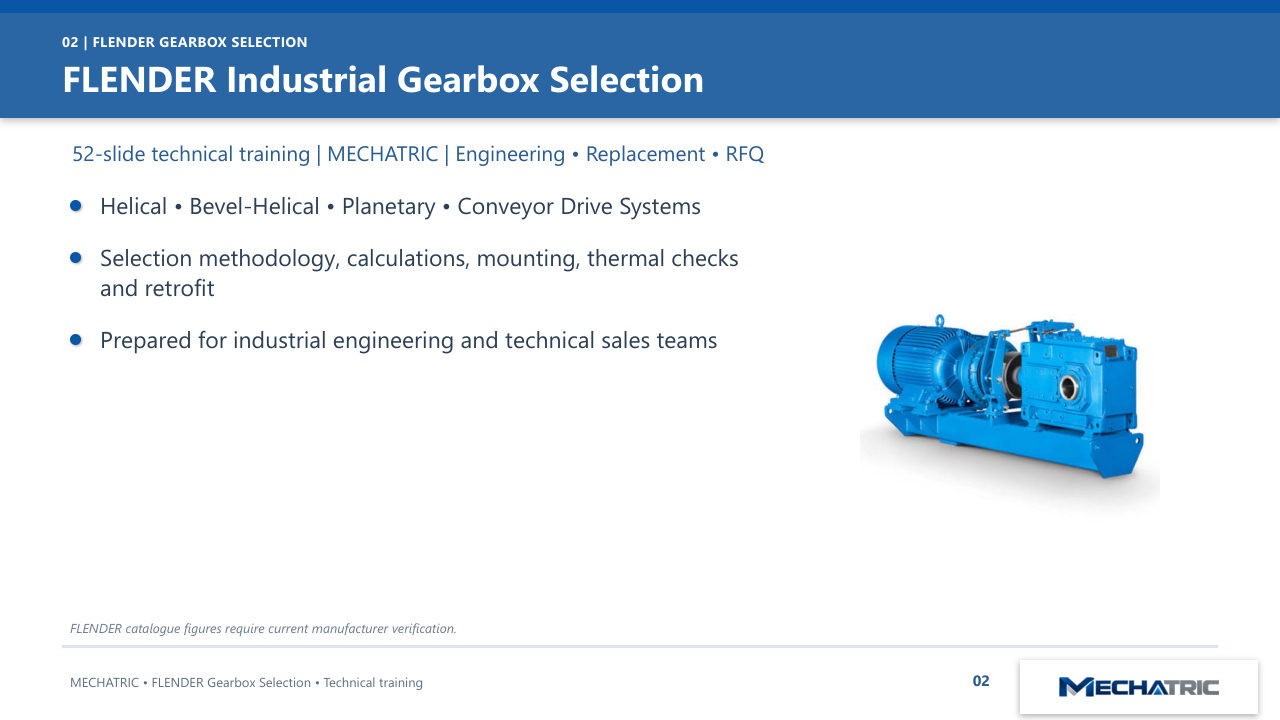
FLENDER Industrial Gearbox Selection
- 52-slide technical training | MECHATRIC | Engineering
- Replacement
- RFQ Helical
- Bevel-Helical
- Planetary
- Conveyor Drive Systems Selection methodology, calculations, mounting, thermal checks and retrofit Prepared for industrial engineering and technical sales teams FLENDER catalogue figures require current manufacturer verification.
03 – FLENDER GEARBOX SELECTION
Training Objectives
- A systematic approach to industrial gearbox specification
- Understand gearbox architectures and application fit
- Calculate speed ratio, output torque and selection margins
- Check thermal, mechanical, shaft and interface constraints
- Prepare complete RFQs and assess equivalent gearboxes
04 – FLENDER GEARBOX SELECTION
Selection Workflow
- From duty definition to verified configuration
- Define machine and process requirements
- Determine power, input/output speeds and torque
- Apply duty factors and transient load assessment
- Check thermal capacity, shaft loads and mounting
- Validate against current FLENDER catalog/configurator
05 – FLENDER GEARBOX SELECTION
Industrial Gearbox: Core Function
- Speed, torque and shaft arrangement
- Gear trains transform speed and torque
- Efficiency losses mean output power is below input power
- Gearbox may also change shaft orientation
- System-level selection includes motor, coupling and machine
06 – FLENDER GEARBOX SELECTION
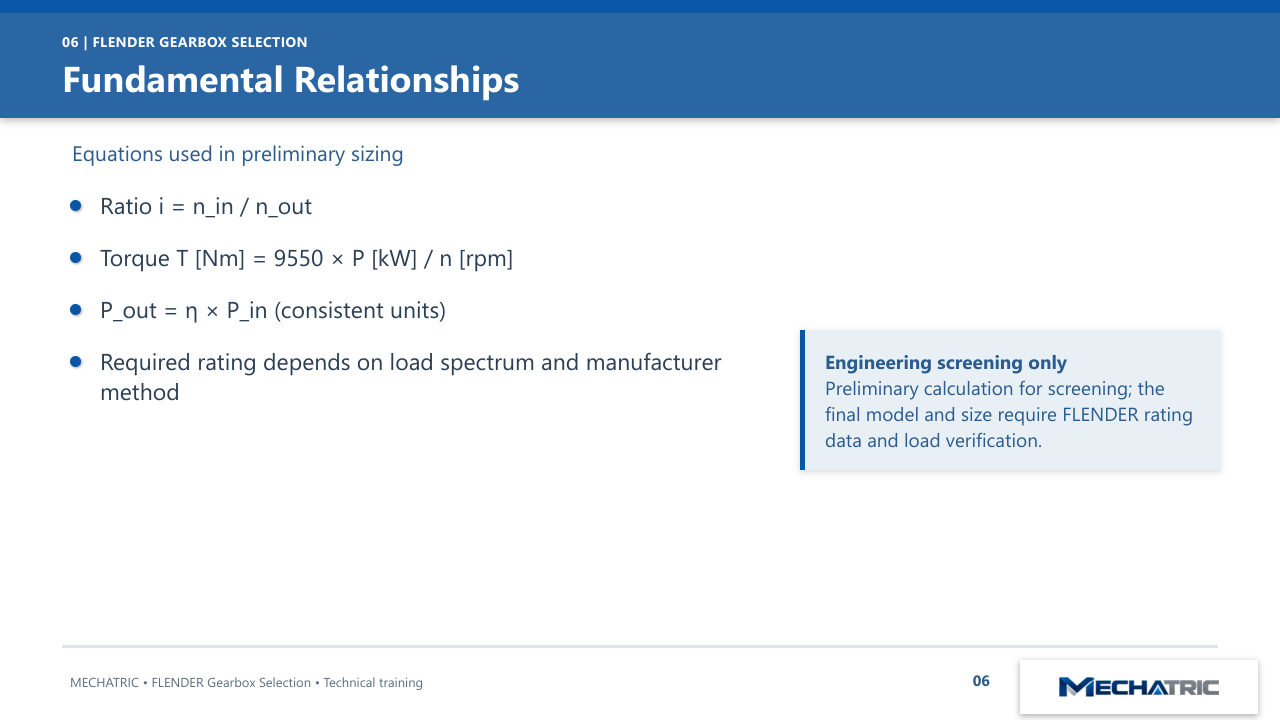
Fundamental Relationships
- Equations used in preliminary sizing
- Ratio i = n_in / n_out
- Torque T [Nm] = 9550 × P [kW] / n [rpm]
- P_out = η × P_in (consistent units)
- Required rating depends on load spectrum and manufacturer
- method
07 – FLENDER GEARBOX SELECTION
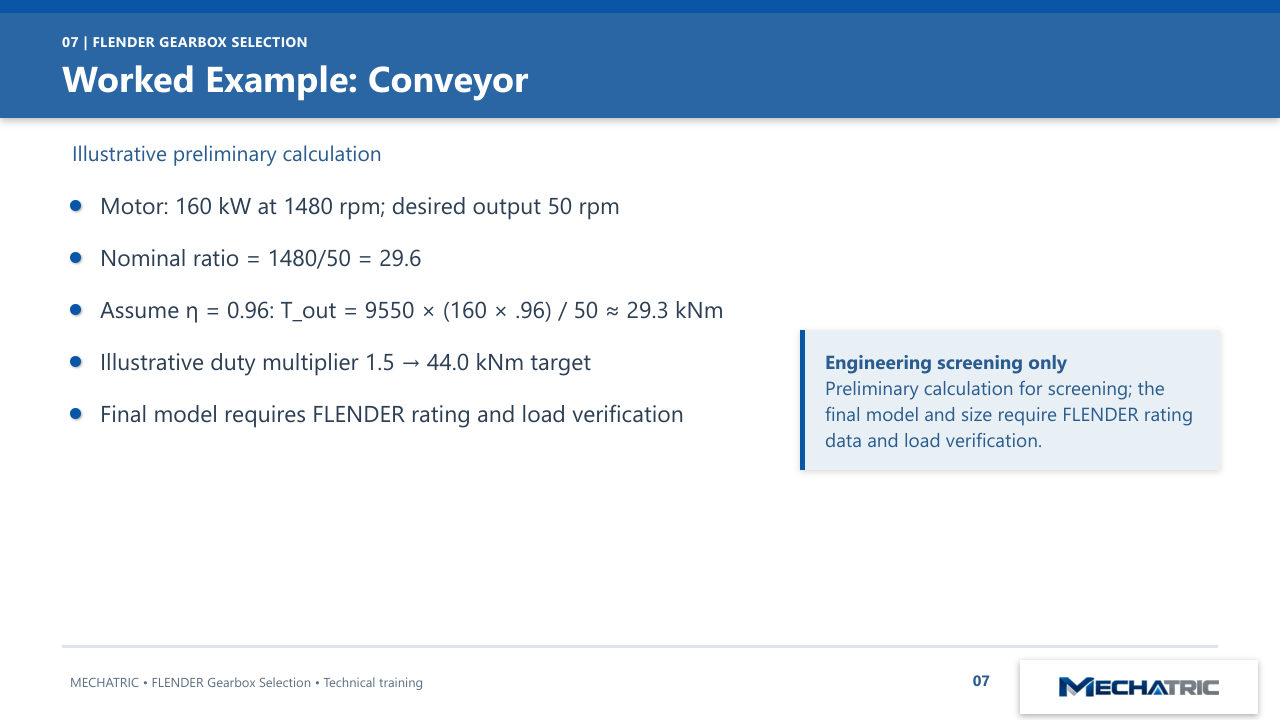
Worked Example: Conveyor
- Illustrative preliminary calculation
- Motor: 160 kW at 1480 rpm; desired output 50 rpm
- Nominal ratio = 1480/50 = 29.6
- Assume η = 0.96: T_out = 9550 × (160 × .96) / 50 ≈ 29.3 kNm
- Illustrative duty multiplier 1.5 → 44.0 kNm target
- Final model requires FLENDER rating and load verification
08 – FLENDER GEARBOX SELECTION
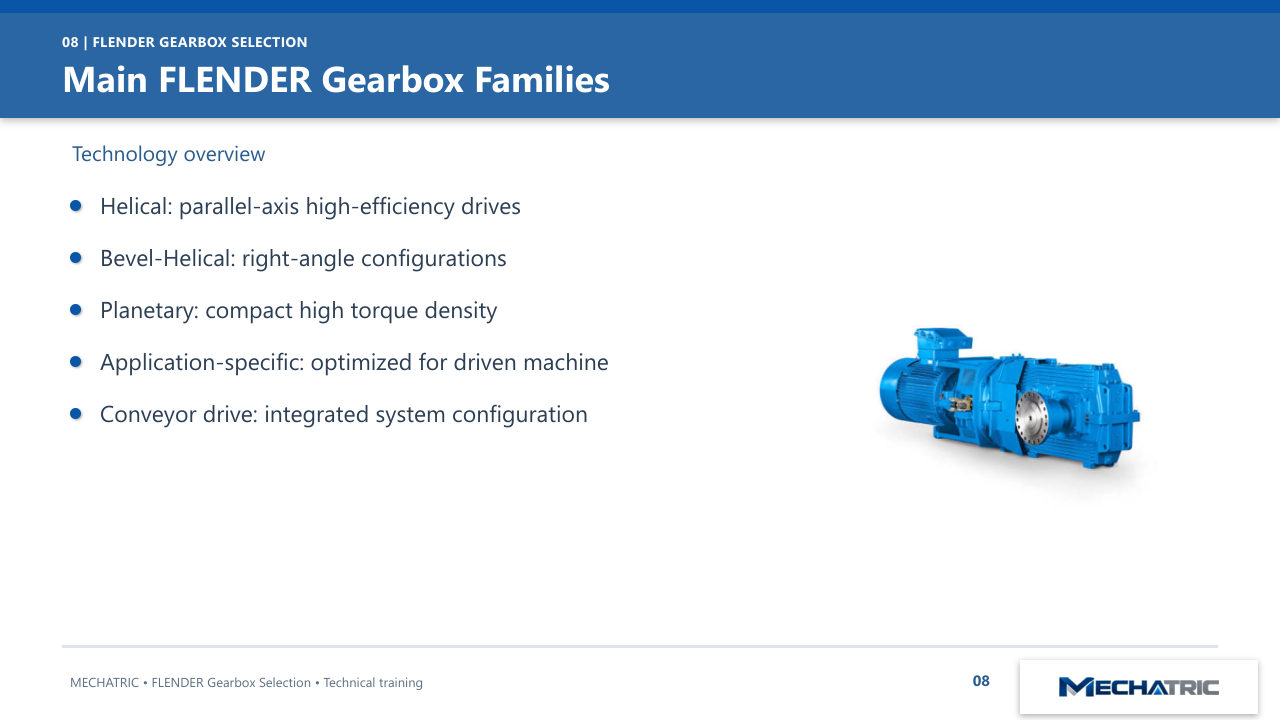
Main FLENDER Gearbox Families
- Technology overview
- Helical: parallel-axis high-efficiency drives
- Bevel-Helical: right-angle configurations
- Planetary: compact high torque density
- Application-specific: optimized for driven machine
- Conveyor drive: integrated system configuration
09 – FLENDER GEARBOX SELECTION
Architecture Selection Matrix
- Choose by load, arrangement and envelope
- Helical | parallel axes | broad process applications
- Bevel-Helical | typically 90° | conveyor and material handling
- Planetary | coaxial/other configured arrangements | high torque
- Integrated drive | multiple components | interface-managed packages
10 – FLENDER GEARBOX SELECTION
FLENDER H / B Gear Unit Portfolio
- MD 20.1 (2018) — catalog scope
- Nominal output torque: 3,100–1,400,000 Nm (portfolio)
- 28 sizes; overall nominal ratio range 1.25–450
- H1–H4: parallel-shaft; B2–B4: right-angle
- Check exact series/size tables before model approval
- MD 20.1 historical portfolio. FLENDER official product page also states 3,100 Nm minimum.
11 – FLENDER GEARBOX SELECTION
Helical H1 / H2 / H3 / H4
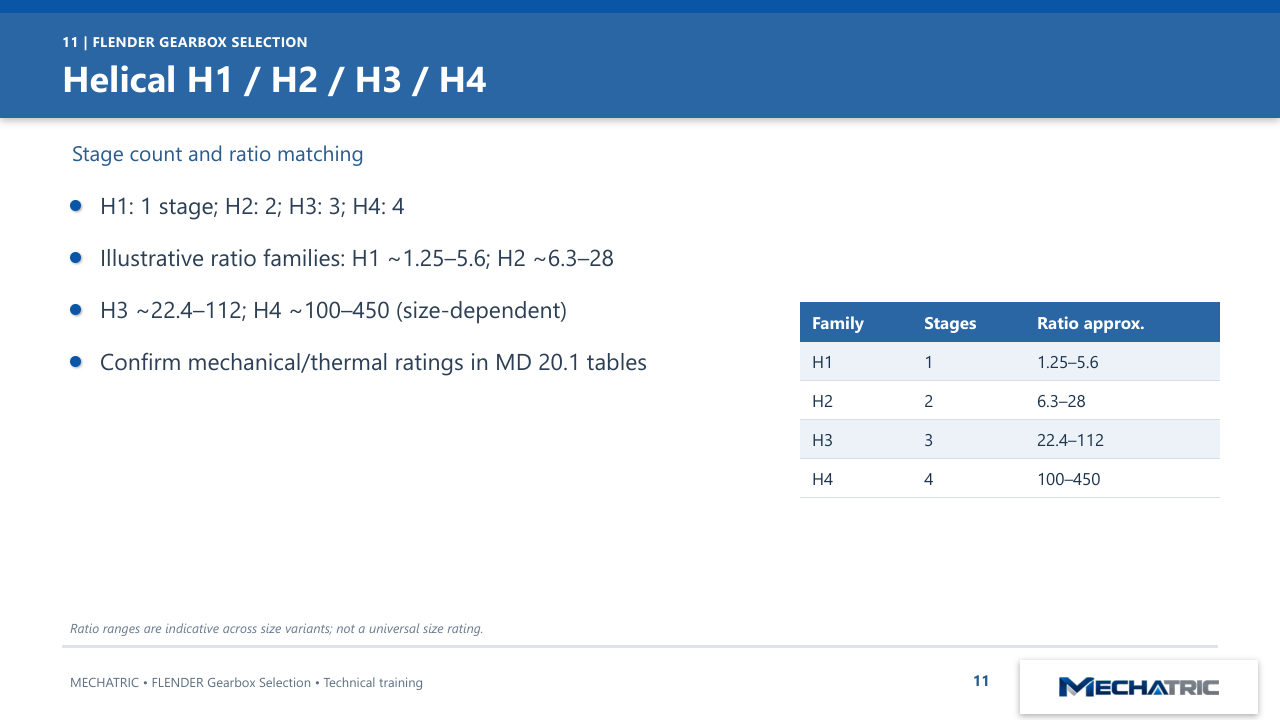
- Stage count and ratio matching
- H1: 1 stage; H2: 2; H3: 3; H4: 4
- Illustrative ratio families: H1 ~1.25–5.6; H2 ~6.3–28
- H3 ~22.4–112; H4 ~100–450 (size-dependent)
- Confirm mechanical/thermal ratings in MD 20.1 tables
- Family
12 – FLENDER GEARBOX SELECTION
Bevel-Helical B2 / B3 / B4
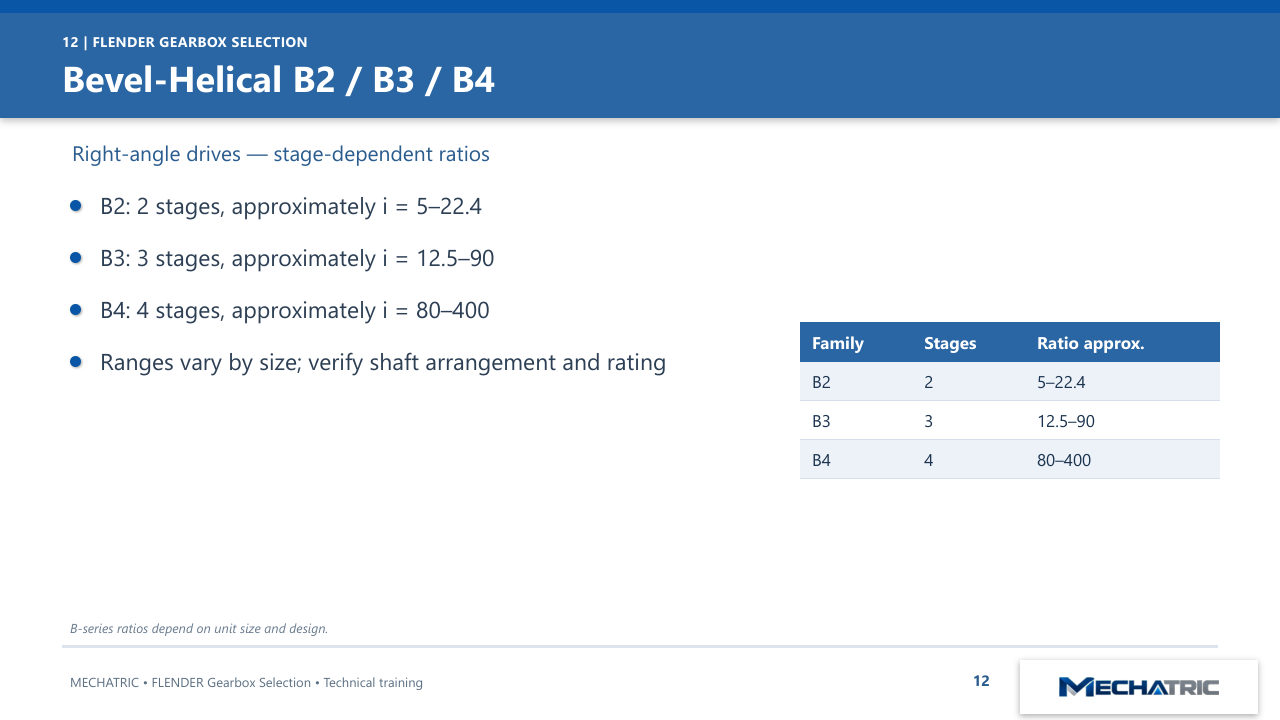
- Right-angle drives — stage-dependent ratios
- B2: 2 stages, approximately i = 5–22.4
- B3: 3 stages, approximately i = 12.5–90
- B4: 4 stages, approximately i = 80–400
- Ranges vary by size; verify shaft arrangement and rating
- Family
13 – FLENDER GEARBOX SELECTION
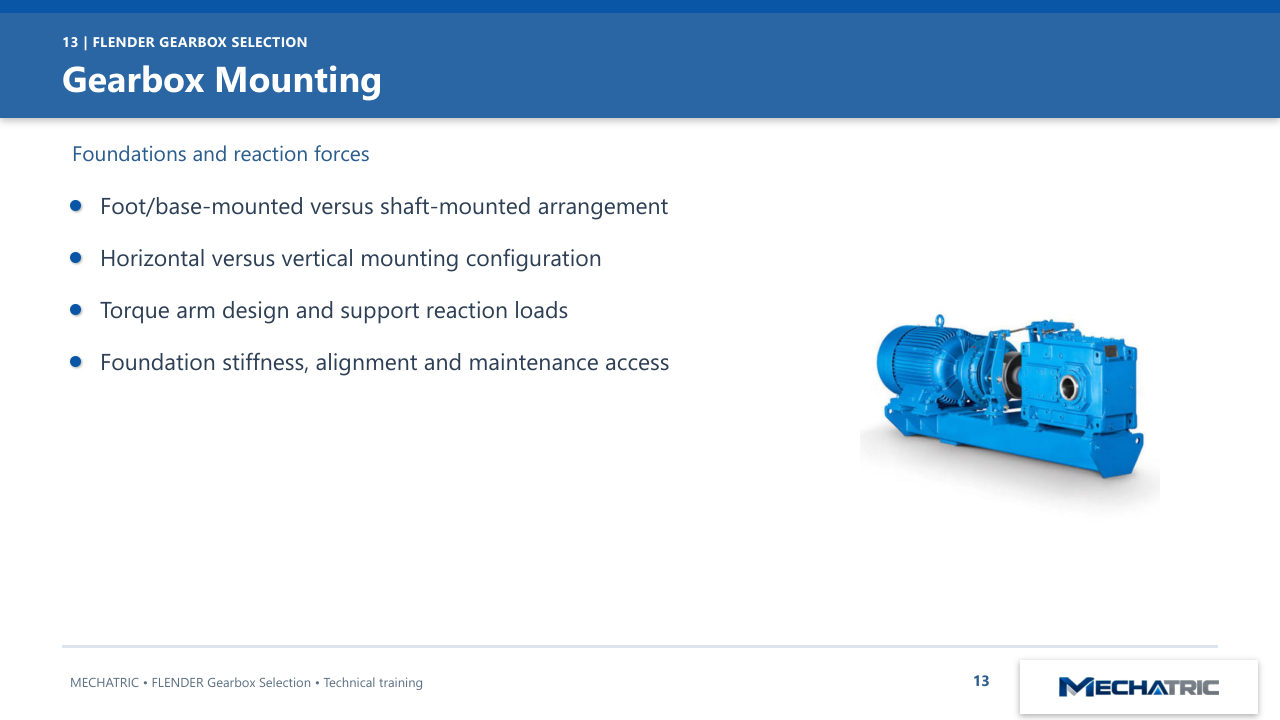
Gearbox Mounting
- Foundations and reaction forces
- Foot/base-mounted versus shaft-mounted arrangement
- Horizontal versus vertical mounting configuration
- Torque arm design and support reaction loads
- Foundation stiffness, alignment and maintenance access
14 – FLENDER GEARBOX SELECTION
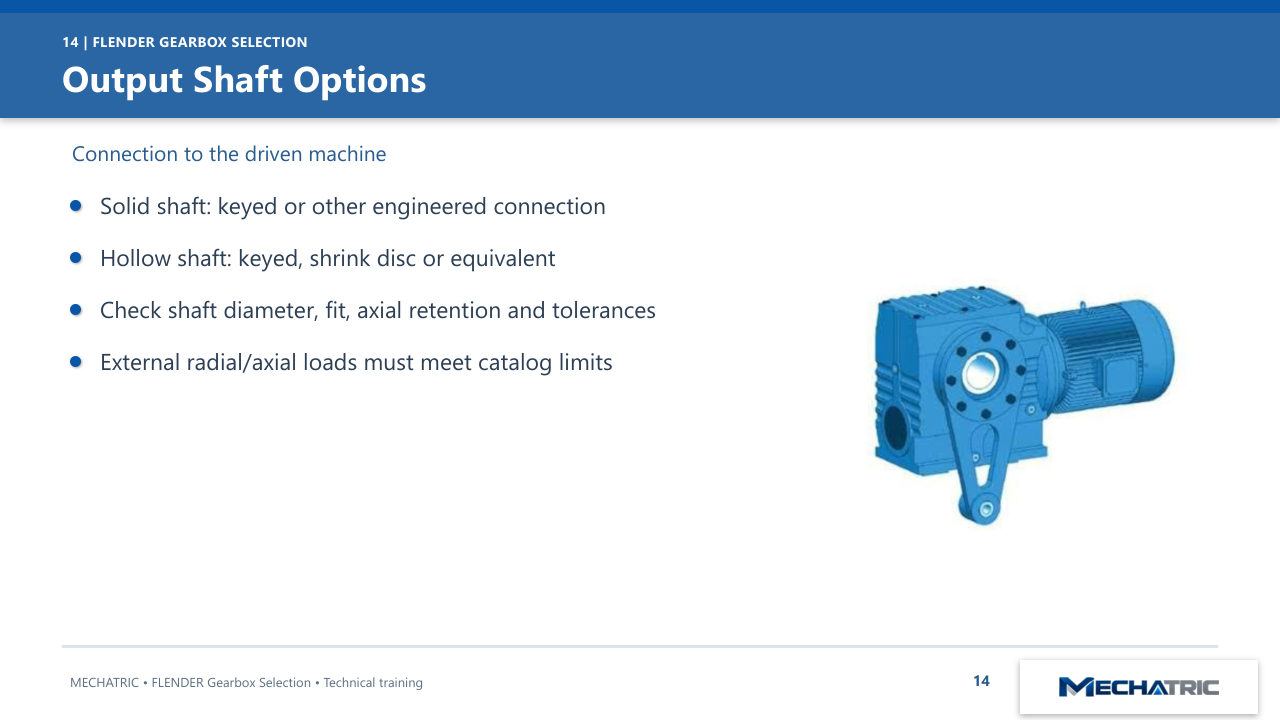
Output Shaft Options
- Connection to the driven machine
- Solid shaft: keyed or other engineered connection
- Hollow shaft: keyed, shrink disc or equivalent
- Check shaft diameter, fit, axial retention and tolerances
- External radial/axial loads must meet catalog limits
15 – FLENDER GEARBOX SELECTION
Accessory Selection
- Common options
- Backstop to prevent reverse rotation where required
- Taconite sealing for abrasive dusty environments
- Motor bell housing and adapter options
- Oil cooler, heater, filter and monitoring interfaces
16 – FLENDER GEARBOX SELECTION
FLENDER ONE
- Application-fit industrial gear unit platform
- Single-stage and multi-stage configurations
- More than 100 applications described by FLENDER
- Application-fit sizing reduces unnecessary oversizing
- Check model-specific ratings and current configurator
17 – FLENDER GEARBOX SELECTION
FLENDER ONE: Efficiency
- Planning and operating considerations
- FLENDER reports average ~20% lower power loss vs predecessor
- Application-fit thermal design and efficient cooling
- Digital 3D planning data can shorten engineering time
- Reported gains depend on product and comparison basis
18 – FLENDER GEARBOX SELECTION
FLENDER ONE: Smart Monitoring
- AIQ gearbox intelligence
- AIQ Core Sensor described as factory installed
- Monitor speed, temperature and vibration
- Condition monitoring complements inspection and maintenance
- Sensor availability/features require configuration verification
19 – FLENDER GEARBOX SELECTION
FLENDER ONE: Ratio Matching
- Speed fit concept
- Fine ratio gradation supports target output speed
- Single-stage platform: FLENDER cites 103 ratios per size
- FLENDER reports >98.5% speed-fit coverage
- Check actual speed, driven process and motor tolerances
20 – FLENDER GEARBOX SELECTION
PLANUREX 3 Planetary
- High torque density series
- Rated torque 480,000–5,450,000 Nm
- 17 sizes; nominal ratios i = 45–300
- Horizontal or vertical mounting configurations
- High overload capability subject to catalog limits
21 – FLENDER GEARBOX SELECTION
Planetary Load Sharing
- Why torque density is high
- Multiple planet gears share transmitted torque
- Compact packaging for heavy-duty industrial drives
- Check radial/axial forces and bearing life
- Dynamic peak loads still require explicit verification
22 – FLENDER GEARBOX SELECTION
PLANUREX 3 Applications
- Heavy industrial equipment
- Roller presses and vertical mill drives
- Apron feeders and central drives
- Sugar cane mills and travel drives
- Validate application-specific torque and duty spectrum
23 – FLENDER GEARBOX SELECTION
PLANUREX 3: Options
- Installation and cooling
- Gear unit base for foot mounting
- Torque reaction support options
- Connections for oil cooling
- Cold ambient variants to –40°C (configuration dependent)
24 – FLENDER GEARBOX SELECTION
Overload Capacity
- Interpret with caution
- FLENDER describes up to 2× nominal torque overload capacity
- Not a substitute for continuous torque sizing
- Duration, repetitions and thermal limits are critical
- Use catalog-specific load and fatigue verification
25 – FLENDER GEARBOX SELECTION
Conveyor Drive Engineering
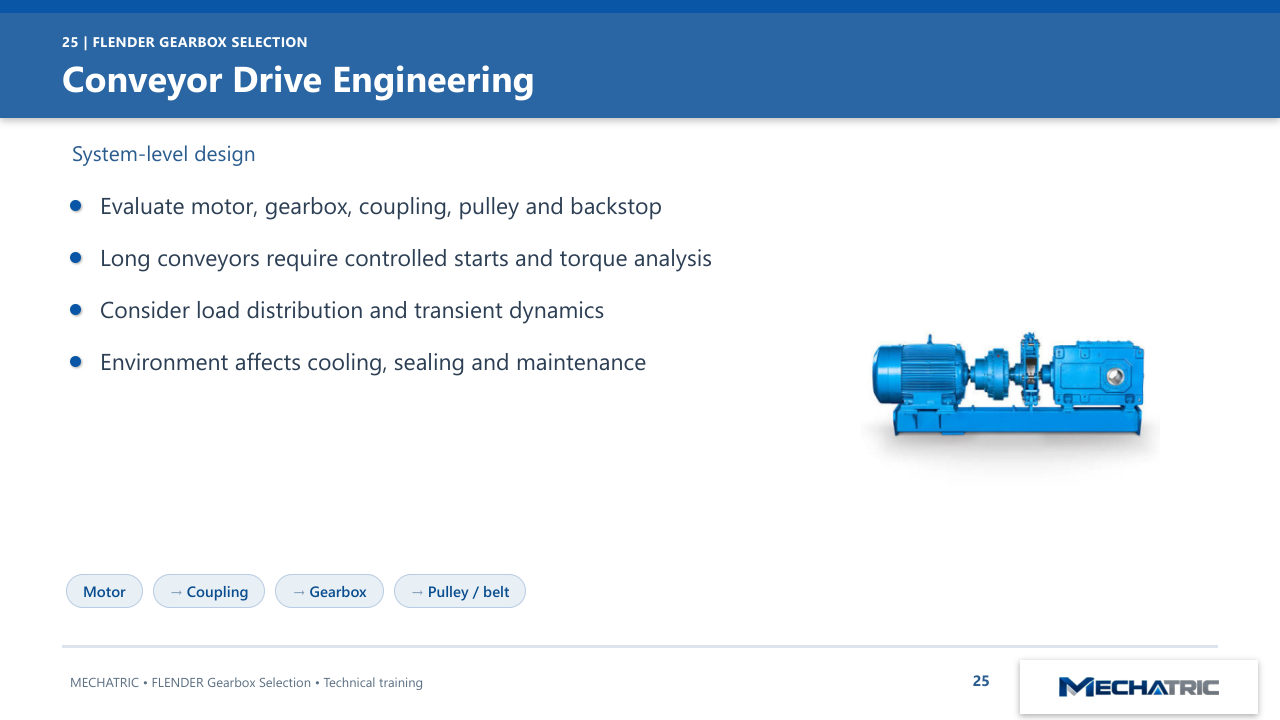
- System-level design
- Evaluate motor, gearbox, coupling, pulley and backstop
- Long conveyors require controlled starts and torque analysis
- Consider load distribution and transient dynamics
- Environment affects cooling, sealing and maintenance
- Motor
26 – FLENDER GEARBOX SELECTION
H-Conveyor Gear Unit
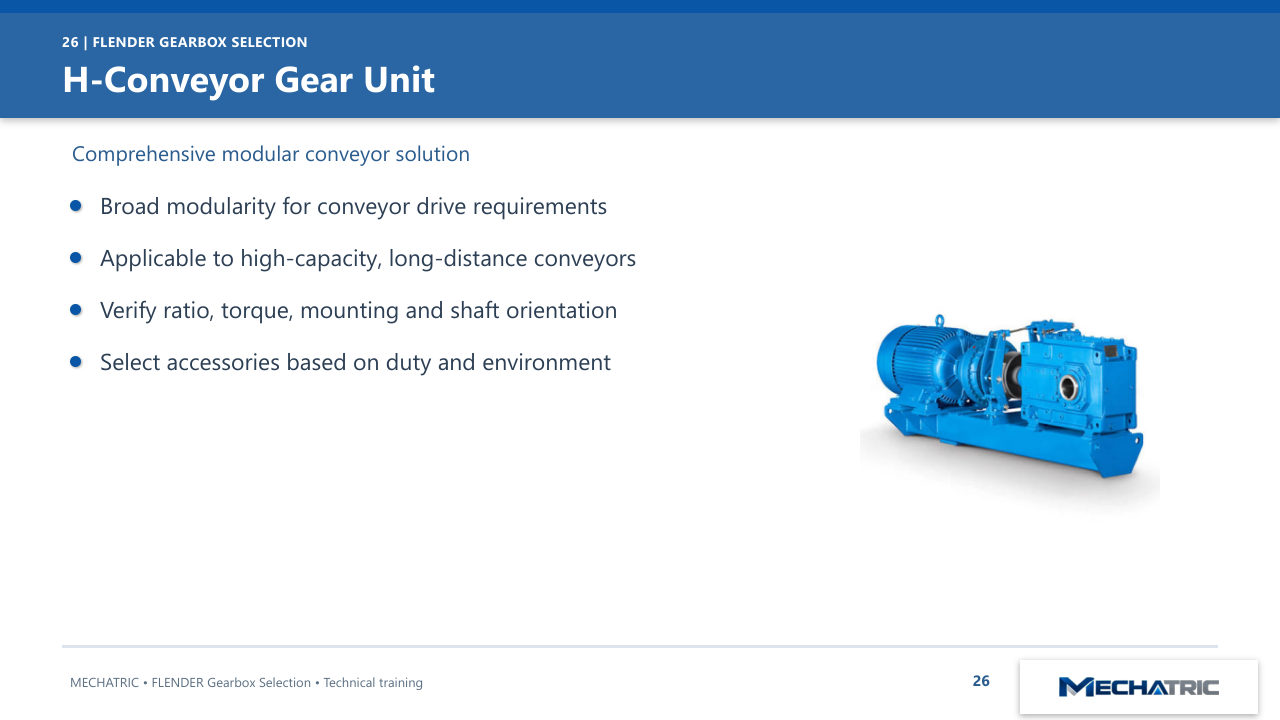
- Comprehensive modular conveyor solution
- Broad modularity for conveyor drive requirements
- Applicable to high-capacity, long-distance conveyors
- Verify ratio, torque, mounting and shaft orientation
- Select accessories based on duty and environment
27 – FLENDER GEARBOX SELECTION
E-Conveyor Gear Unit
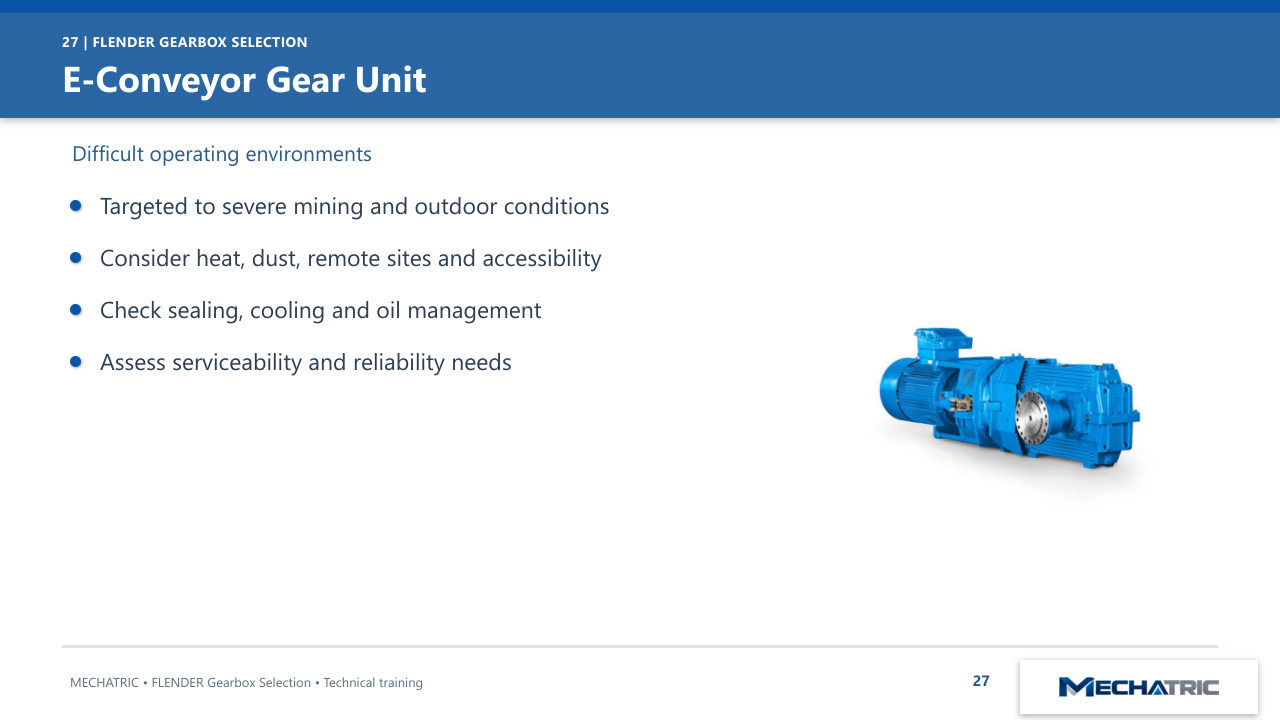
- Difficult operating environments
- Targeted to severe mining and outdoor conditions
- Consider heat, dust, remote sites and accessibility
- Check sealing, cooling and oil management
- Assess serviceability and reliability needs
28 – FLENDER GEARBOX SELECTION
A-Conveyor Drive System
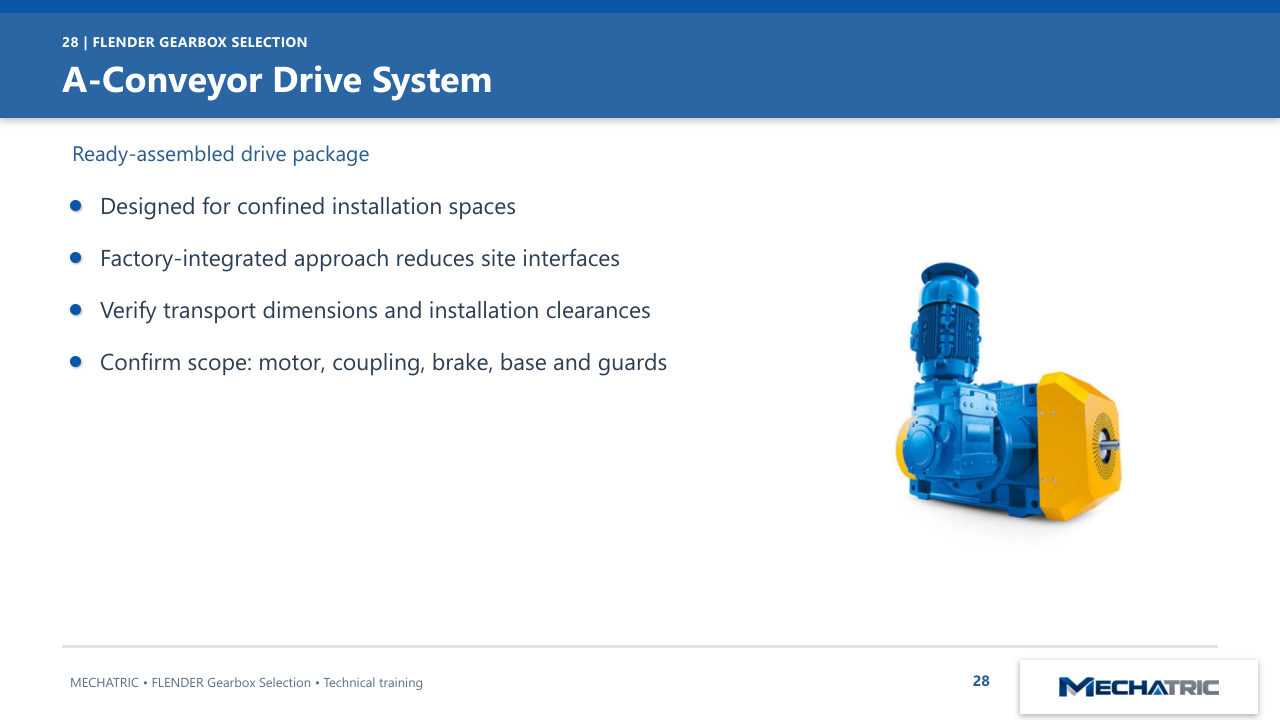
- Ready-assembled drive package
- Designed for confined installation spaces
- Factory-integrated approach reduces site interfaces
- Verify transport dimensions and installation clearances
- Confirm scope: motor, coupling, brake, base and guards
29 – FLENDER GEARBOX SELECTION
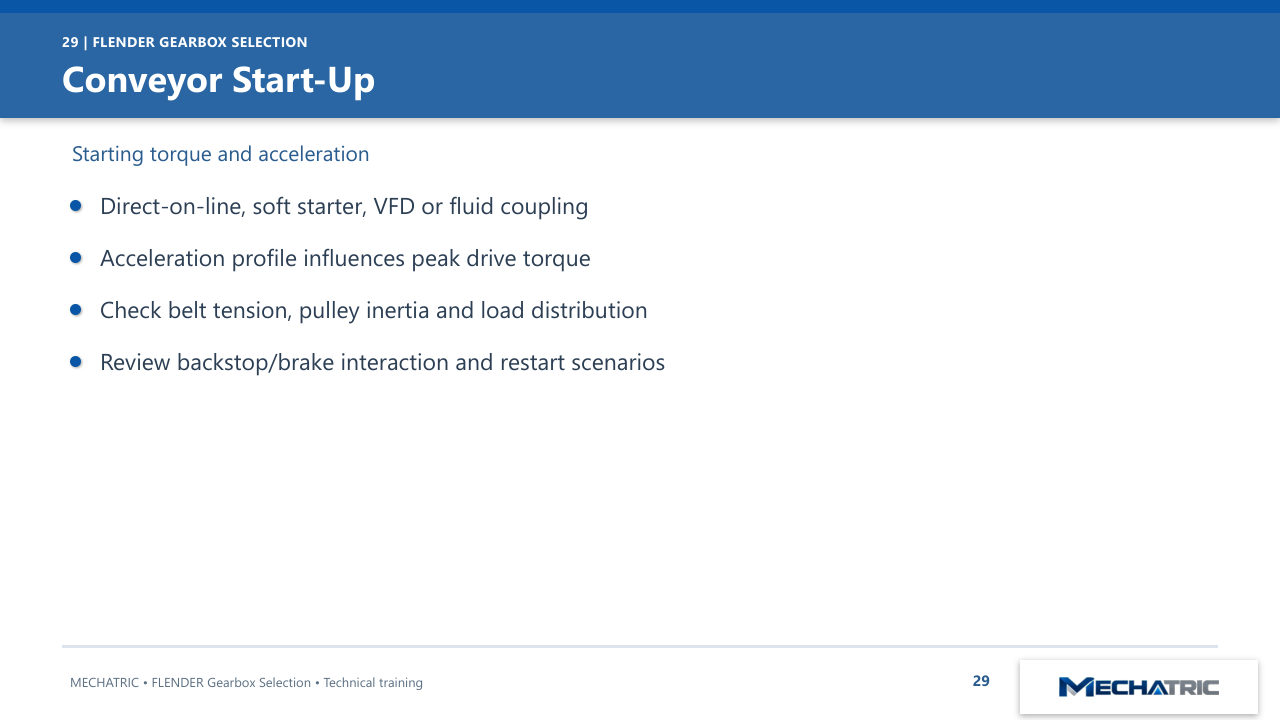
Conveyor Start-Up
- Starting torque and acceleration
- Direct-on-line, soft starter, VFD or fluid coupling
- Acceleration profile influences peak drive torque
- Check belt tension, pulley inertia and load distribution
- Review backstop/brake interaction and restart scenarios
30 – FLENDER GEARBOX SELECTION
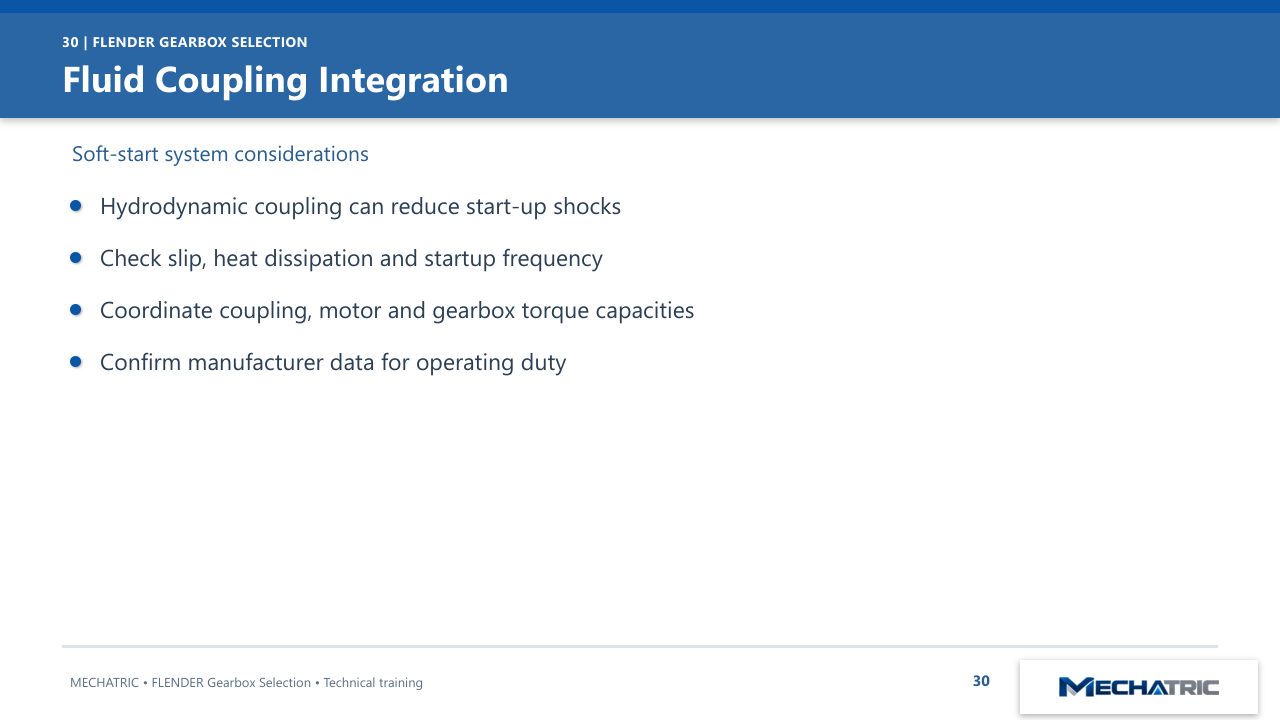
Fluid Coupling Integration
- Soft-start system considerations
- Hydrodynamic coupling can reduce start-up shocks
- Check slip, heat dissipation and startup frequency
- Coordinate coupling, motor and gearbox torque capacities
- Confirm manufacturer data for operating duty
31 – FLENDER GEARBOX SELECTION
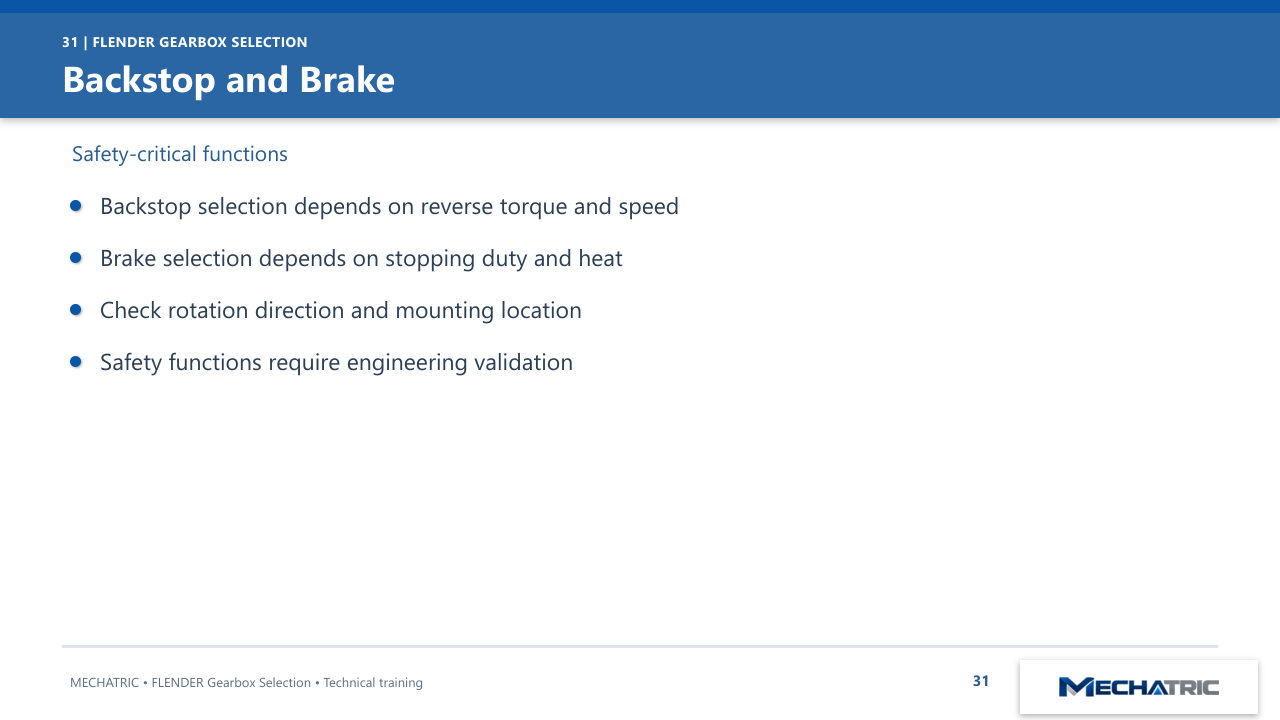
Backstop and Brake
- Safety-critical functions
- Backstop selection depends on reverse torque and speed
- Brake selection depends on stopping duty and heat
- Check rotation direction and mounting location
- Safety functions require engineering validation
32 – FLENDER GEARBOX SELECTION
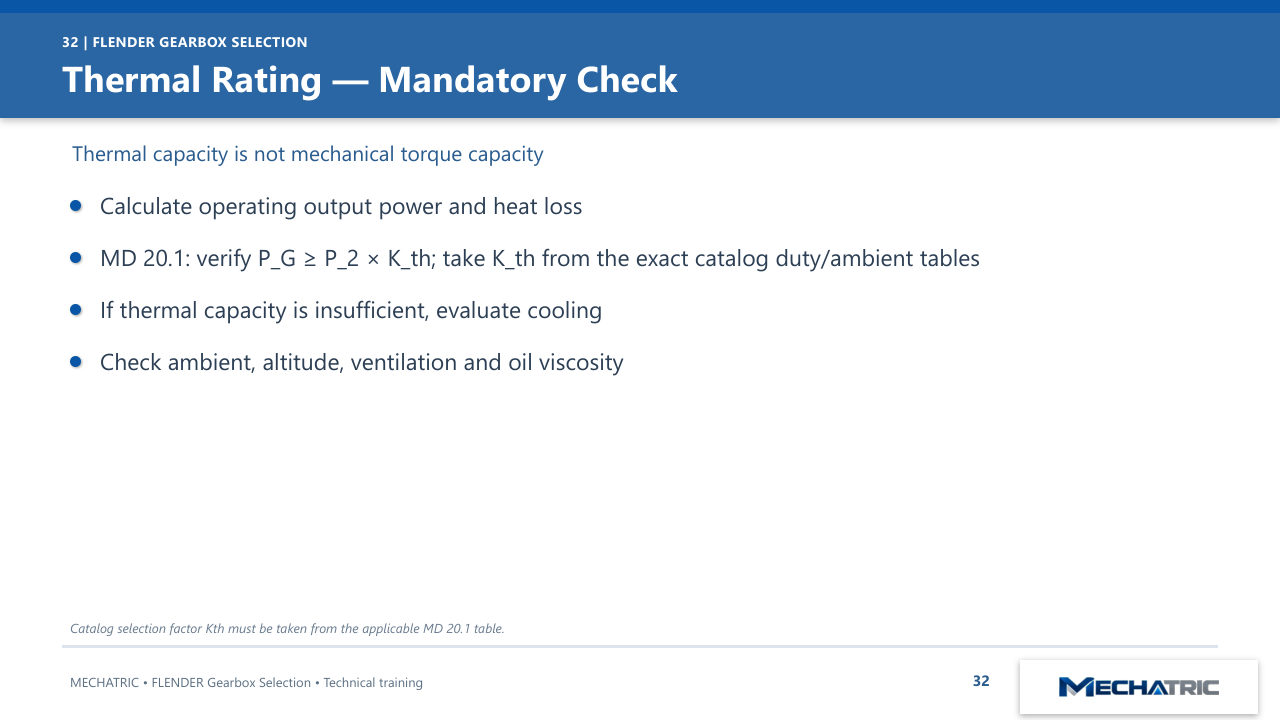
Thermal Rating — Mandatory Check
- Thermal capacity is not mechanical torque capacity
- Calculate operating output power and heat loss
- MD 20.1: verify P_G ≥ P_2 × K_th; take K_th from the exact catalog duty/ambient tables
- If thermal capacity is insufficient, evaluate cooling
- Check ambient, altitude, ventilation and oil viscosity
- Catalog selection factor Kth must be taken from the applicable MD 20.1 table.
33 – FLENDER GEARBOX SELECTION
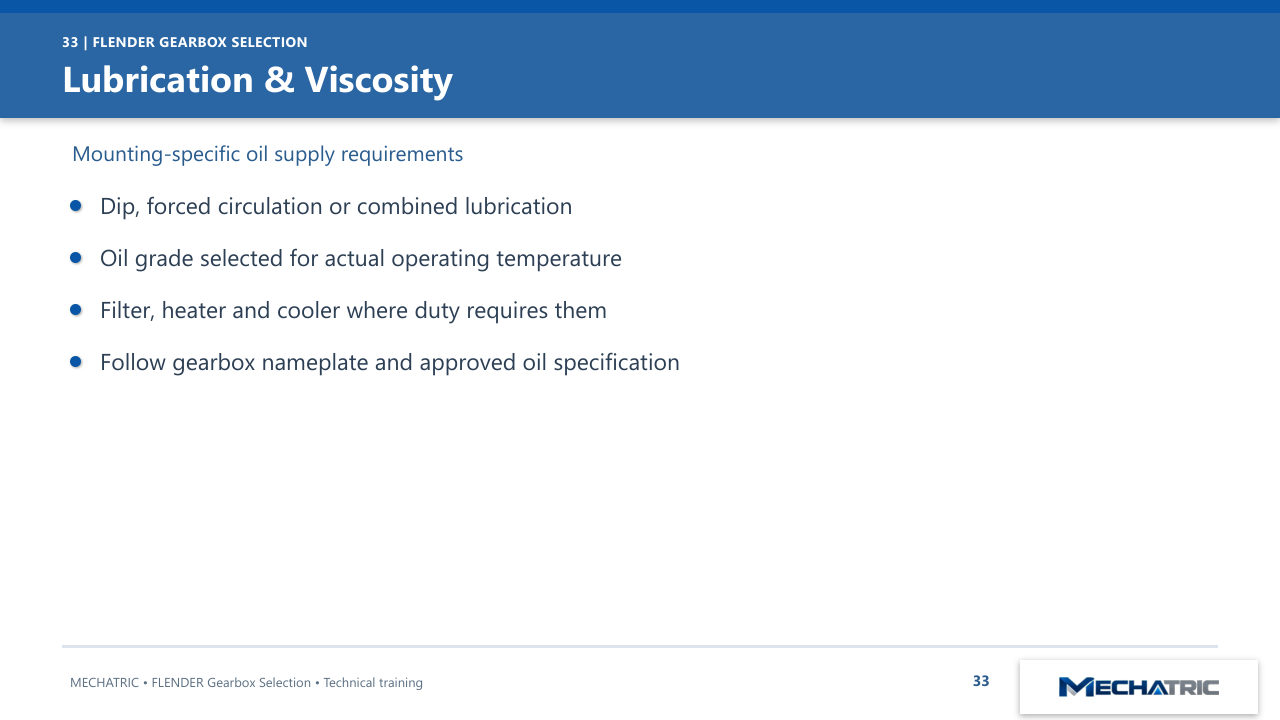
Lubrication & Viscosity
- Mounting-specific oil supply requirements
- Dip, forced circulation or combined lubrication
- Oil grade selected for actual operating temperature
- Filter, heater and cooler where duty requires them
- Follow gearbox nameplate and approved oil specification
34 – FLENDER GEARBOX SELECTION
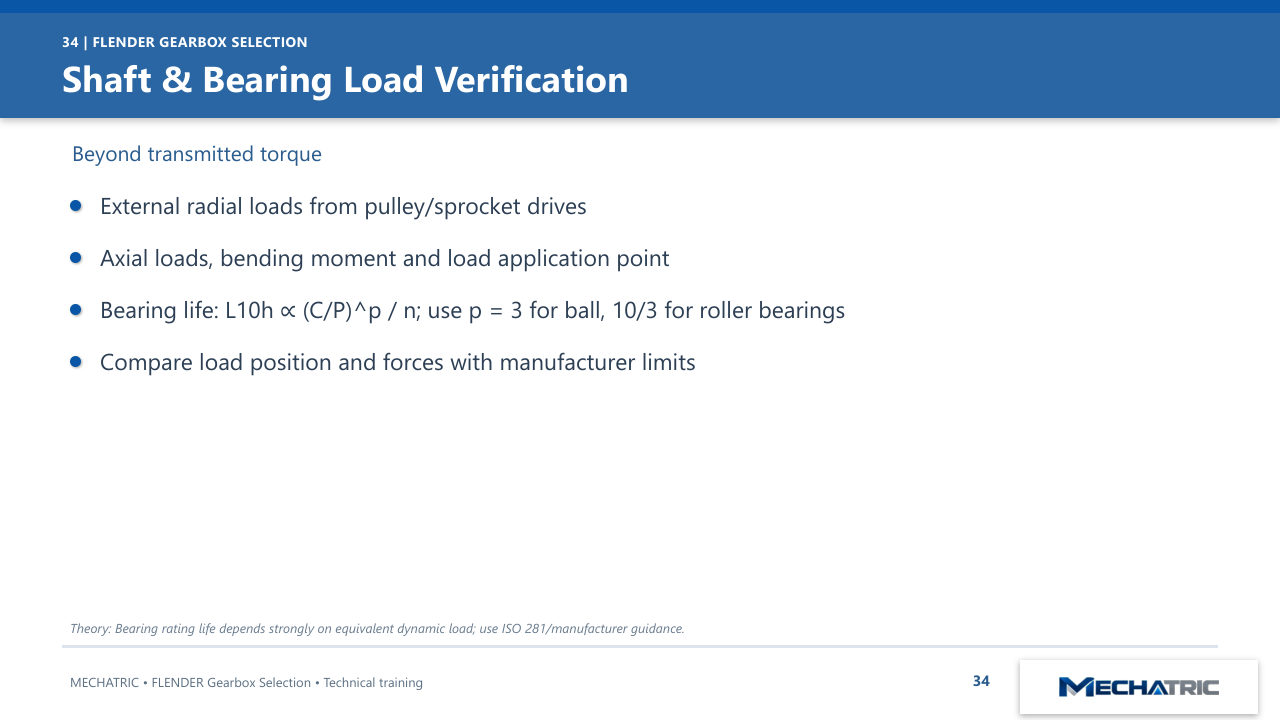
Shaft & Bearing Load Verification
- Beyond transmitted torque
- External radial loads from pulley/sprocket drives
- Axial loads, bending moment and load application point
- Bearing life: L10h ∝ (C/P)^p / n; use p = 3 for ball, 10/3 for roller bearings
- Compare load position and forces with manufacturer limits
- Theory: Bearing rating life depends strongly on equivalent dynamic load; use ISO 281/manufacturer guidance.
35 – FLENDER GEARBOX SELECTION
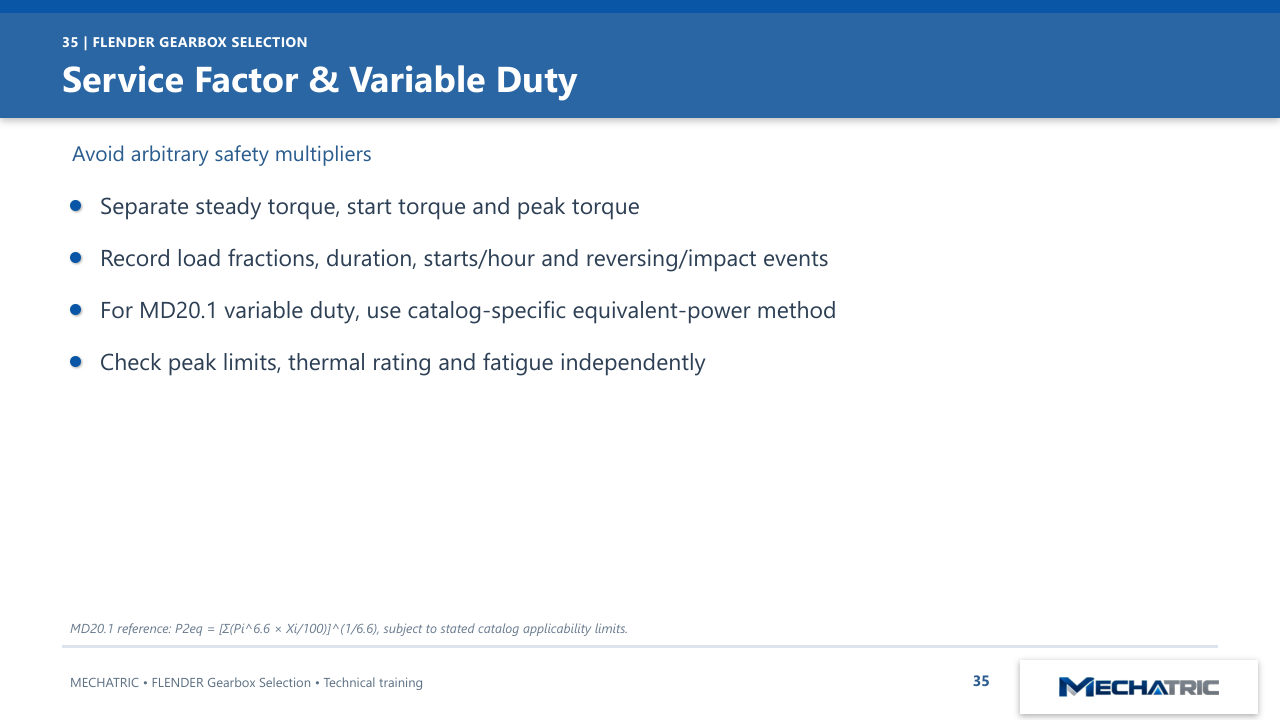
Service Factor & Variable Duty
- Avoid arbitrary safety multipliers
- Separate steady torque, start torque and peak torque
- Record load fractions, duration, starts/hour and reversing/impact events
- For MD20.1 variable duty, use catalog-specific equivalent-power method
- Check peak limits, thermal rating and fatigue independently
- MD20.1 reference: P2eq = [Σ(Pi^6.6 × Xi/100)]^(1/6.6), subject to stated catalog applicability limits.
36 – FLENDER GEARBOX SELECTION
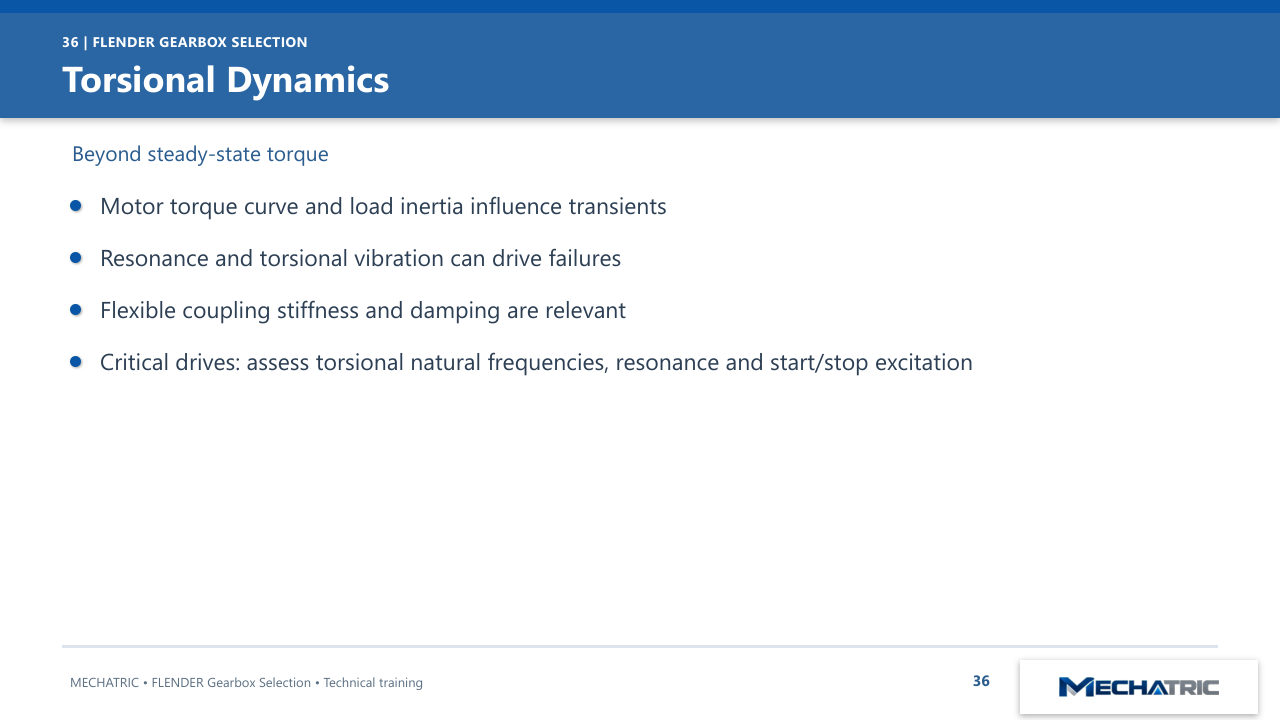
Torsional Dynamics
- Beyond steady-state torque
- Motor torque curve and load inertia influence transients
- Resonance and torsional vibration can drive failures
- Flexible coupling stiffness and damping are relevant
- Critical drives: assess torsional natural frequencies, resonance and start/stop excitation
37 – FLENDER GEARBOX SELECTION
Coupling & Gearbox Compatibility
- Interface engineering checklist
- Rated torque, peak torque and service conditions
- Bore/shaft fit, hub dimensions and key or locking assembly
- Misalignment, axial displacement and spacer length
- Balance, speed, torsional stiffness and maintenance access
38 – FLENDER GEARBOX SELECTION
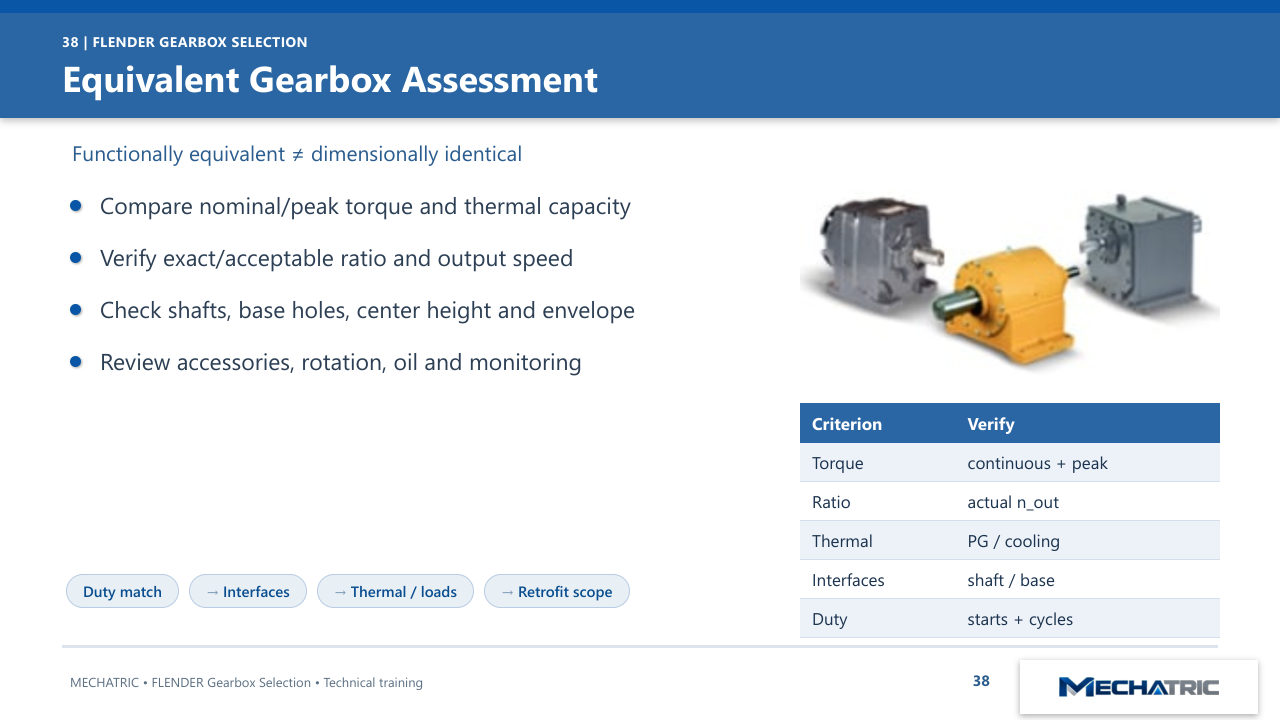
Equivalent Gearbox Assessment
- Functionally equivalent ≠ dimensionally identical
- Compare nominal/peak torque and thermal capacity
- Verify exact/acceptable ratio and output speed
- Check shafts, base holes, center height and envelope
- Review accessories, rotation, oil and monitoring
- Criterion
39 – FLENDER GEARBOX SELECTION
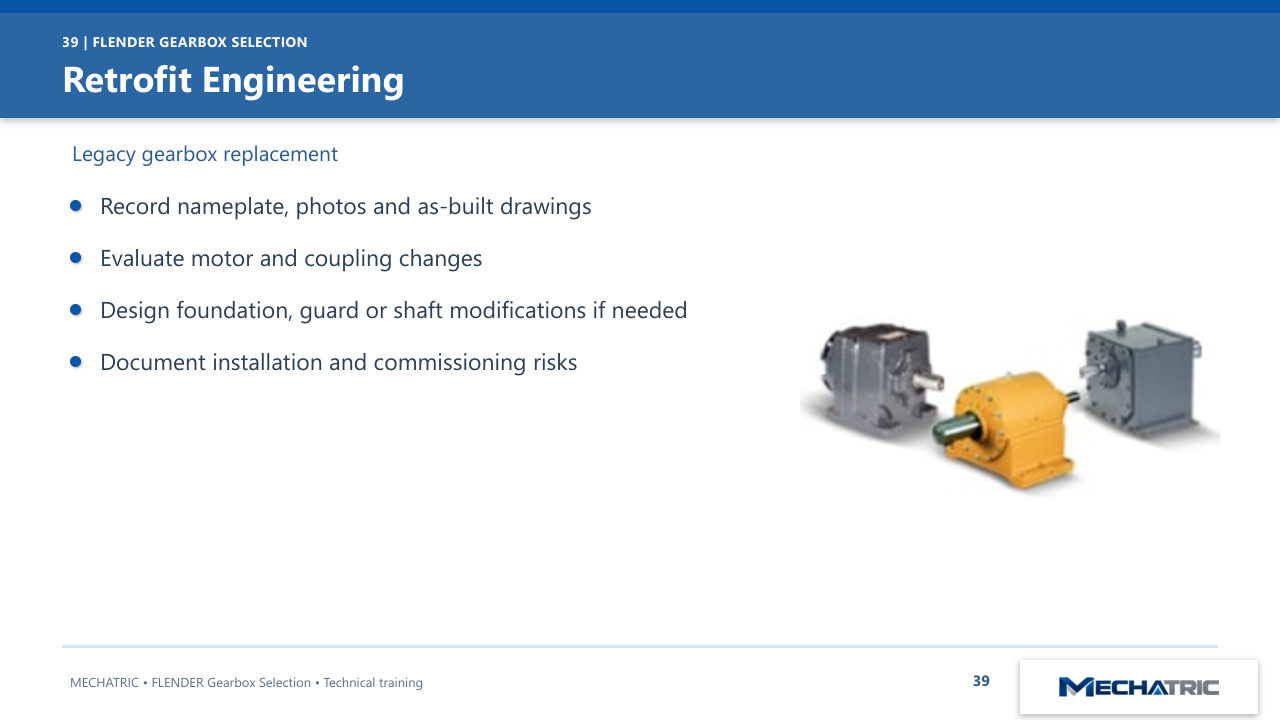
Retrofit Engineering
- Legacy gearbox replacement
- Record nameplate, photos and as-built drawings
- Evaluate motor and coupling changes
- Design foundation, guard or shaft modifications if needed
- Document installation and commissioning risks
40 – FLENDER GEARBOX SELECTION
Worked Example — Planetary Drive
- Preliminary power and ratio screening
- Continuous output torque = 1,250 kNm
- Output speed = 12 rpm; Pout ≈ 1,571 kW
- Select ratio from input speed, then check PLANUREX data
- Confirm transient torque, bearings, thermal and fatigue
- Example only: not a final FLENDER selection
41 – FLENDER GEARBOX SELECTION
Worked Example: Bevel-Helical
- Illustrative ratio and torque
- Motor: 250 kW, 1490 rpm; target output 42 rpm
- Required ratio ≈ 35.48
- At η = 0.96, output torque ≈ 54.6 kNm
- Verify catalog ratio, thermal capacity and shaft loads
- Check service conditions before selecting size
42 – FLENDER GEARBOX SELECTION
Cement Industry
- Typical FLENDER gearbox duties
- Clinker and raw material conveyors
- Crushers and grinding/mill auxiliary drives
- Rotary kiln and cooler-related equipment
- Dust sealing and 24/7 duty are major considerations
43 – FLENDER GEARBOX SELECTION
Mining & Minerals
- Heavy material-handling applications
- Long-distance belt conveyors and apron feeders
- Crushers, roller presses and processing equipment
- High starting torque and abrasive dust
- Thermal performance at remote hot sites
44 – FLENDER GEARBOX SELECTION
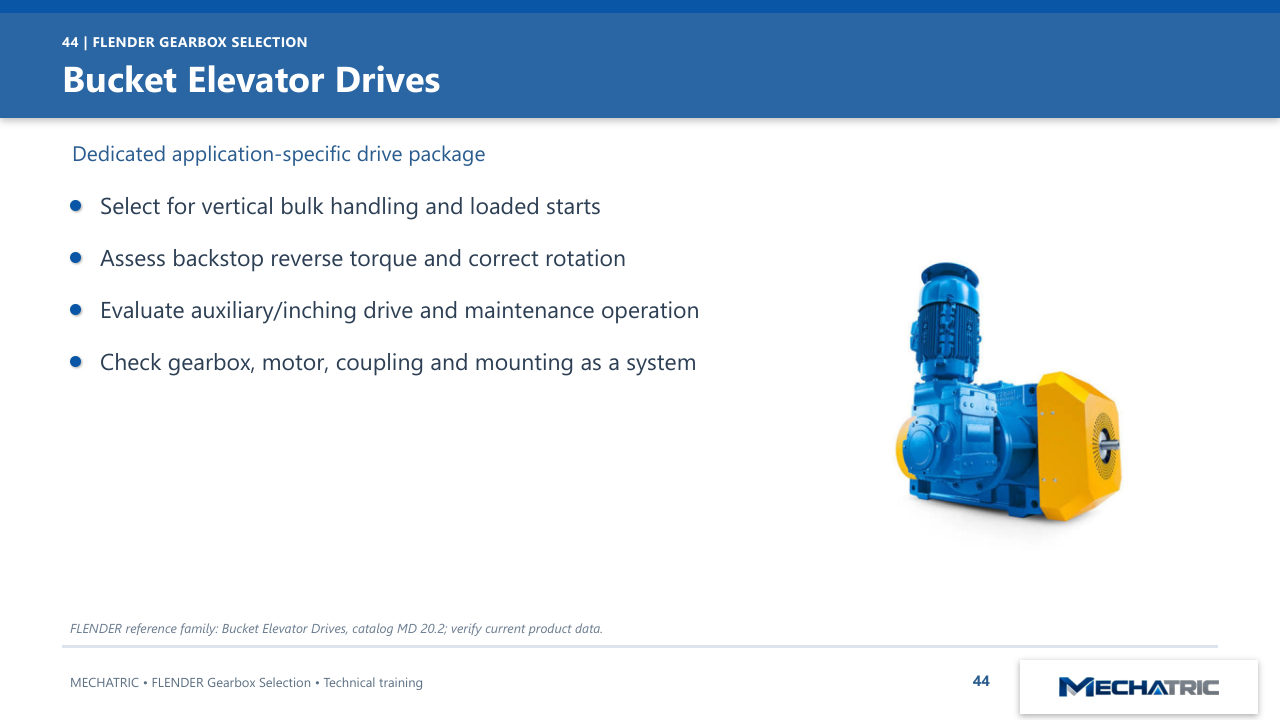
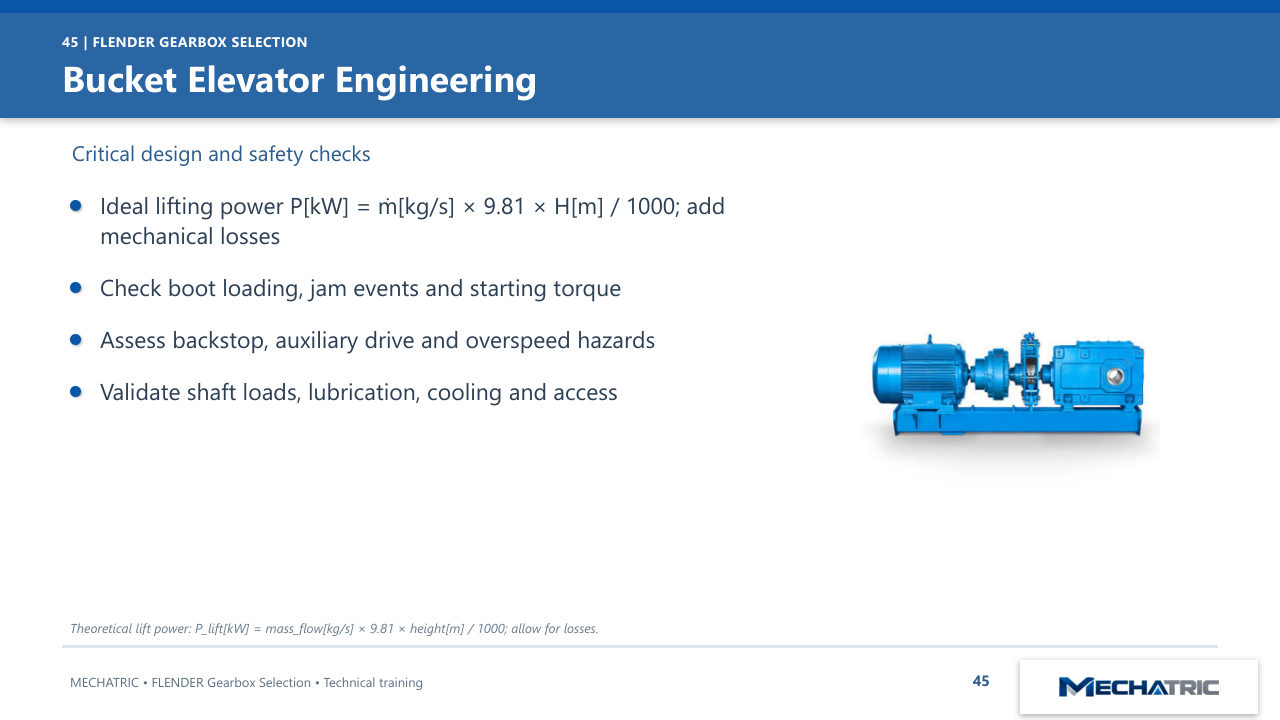
Bucket Elevator Drives
- Dedicated application-specific drive package
- Select for vertical bulk handling and loaded starts
- Assess backstop reverse torque and correct rotation
- Evaluate auxiliary/inching drive and maintenance operation
- Check gearbox, motor, coupling and mounting as a system
- FLENDER reference family: Bucket Elevator Drives, catalog MD 20.2; verify current product data.
45 – FLENDER GEARBOX SELECTION
Bucket Elevator Engineering
- Critical design and safety checks
- Ideal lifting power P[kW] = ṁ[kg/s] × 9.81 × H[m] / 1000; add
- mechanical losses
- Check boot loading, jam events and starting torque
- Assess backstop, auxiliary drive and overspeed hazards
- Validate shaft loads, lubrication, cooling and access
46 – FLENDER GEARBOX SELECTION
Digital Condition Monitoring
- AIQ and DIAGNOSTEX
- Temperature, speed and vibration trending
- Identify developing anomalies and plan maintenance
- Sensor options differ by gearbox platform
- Monitoring does not replace mechanical design checks
47 – FLENDER GEARBOX SELECTION
RFQ — Mechanical Data
- Minimum information for technical selection
- Existing type, serial number and nameplate photo
- Input power/speed; target output speed and torque
- Duty cycle, starts/hour, shock and overload spectrum
- Shafts, mounting position, center height and drawings
48 – FLENDER GEARBOX SELECTION
RFQ Data: Environment
- Application-specific inputs
- Ambient temperature, altitude and dust
- Indoor/outdoor and hazardous area
- Operating hours and start frequency
- Cooling, lubrication, backstop and monitoring needs
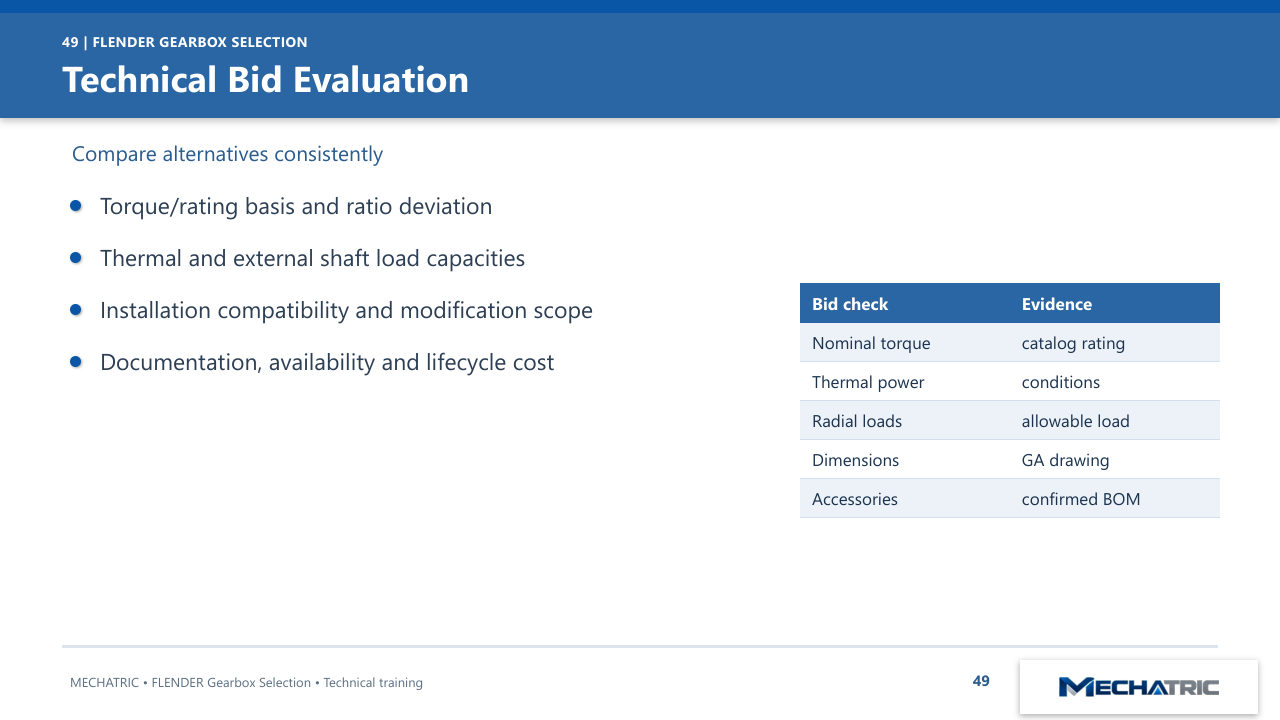
49 – FLENDER GEARBOX SELECTION
Technical Bid Evaluation
- Compare alternatives consistently
- Torque/rating basis and ratio deviation
- Thermal and external shaft load capacities
- Installation compatibility and modification scope
- Documentation, availability and lifecycle cost
- Bid check
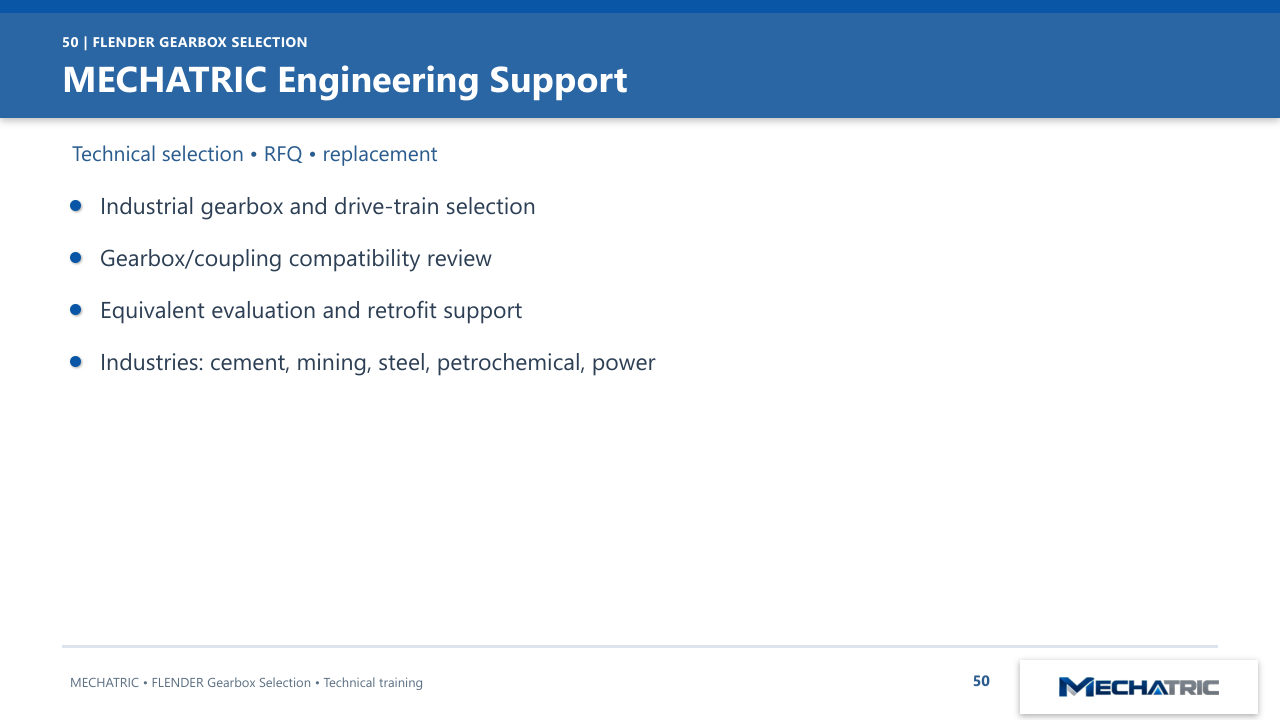
50 – FLENDER GEARBOX SELECTION
Technical selection • RFQ • replacement
- Industrial gearbox and drive-train selection
- Gearbox/coupling compatibility review
- Equivalent evaluation and retrofit support
- Industries: cement, mining, steel, petrochemical, power
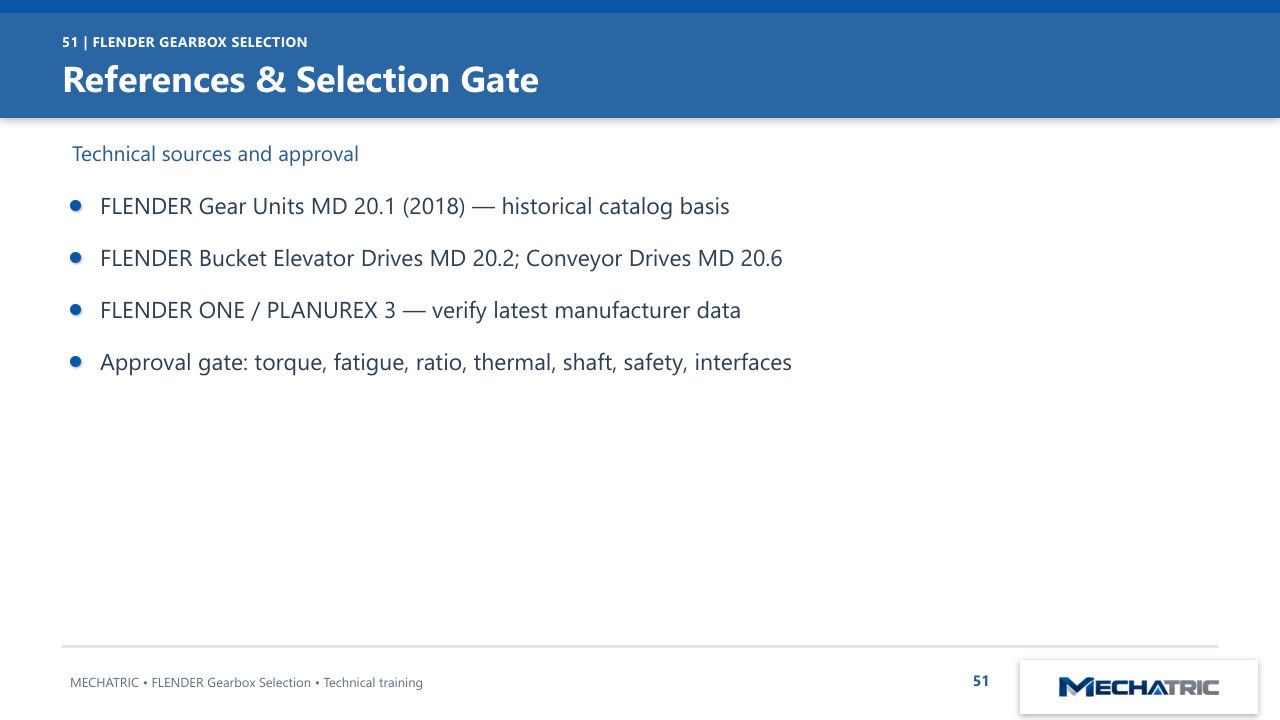
51 – FLENDER GEARBOX SELECTION
References & Selection Gate
- Technical sources and approval
- FLENDER Gear Units MD 20.1 (2018) — historical catalog basis
- FLENDER Bucket Elevator Drives MD 20.2; Conveyor Drives MD 20.6
- FLENDER ONE / PLANUREX 3 — verify latest manufacturer data
- Approval gate: torque, fatigue, ratio, thermal, shaft, safety, interfaces
Need engineering support?
Send your application data and the existing equipment details – MECHATRIC reviews the selection, specification or replacement and prepares the RFQ.
Training material prepared by MECHATRIC from the cited standards and manufacturer documentation. Trademarks belong to their respective owners. Confirm all requirements and ratings against the current editions and manufacturer data for each project.