
MECHATRIC Coupling Academy
Engineering Specification of API Couplings – API 671 & API 610
40-slide training on special-purpose (API 671) and pump (API 610 / ISO 13709) couplings: scope, coupling types, service factors, sizing, dynamic behaviour, balancing, spacer retention, procurement and verification.

Swipe or use the arrows
Presentation Outline
Key points of each slide – a quick engineering reference.
Course Topics
Purpose and Deliverables
- A specification-driven approach
- Define the coupling duty and service envelope; identify mandatory and purchaser-specified requirements; produce a reviewable RFQ and compliance matrix.
Reference Editions and Interpretation
- Documents supplied for this training
- API 671: Third Edition, October 1998; API 610: Eleventh Edition, September 2010 (ISO 13709:2009). The two API 671 uploads appear to be the same 1998 edition. Check contract- required editions before procurement.
API 610 vs API 671
- Different roles in the rotating-equipment train
- API 610 §7.2 defines pump-train coupling and guard requirements. API 671 specifies special-purpose coupling design, dynamics, balancing, inspection, testing and vendor data. A pump compliant with API 610 does not automatically require full API 671 compliance.
When Is API 671 Required?
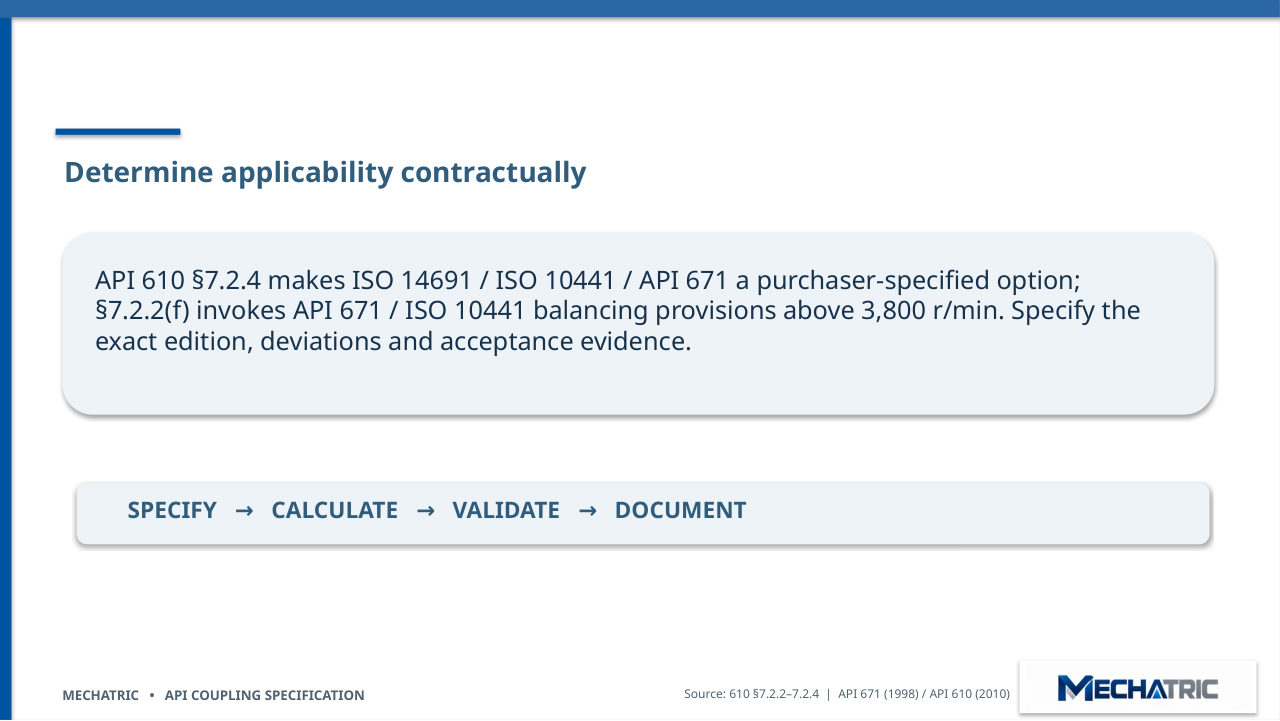
- Determine applicability contractually
- API 610 §7.2.4 makes ISO 14691 / ISO 10441 / API 671 a purchaser-specified option; §7.2.2(f) invokes API 671 / ISO 10441 balancing provisions above 3,800 r/min. Specify the exact edition, deviations and acceptance evidence.
API 671 Coupling Families
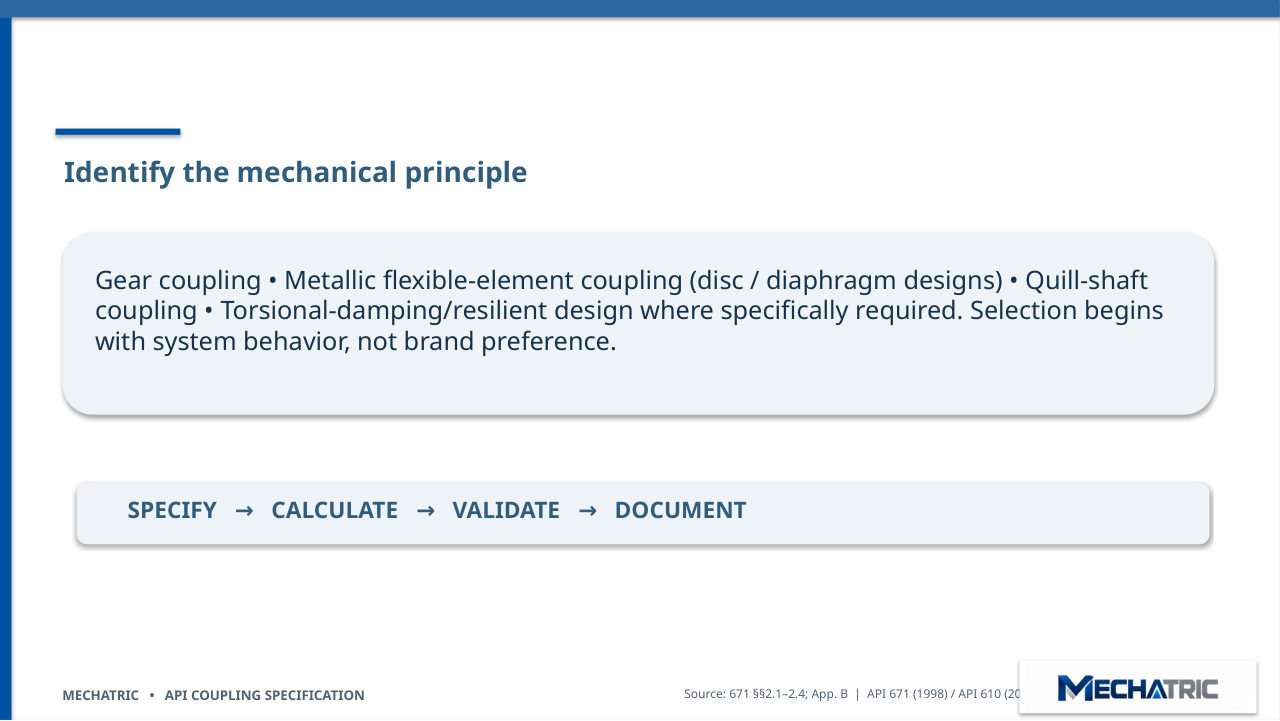
- Identify the mechanical principle
- Gear coupling • Metallic flexible-element coupling (disc / diaphragm designs) • Quill-shaft coupling • Torsional-damping/resilient design where specifically required. Selection begins with system behavior, not brand preference.
General Selection Workflow
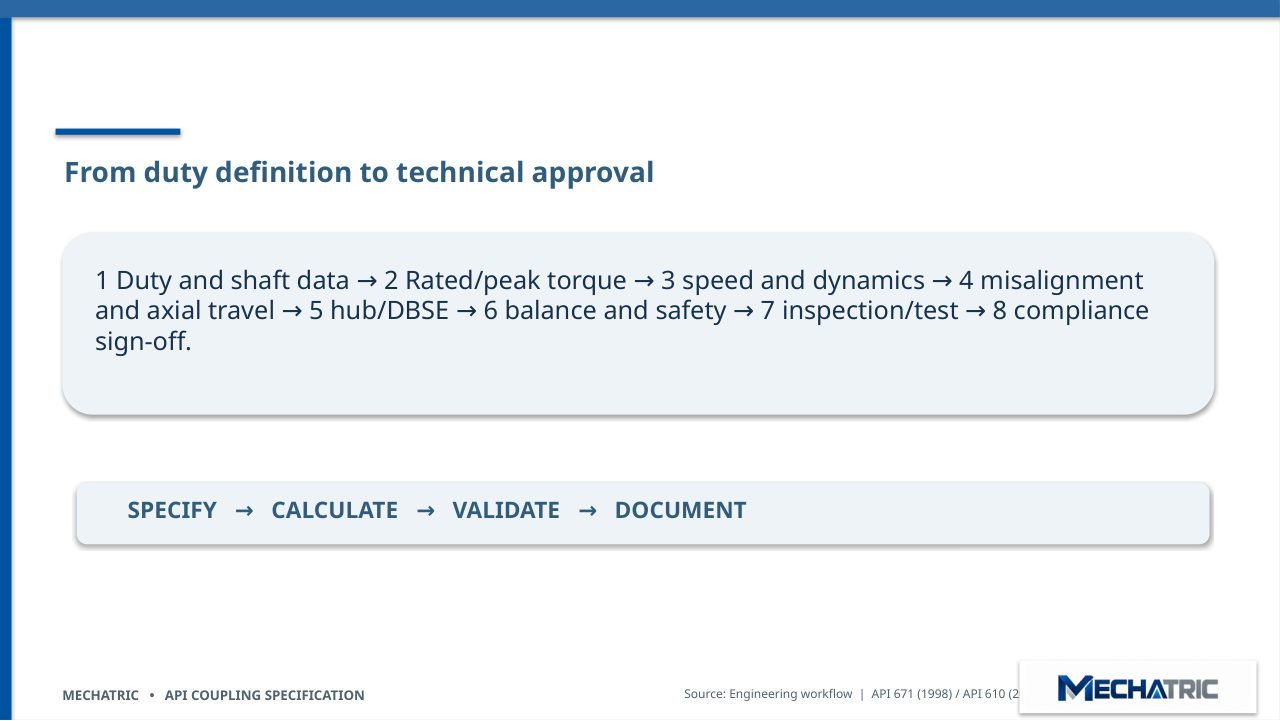
- From duty definition to technical approval
- 1 Duty and shaft data 2 Rated/peak torque 3 speed and dynamics 4 misalignment
Minimum Purchaser Input
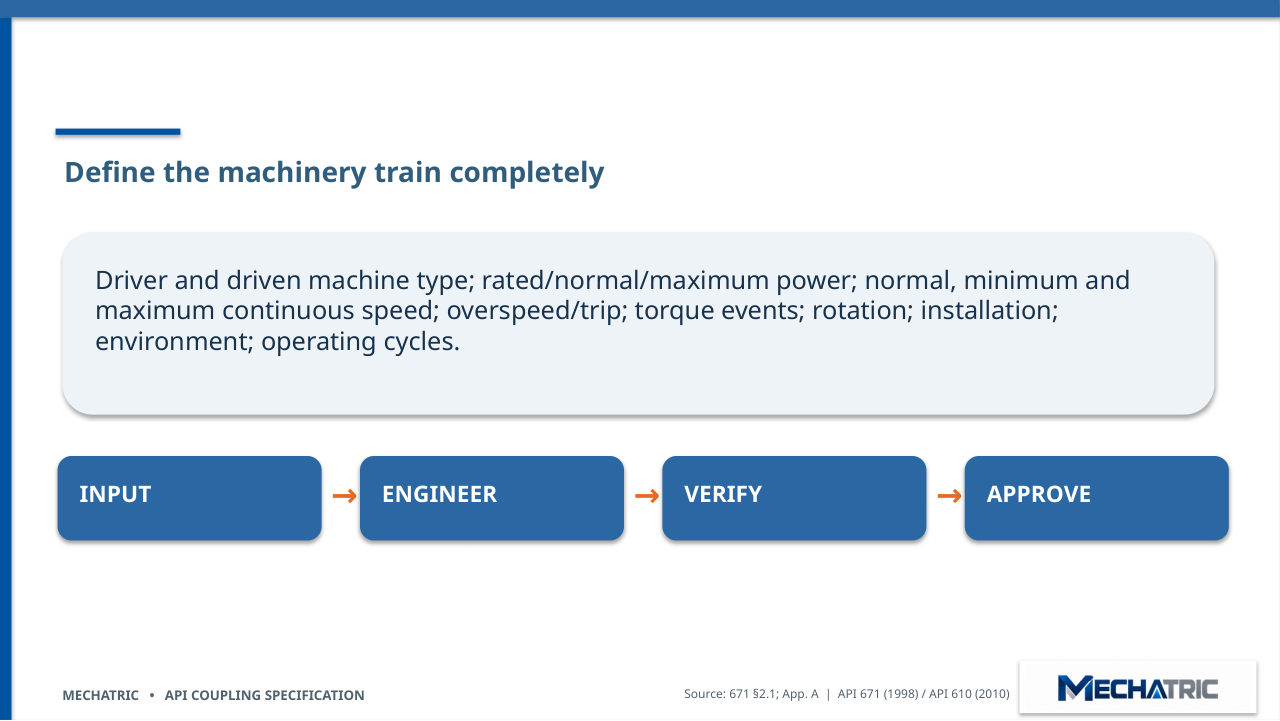
- Define the machinery train completely
- Driver and driven machine type; rated/normal/maximum power; normal, minimum and maximum continuous speed; overspeed/trip; torque events; rotation; installation; environment; operating cycles.
Torque: Unit Conversion
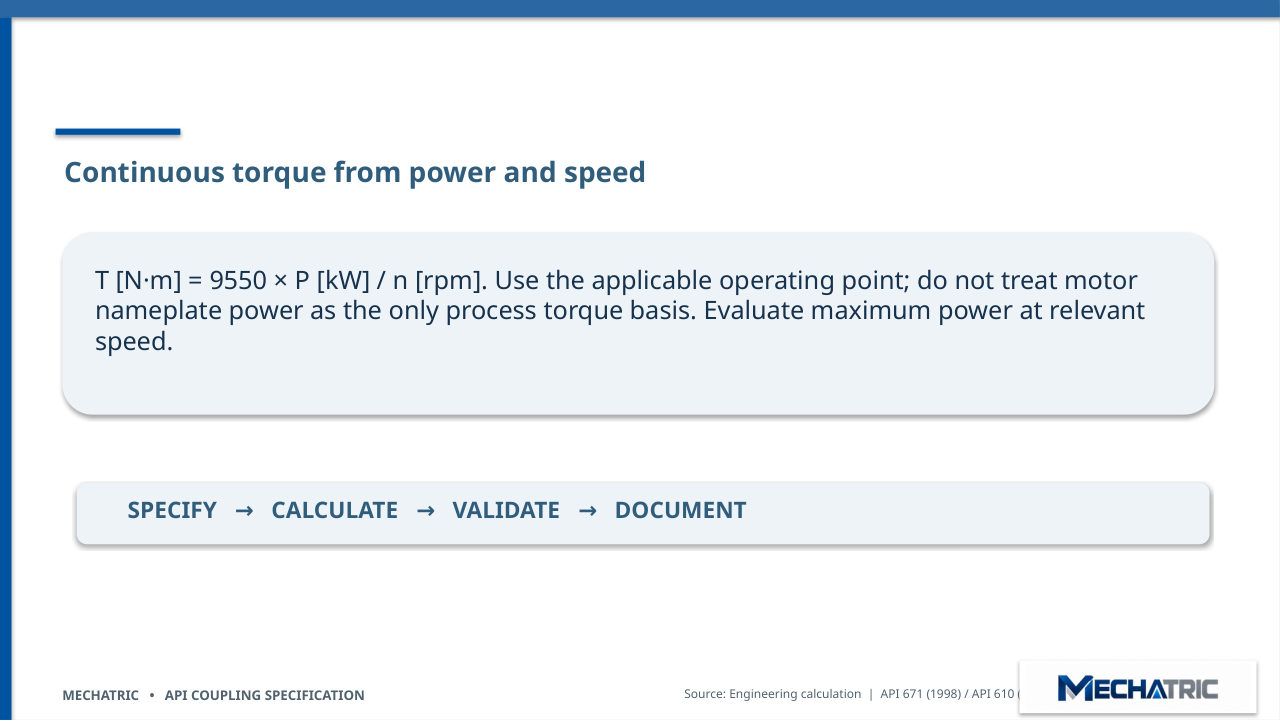
- Continuous torque from power and speed
- T [N·m] = 9550 × P [kW] / n [rpm]. Use the applicable operating point; do not treat motor nameplate power as the only process torque basis. Evaluate maximum power at relevant speed.
Worked Torque Example
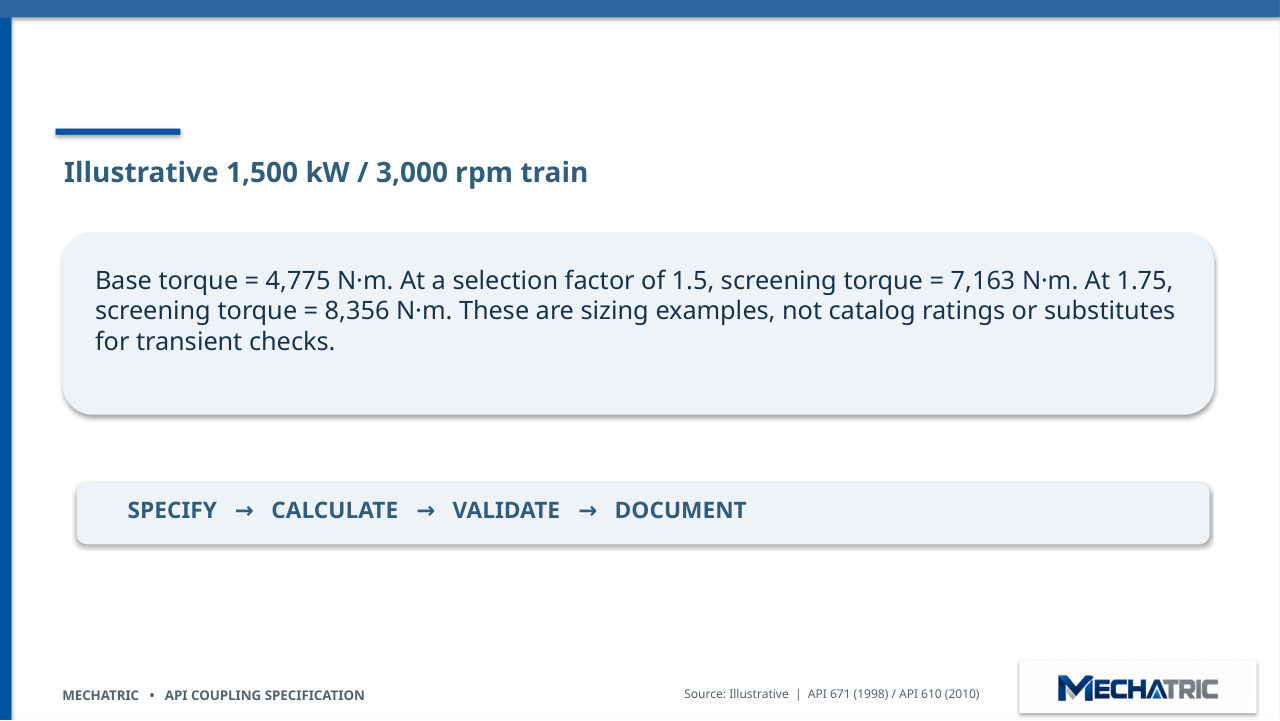
- Illustrative 1,500 kW / 3,000 rpm train
- Base torque = 4,775 N·m. At a selection factor of 1.5, screening torque = 7,163 N·m. At 1.75, screening torque = 8,356 N·m. These are sizing examples, not catalog ratings or substitutes for transient checks.
API 671 Service Factors
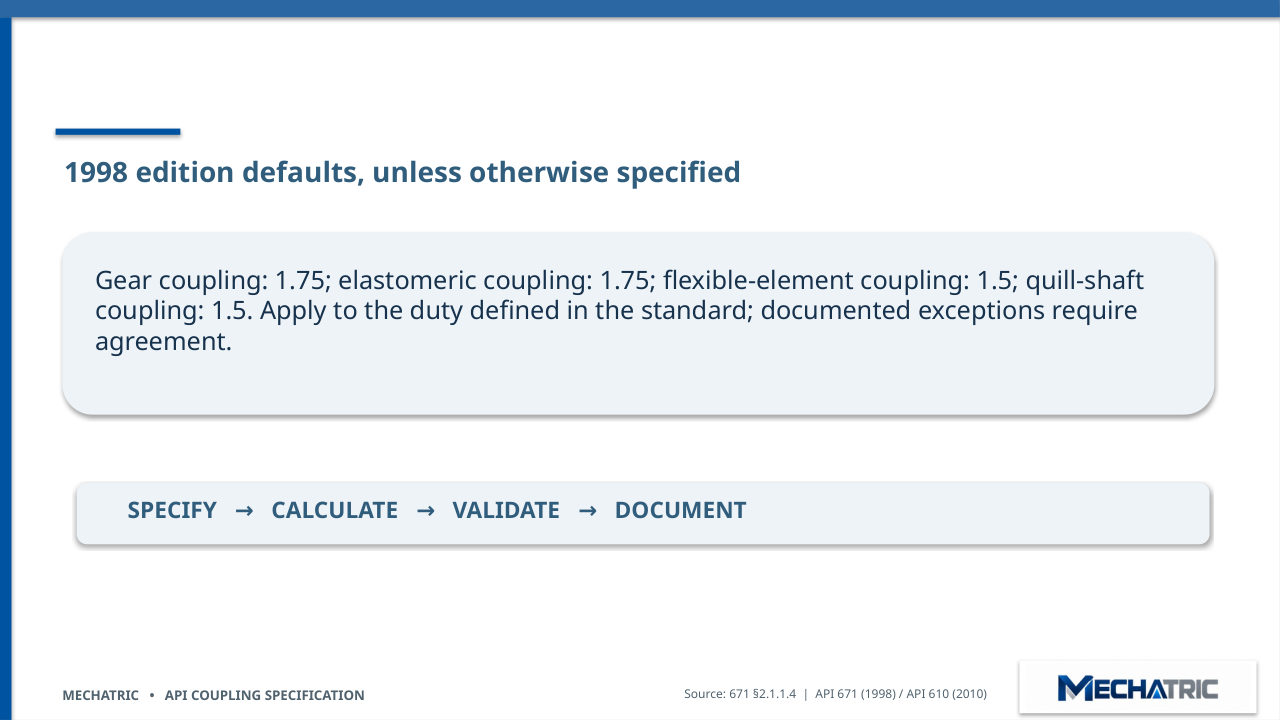
- 1998 edition defaults, unless otherwise specified
- Gear coupling: 1.75; elastomeric coupling: 1.75; flexible-element coupling: 1.5; quill-shaft coupling: 1.5. Apply to the duty defined in the standard; documented exceptions require agreement.
Coupling-to-Shaft Rating
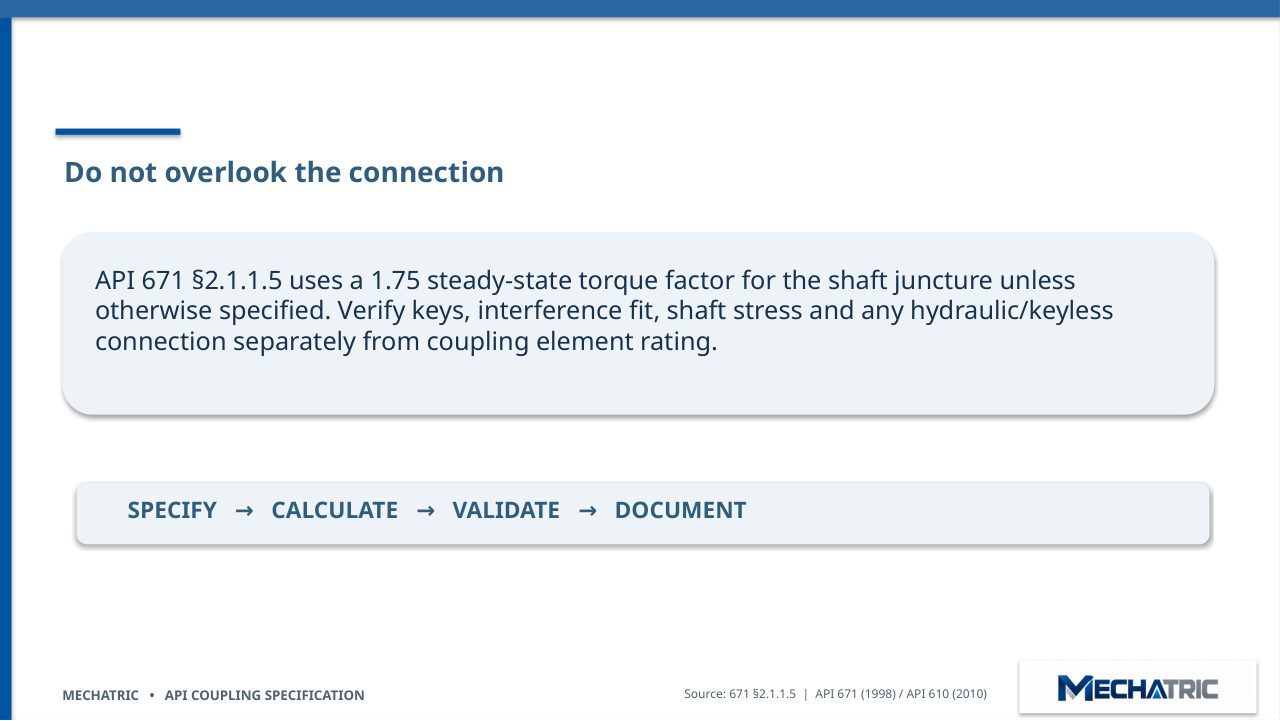
- Do not overlook the connection
- API 671 §2.1.1.5 uses a 1.75 steady-state torque factor for the shaft juncture unless otherwise specified. Verify keys, interference fit, shaft stress and any hydraulic/keyless connection separately from coupling element rating.
Transient and Peak Torque
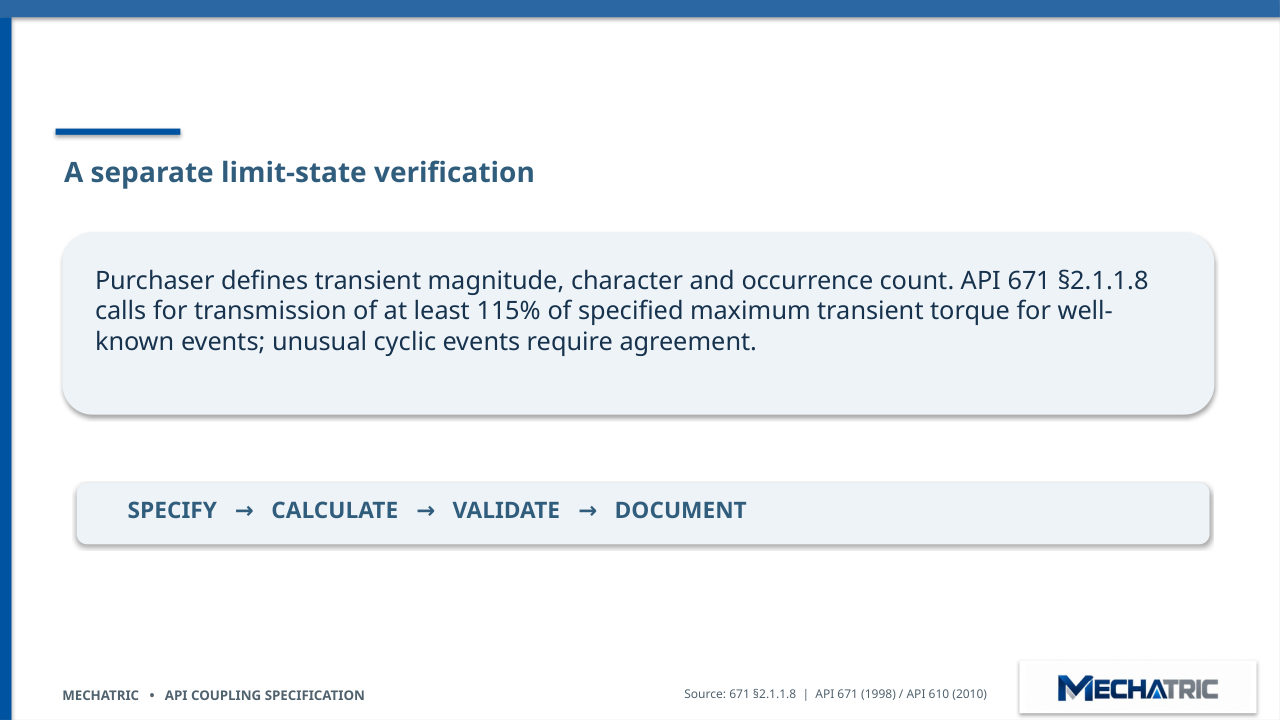
- A separate limit-state verification
- Purchaser defines transient magnitude, character and occurrence count. API 671 §2.1.1.8 calls for transmission of at least 115% of specified maximum transient torque for well- known events; unusual cyclic events require agreement.
Fatigue and Yield Margins
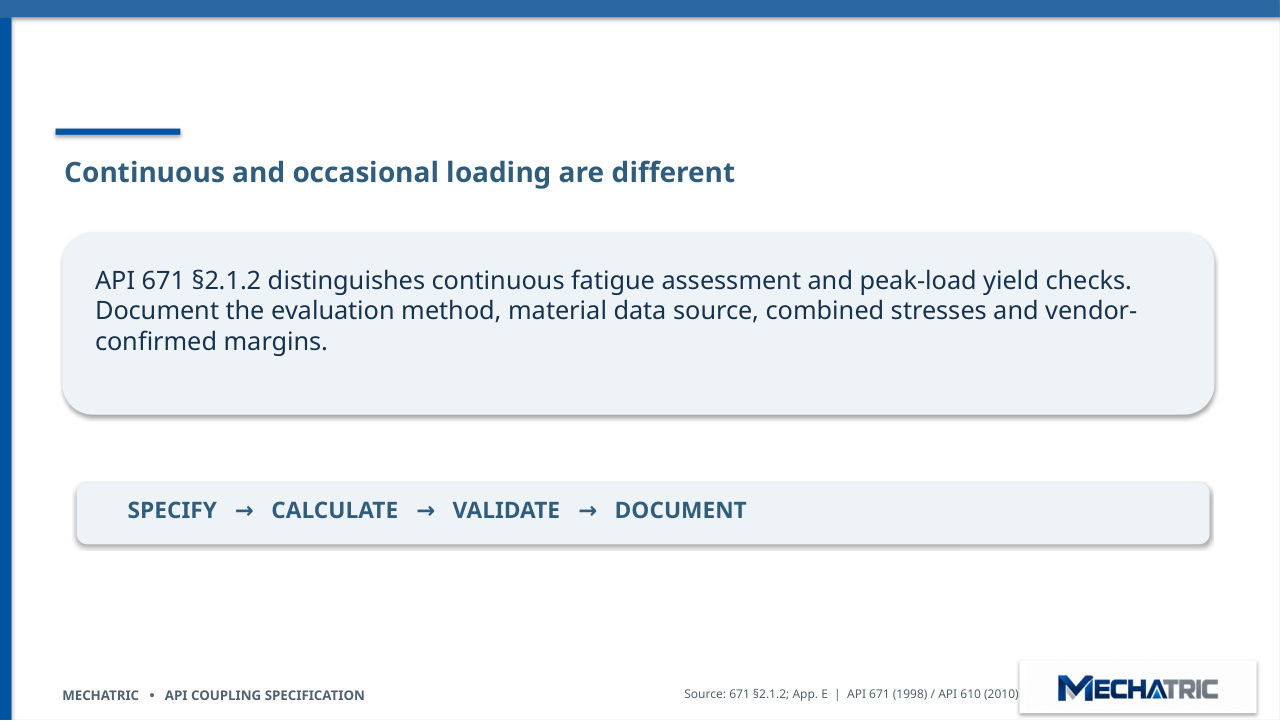
- Continuous and occasional loading are different
- API 671 §2.1.2 distinguishes continuous fatigue assessment and peak-load yield checks. Document the evaluation method, material data source, combined stresses and vendor- confirmed margins.
Misalignment Is a Combined Load
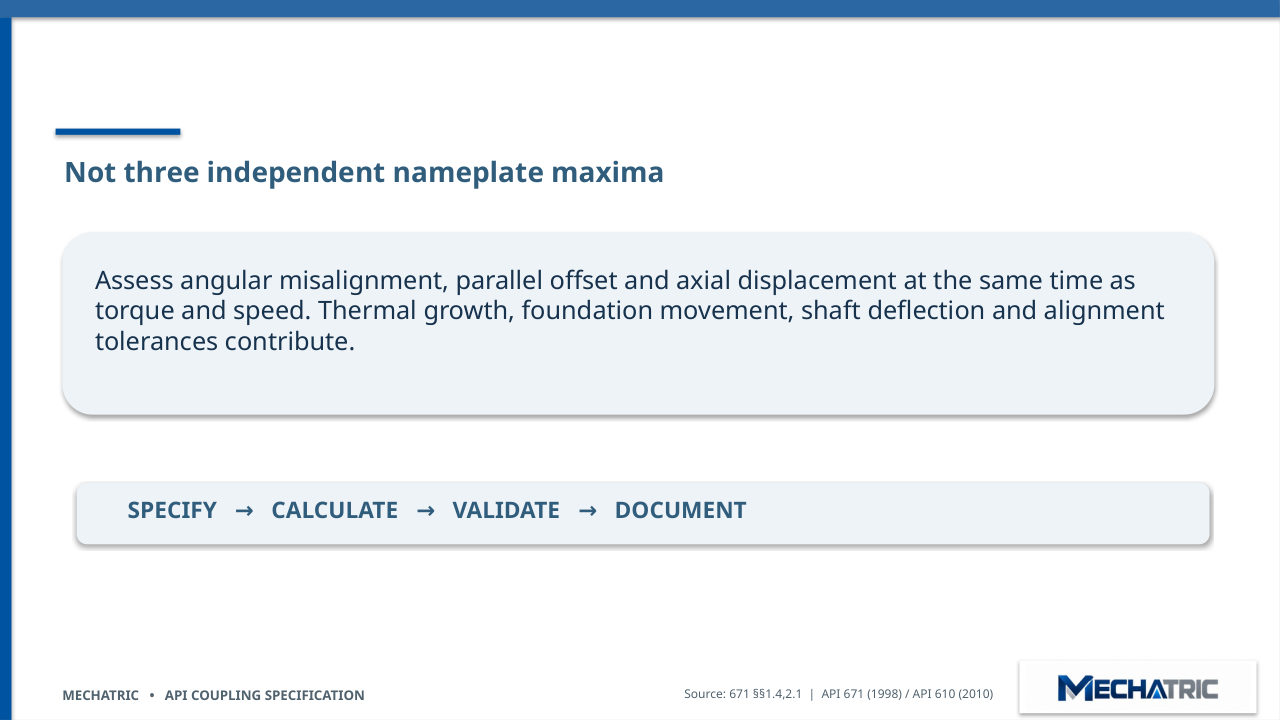
- Not three independent nameplate maxima
- Assess angular misalignment, parallel offset and axial displacement at the same time as torque and speed. Thermal growth, foundation movement, shaft deflection and alignment tolerances contribute.
API 671 Minimum Flexibility Basis
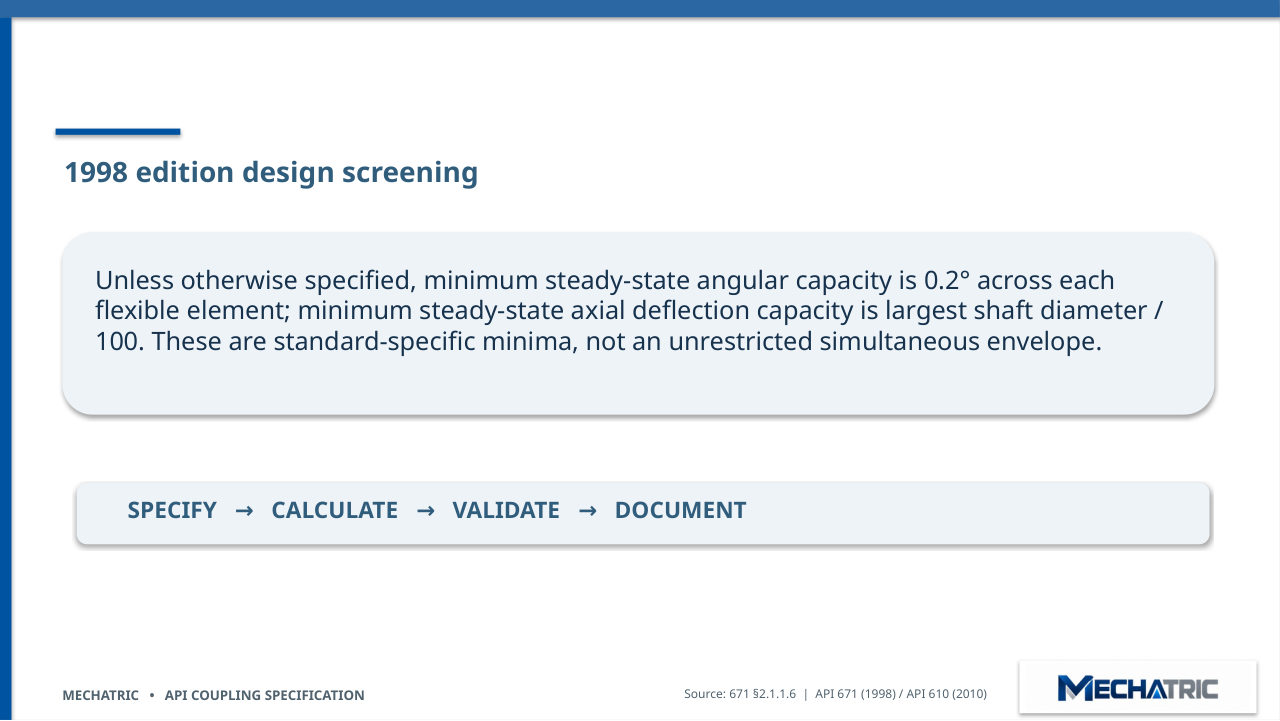
- 1998 edition design screening
- Unless otherwise specified, minimum steady-state angular capacity is 0.2° across each flexible element; minimum steady-state axial deflection capacity is largest shaft diameter / 100. These are standard-specific minima, not an unrestricted simultaneous envelope.
Double-Flex Spacer Geometry
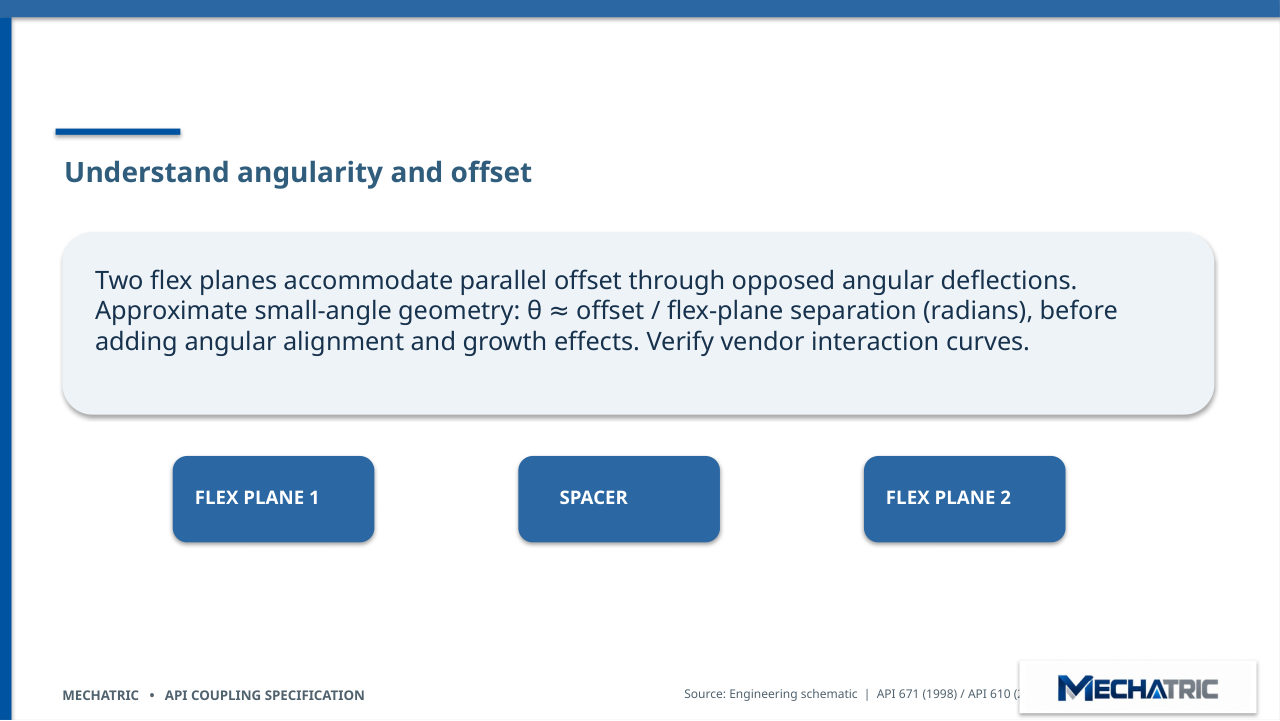
- Understand angularity and offset
- Two flex planes accommodate parallel offset through opposed angular deflections. Approximate small-angle geometry: θ offset / flex-plane separation (radians), before ≈ adding angular alignment and growth effects. Verify vendor interaction curves.
Axial Travel and Thermal Growth
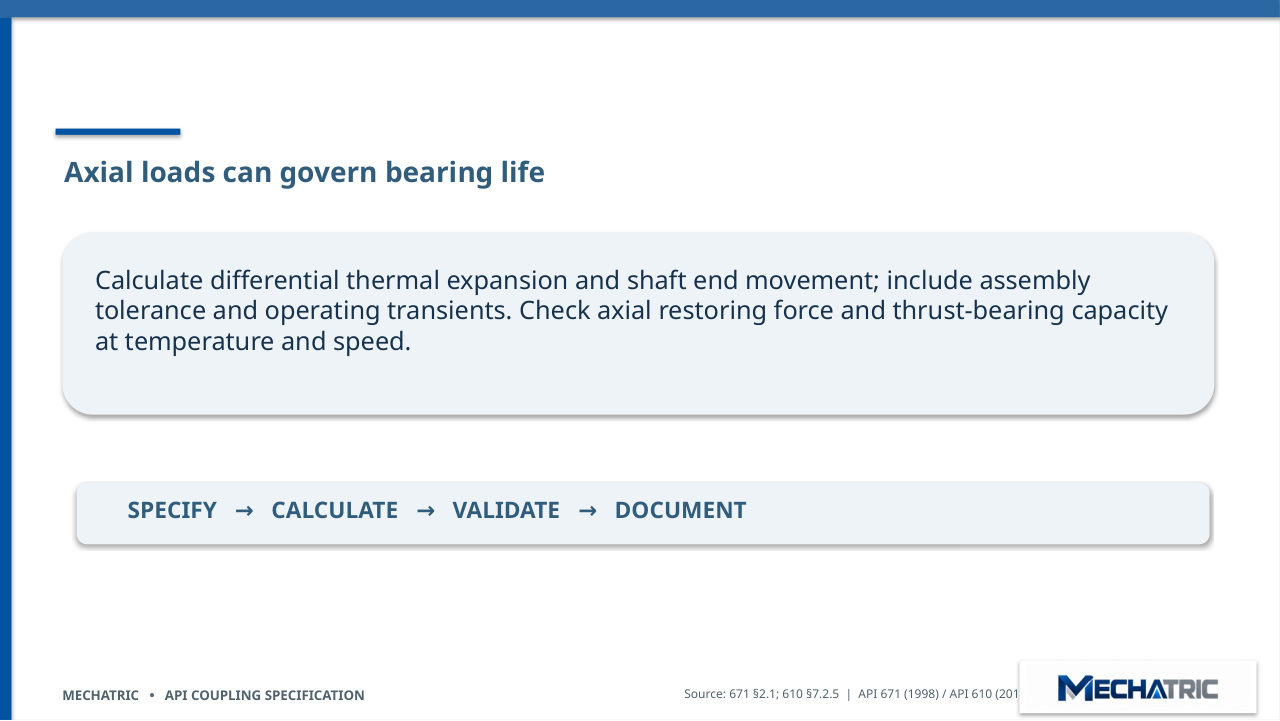
- Axial loads can govern bearing life
- Calculate differential thermal expansion and shaft end movement; include assembly tolerance and operating transients. Check axial restoring force and thrust-bearing capacity at temperature and speed.
DBSE / BSE: What to Specify
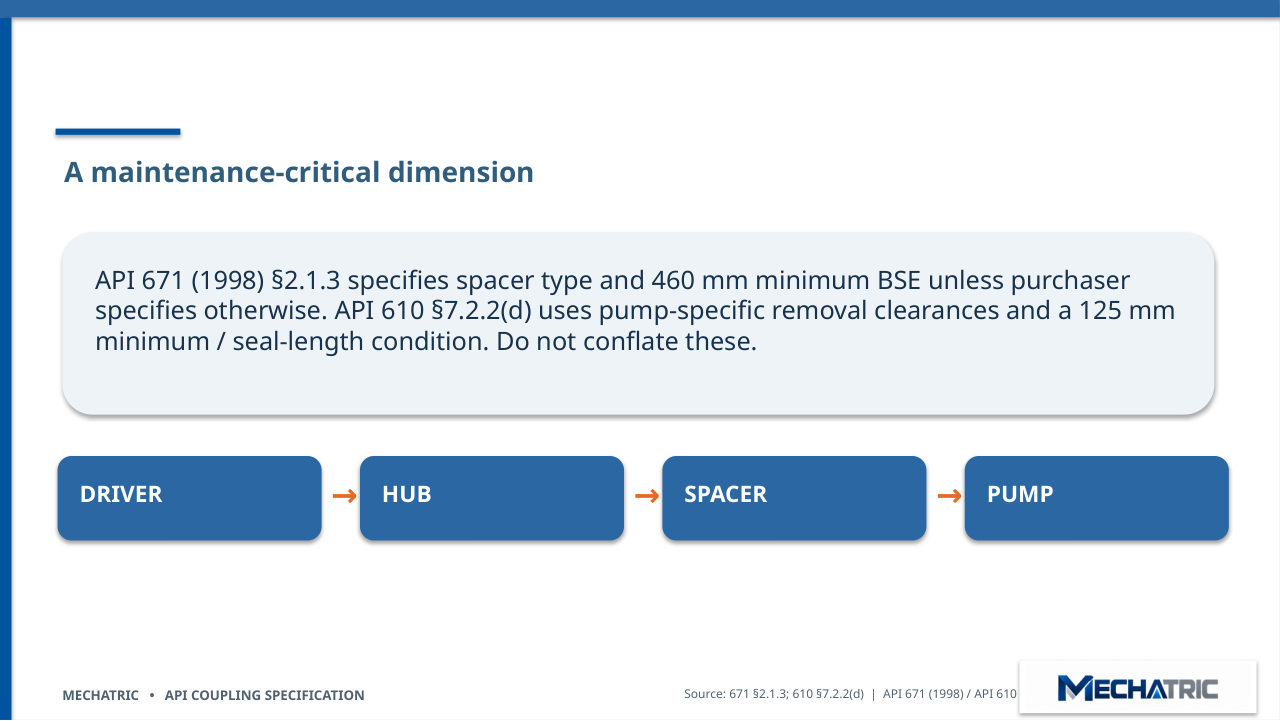
- A maintenance-critical dimension
- API 671 (1998) §2.1.3 specifies spacer type and 460 mm minimum BSE unless purchaser specifies otherwise. API 610 §7.2.2(d) uses pump-specific removal clearances and a 125 mm minimum / seal-length condition. Do not conflate these.
API 610 Pump-Train Coupling
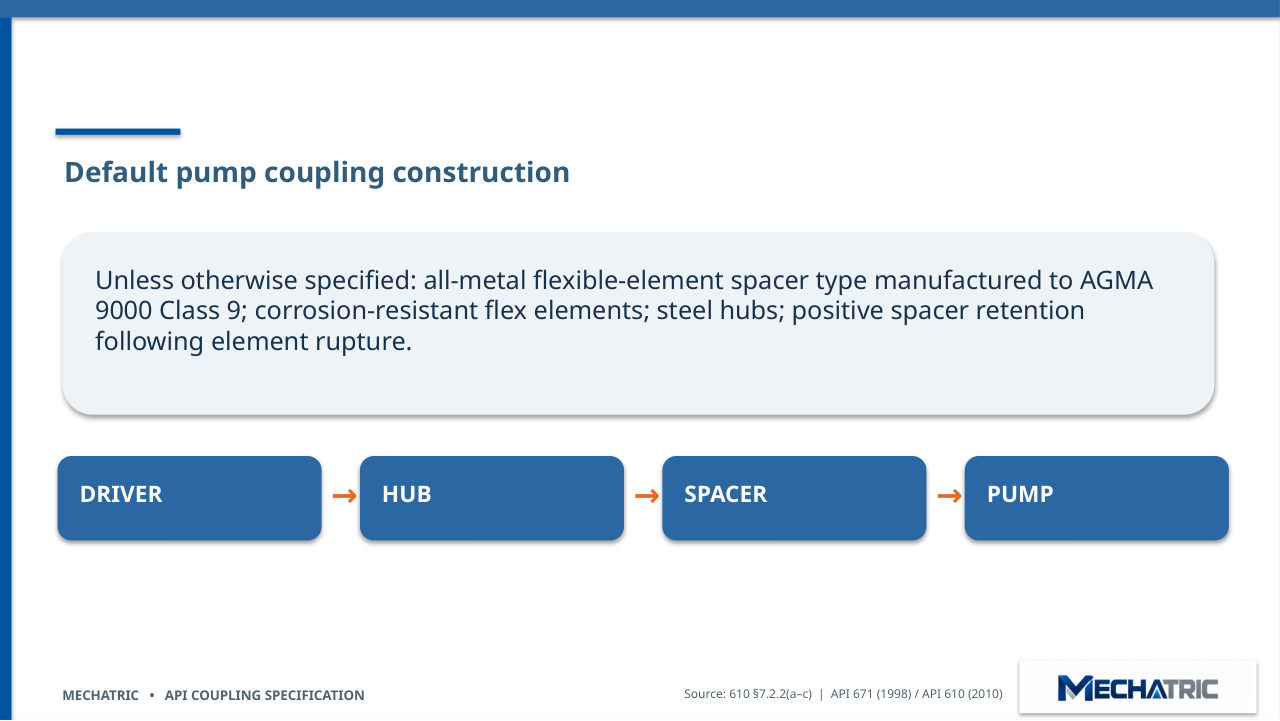
- Default pump coupling construction
- Unless otherwise specified: all-metal flexible-element spacer type manufactured to AGMA 9000 Class 9; corrosion-resistant flex elements; steel hubs; positive spacer retention following element rupture.
Positive Spacer Retention
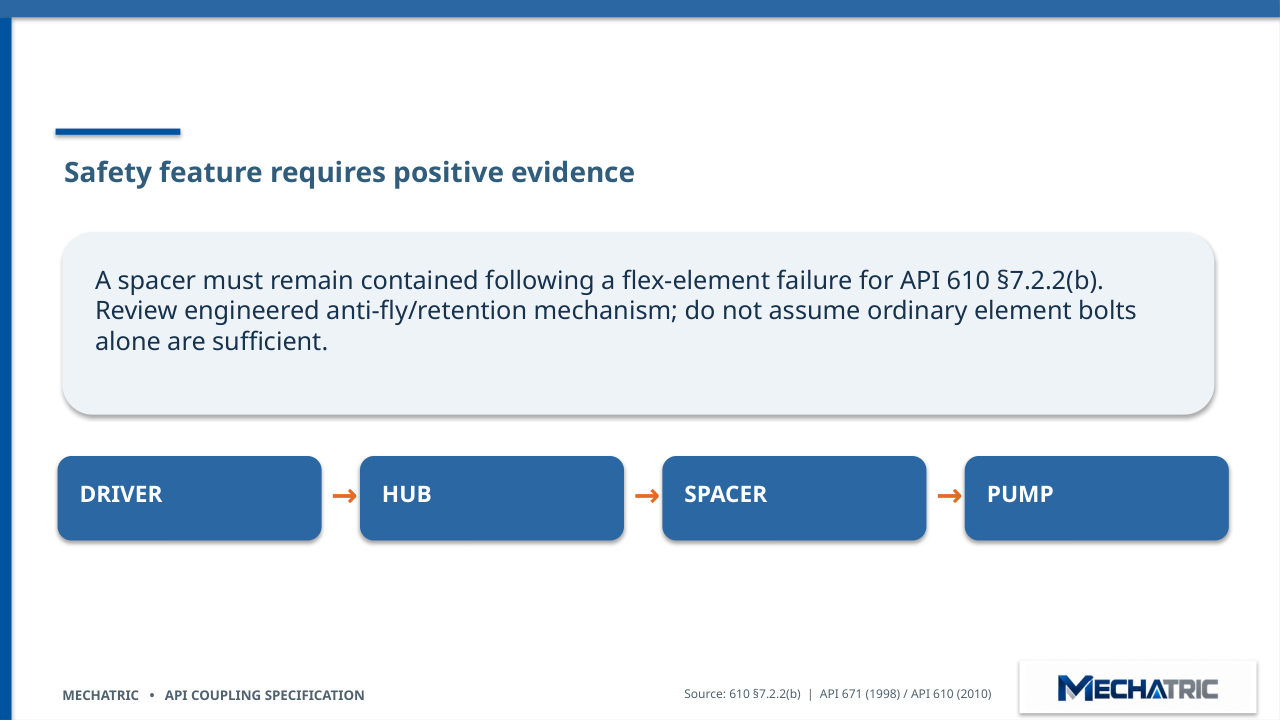
- Safety feature requires positive evidence
- A spacer must remain contained following a flex-element failure for API 610 §7.2.2(b). Review engineered anti-fly/retention mechanism; do not assume ordinary element bolts alone are sufficient.
Gear Coupling Engineering
- Lubrication and wear are design variables
- Evaluate tooth load distribution, lubrication, sealing, misalignment-related tooth loading, maintenance intervals and wear inspection. Compare gear designs only after confirming the API 671 gear-coupling requirements.
Metallic Flexible-Element Designs
- Disc packs and diaphragms
- Flexibility is achieved through elastic metallic deformation. Evaluate element stress/fatigue, fasteners, pack replacement, axial stiffness, corrosion and overload retention; supplier designs differ.
Quill-Shaft and Damping Designs
- Specialized torsional solutions
- Quill shafts alter torsional compliance; damping couplings require explicit analysis of thermal and dynamic behavior. Do not assume a torsionally soft design is a direct substitute for a metallic flexible-element coupling.
Torsional Dynamics
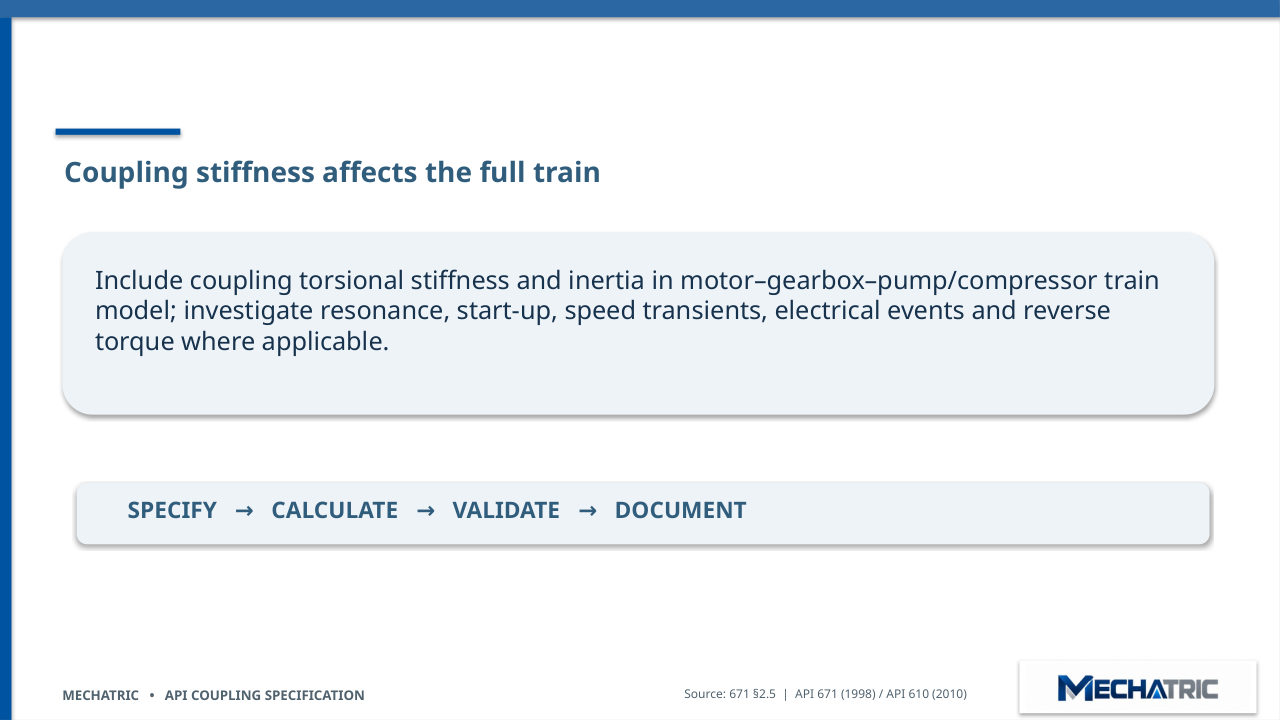
- Coupling stiffness affects the full train
- Include coupling torsional stiffness and inertia in motor–gearbox–pump/compressor train model; investigate resonance, start-up, speed transients, electrical events and reverse torque where applicable.
Lateral Dynamics and Overhung Mass
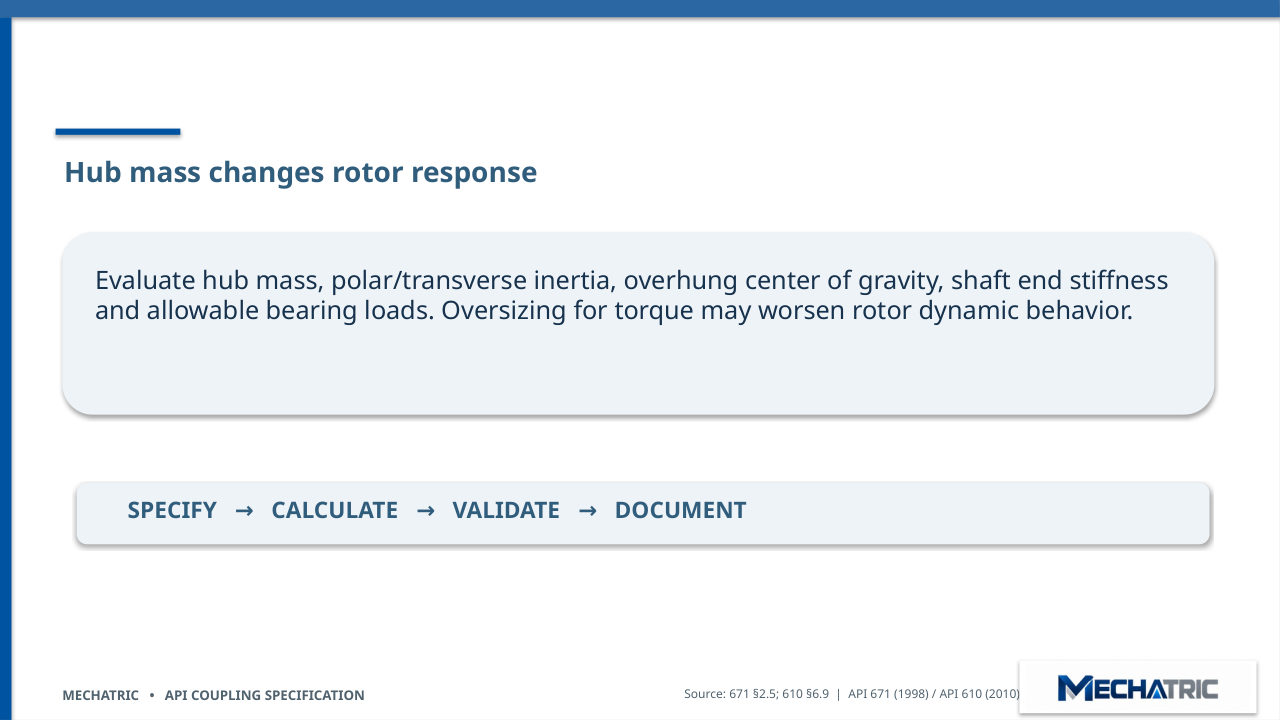
- Hub mass changes rotor response
- Evaluate hub mass, polar/transverse inertia, overhung center of gravity, shaft end stiffness and allowable bearing loads. Oversizing for torque may worsen rotor dynamic behavior.
Balance: Three Methods
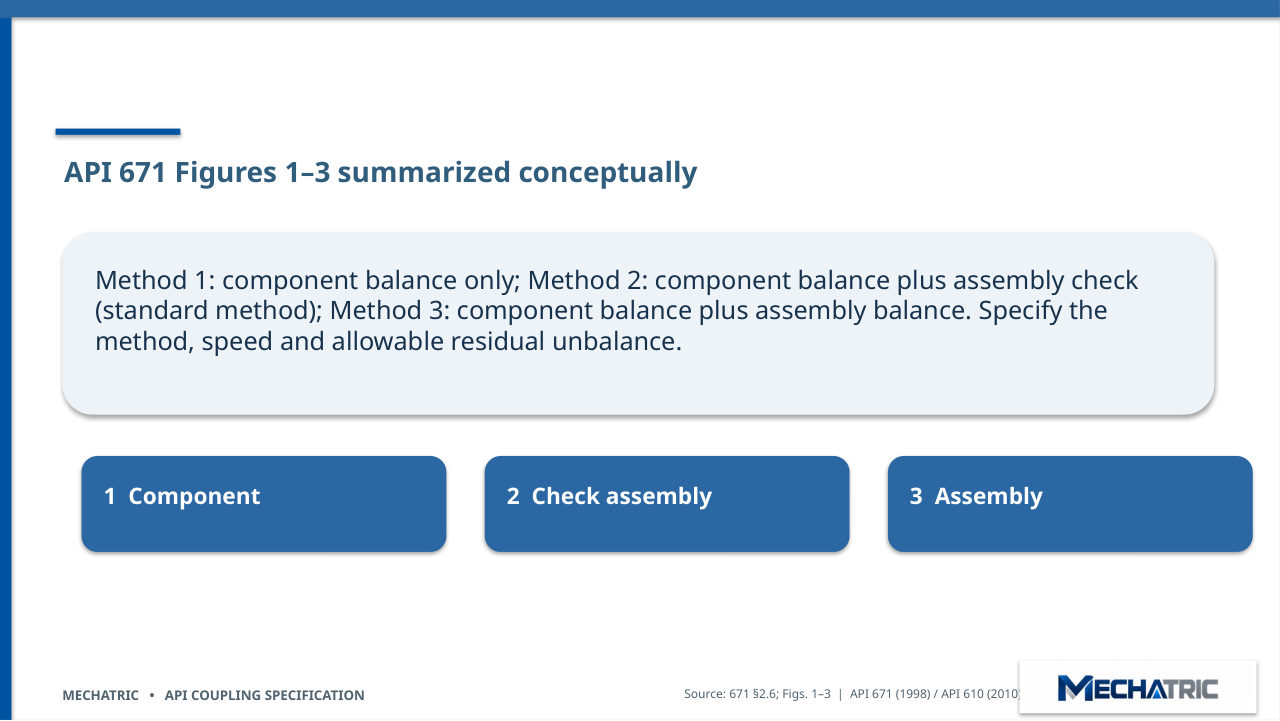
- API 671 Figures 1–3 summarized conceptually
- Method 1: component balance only; Method 2: component balance plus assembly check (standard method); Method 3: component balance plus assembly balance. Specify the method, speed and allowable residual unbalance. 1 Component 2 Check assembly 3 Assembly
API 610 Speed Threshold
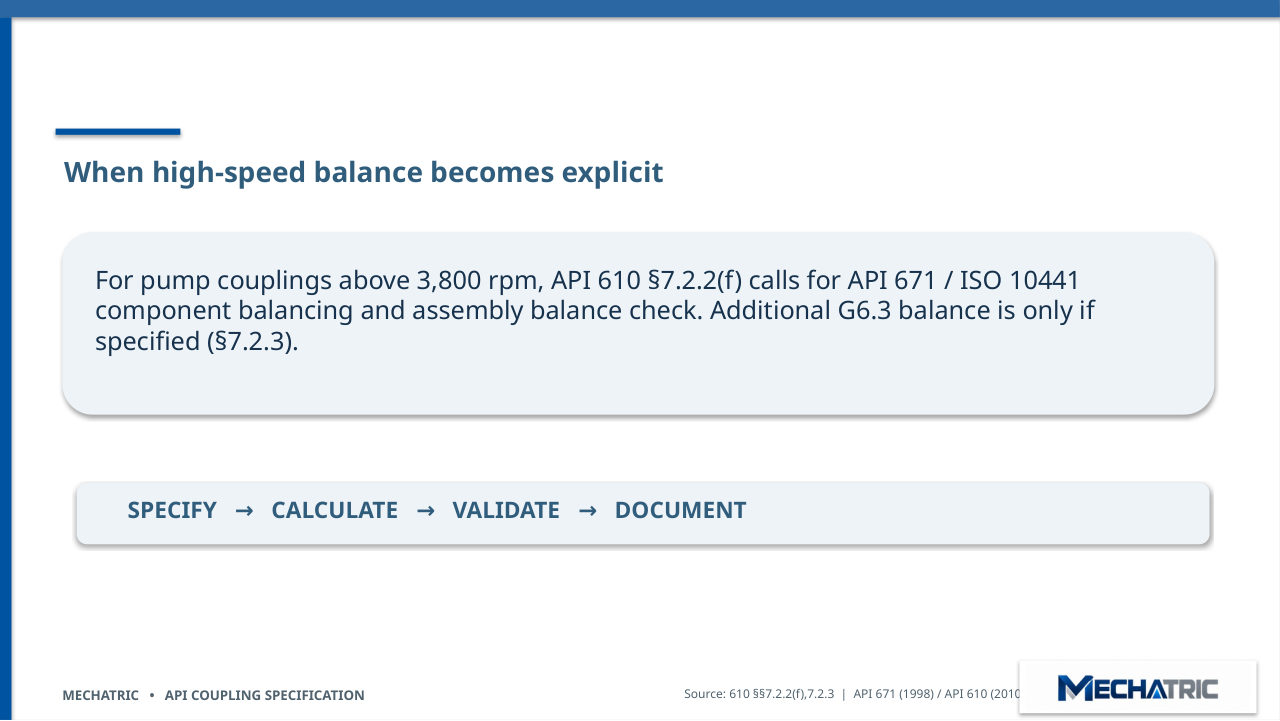
- When high-speed balance becomes explicit
- For pump couplings above 3,800 rpm, API 610 §7.2.2(f) calls for API 671 / ISO 10441 component balancing and assembly balance check. Additional G6.3 balance is only if specified (§7.2.3).
Hub Bore, Keys and Fits
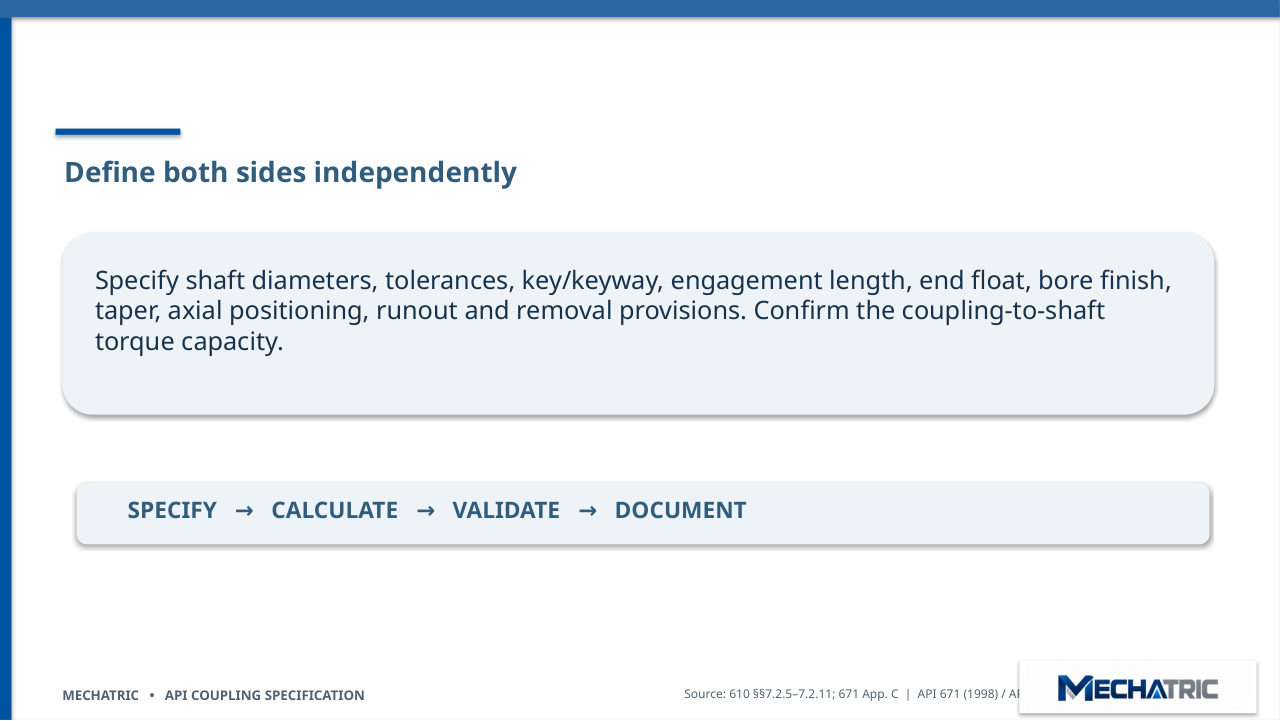
- Define both sides independently
- Specify shaft diameters, tolerances, key/keyway, engagement length, end float, bore finish, taper, axial positioning, runout and removal provisions. Confirm the coupling-to-shaft torque capacity.
API 610 Taper-Fit Conditions
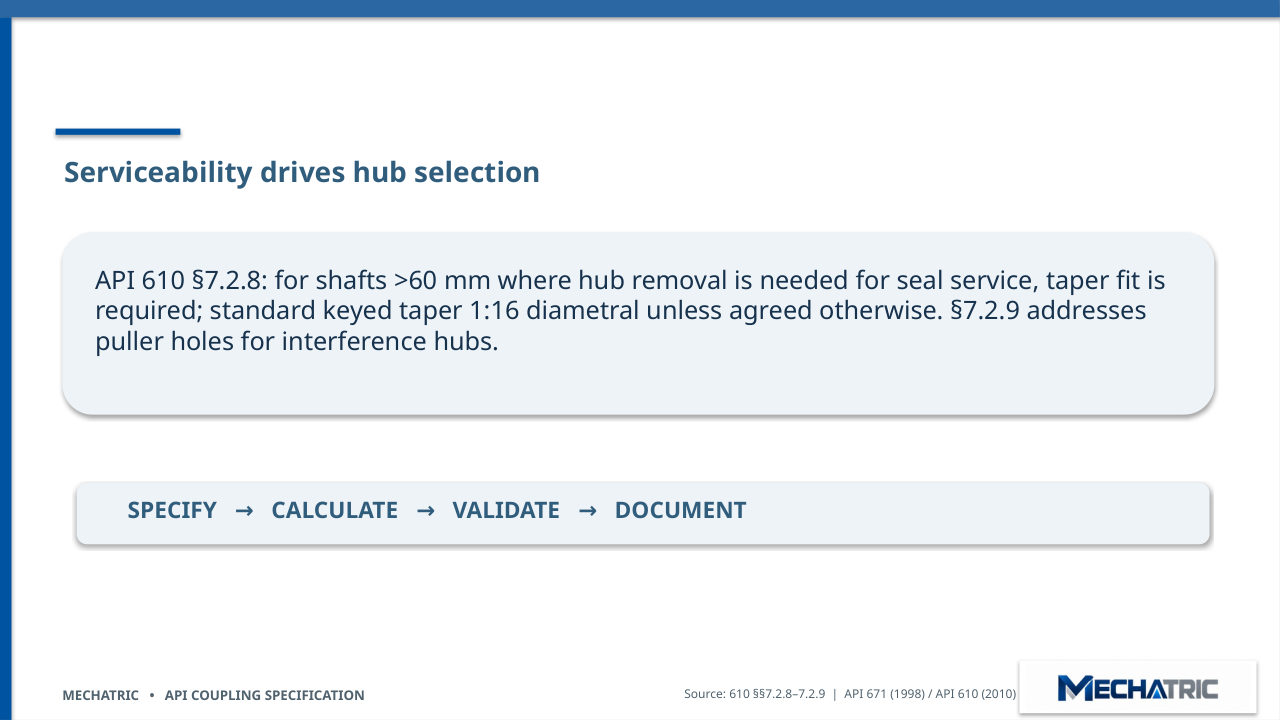
- Serviceability drives hub selection
- API 610 §7.2.8: for shafts >60 mm where hub removal is needed for seal service, taper fit is required; standard keyed taper 1:16 diametral unless agreed otherwise. §7.2.9 addresses puller holes for interference hubs.
Guards and Personnel Safety
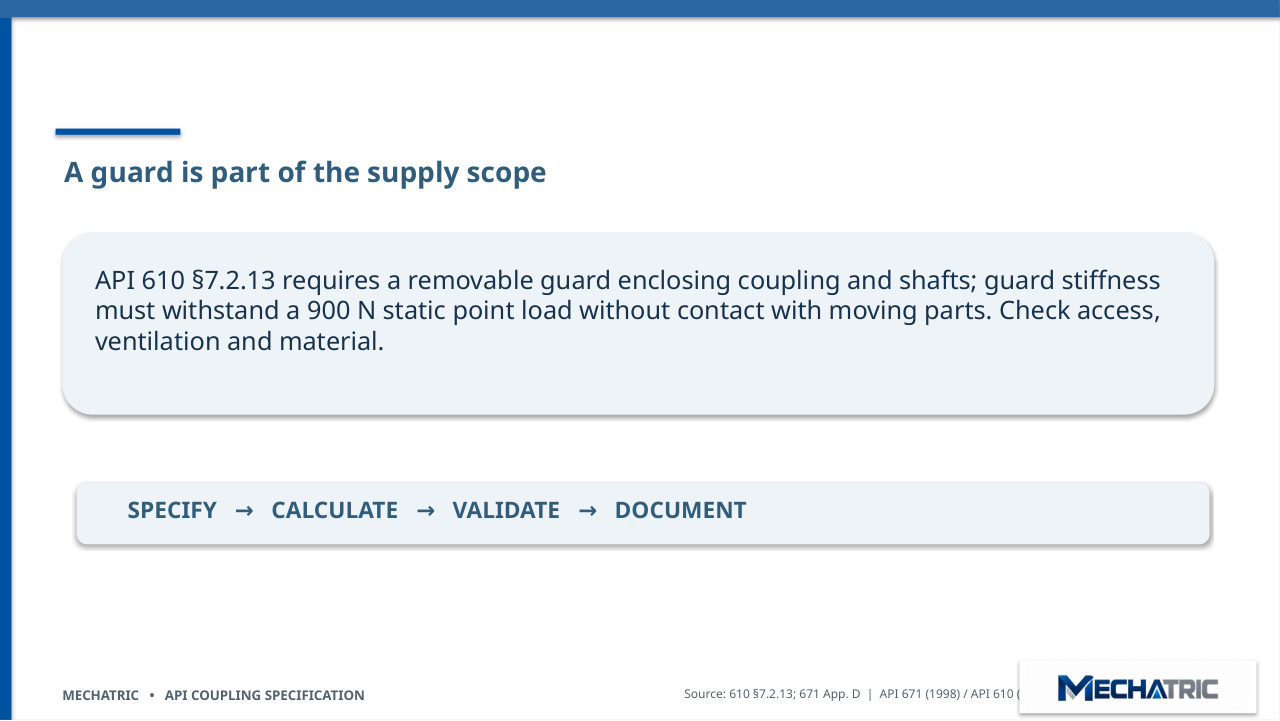
- A guard is part of the supply scope
- API 610 §7.2.13 requires a removable guard enclosing coupling and shafts; guard stiffness must withstand a 900 N static point load without contact with moving parts. Check access, ventilation and material.
Materials and Environment
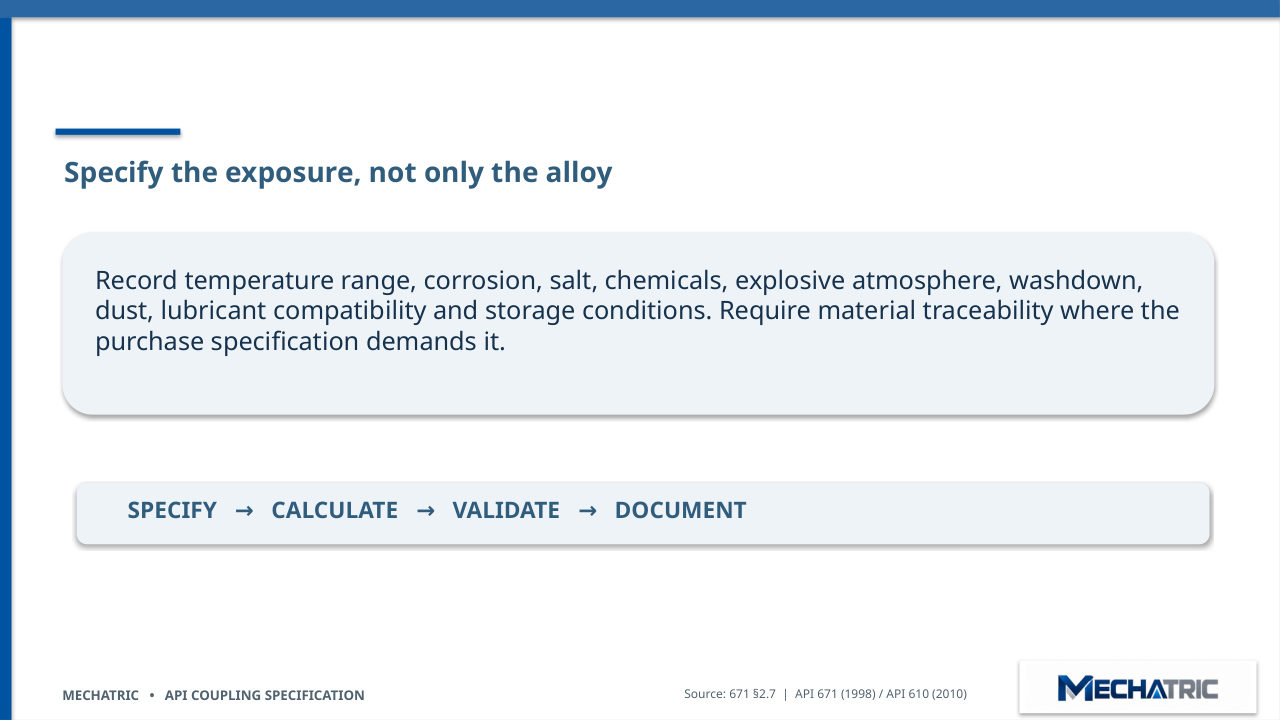
- Specify the exposure, not only the alloy
- Record temperature range, corrosion, salt, chemicals, explosive atmosphere, washdown, dust, lubricant compatibility and storage conditions. Require material traceability where the purchase specification demands it.
Manufacturing Quality Plan
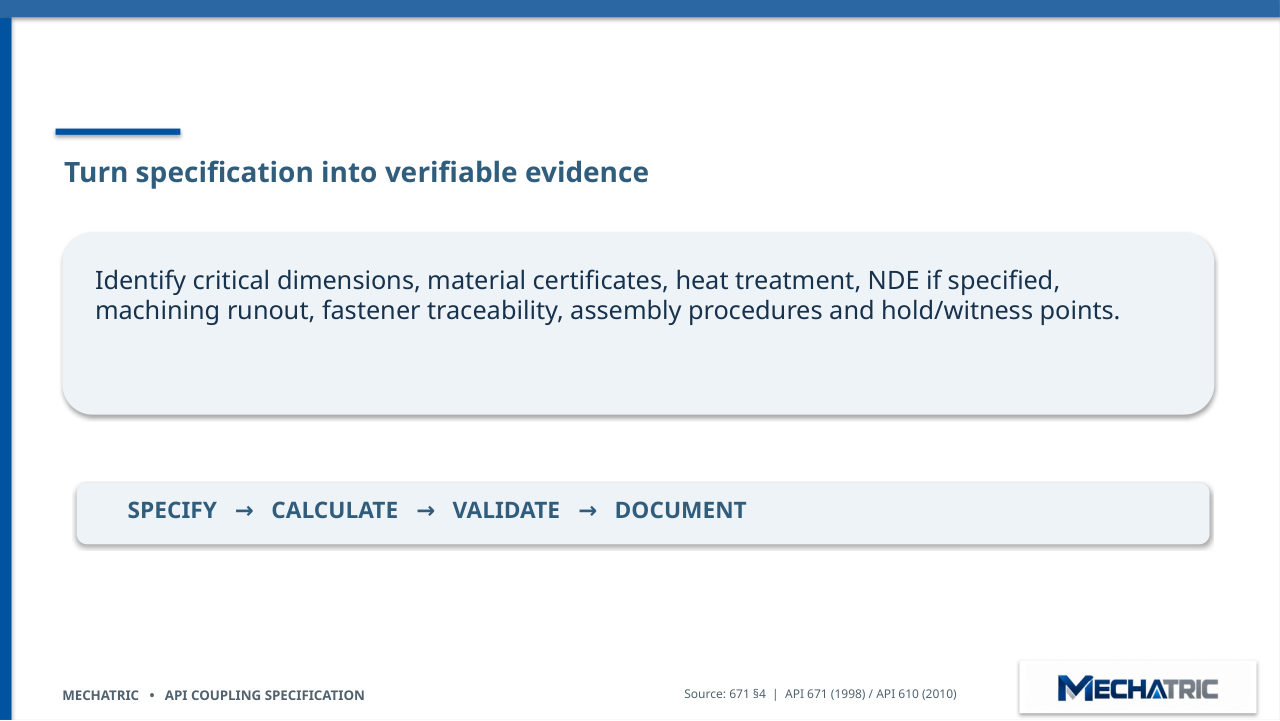
- Turn specification into verifiable evidence
- Identify critical dimensions, material certificates, heat treatment, NDE if specified, machining runout, fastener traceability, assembly procedures and hold/witness points.
Inspection and Testing
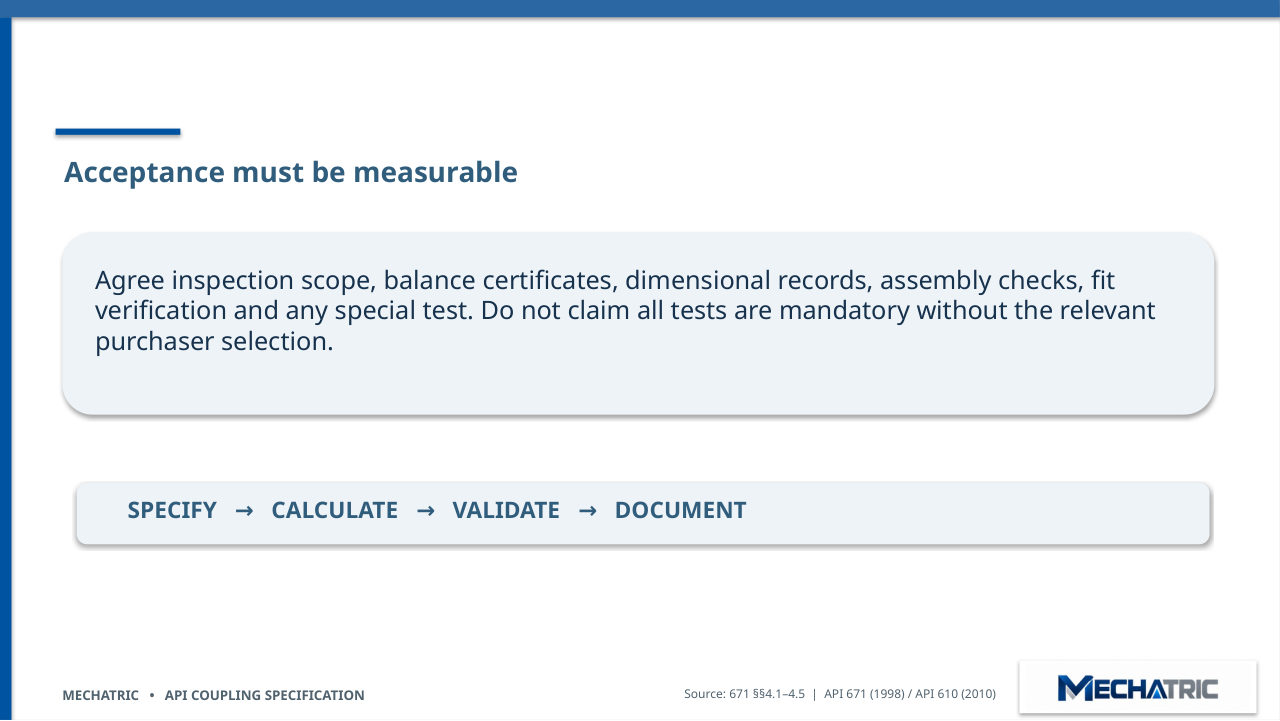
- Acceptance must be measurable
- Agree inspection scope, balance certificates, dimensional records, assembly checks, fit verification and any special test. Do not claim all tests are mandatory without the relevant purchaser selection.
Vendor Documentation Package
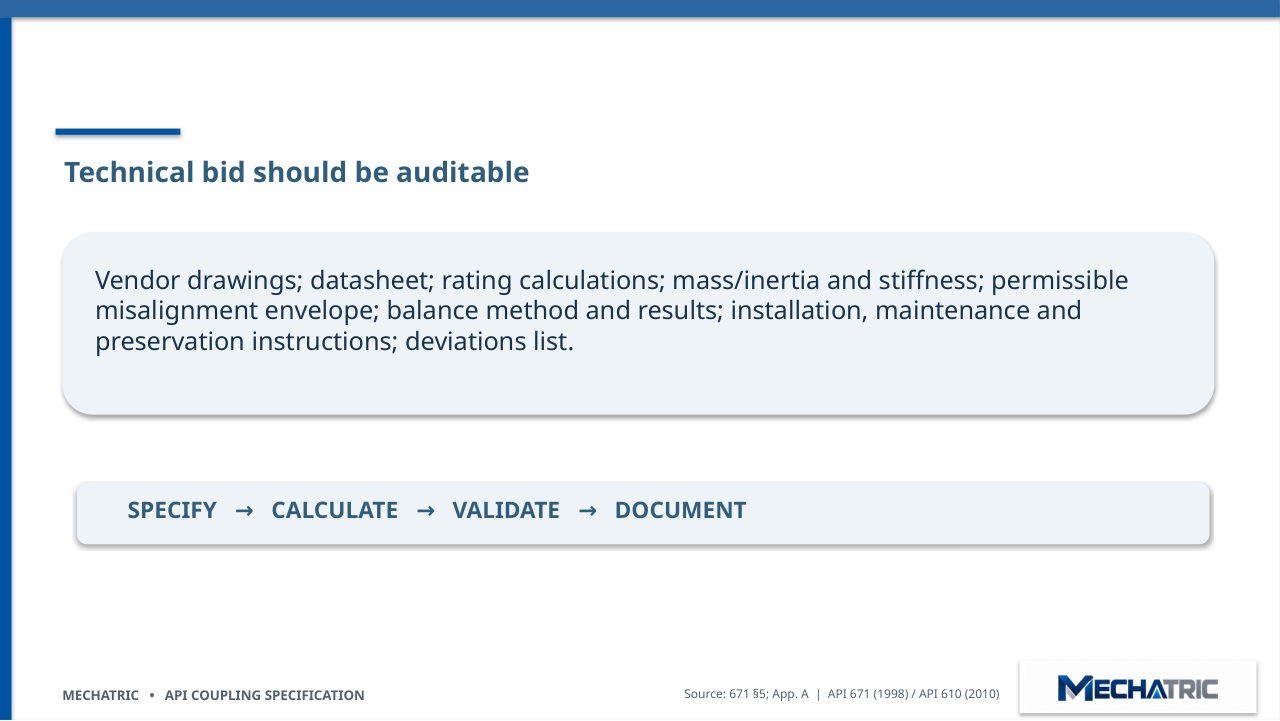
- Technical bid should be auditable
- Vendor drawings; datasheet; rating calculations; mass/inertia and stiffness; permissible misalignment envelope; balance method and results; installation, maintenance and preservation instructions; deviations list.
RFQ Datasheet: Operating Data
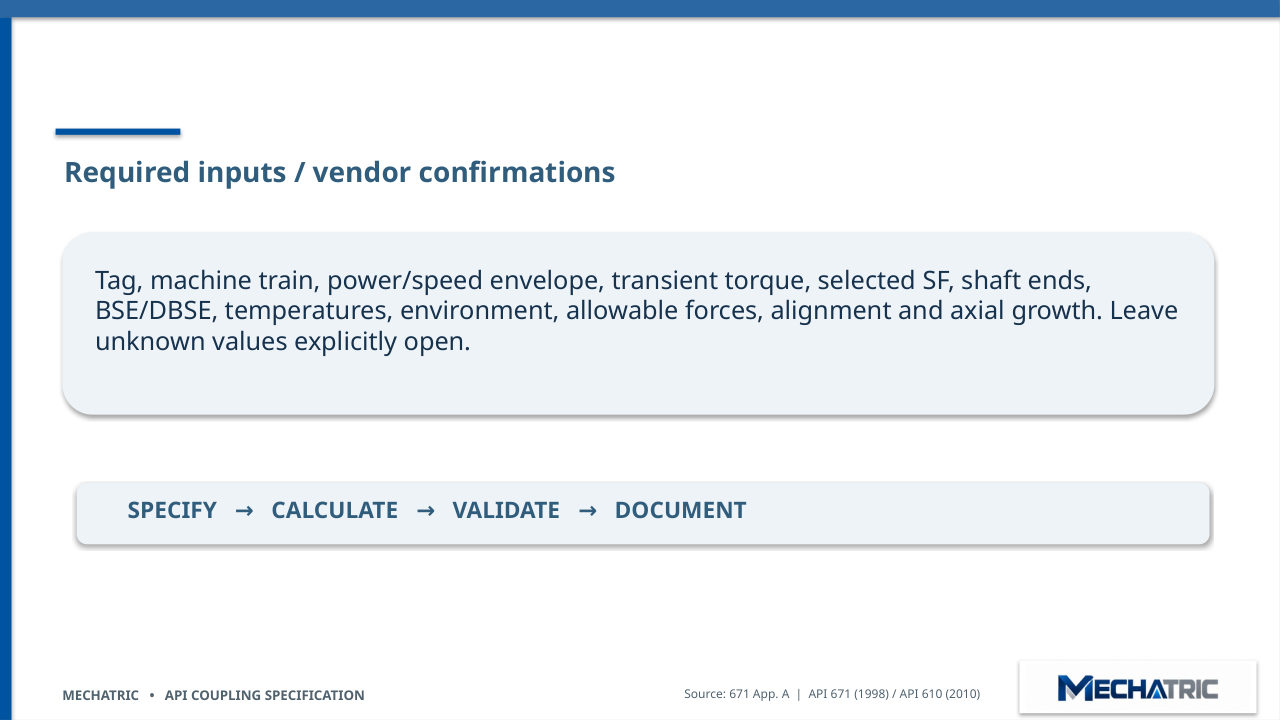
- Required inputs / vendor confirmations
- Tag, machine train, power/speed envelope, transient torque, selected SF, shaft ends, BSE/DBSE, temperatures, environment, allowable forces, alignment and axial growth. Leave unknown values explicitly open.
RFQ Datasheet: Mechanical Data
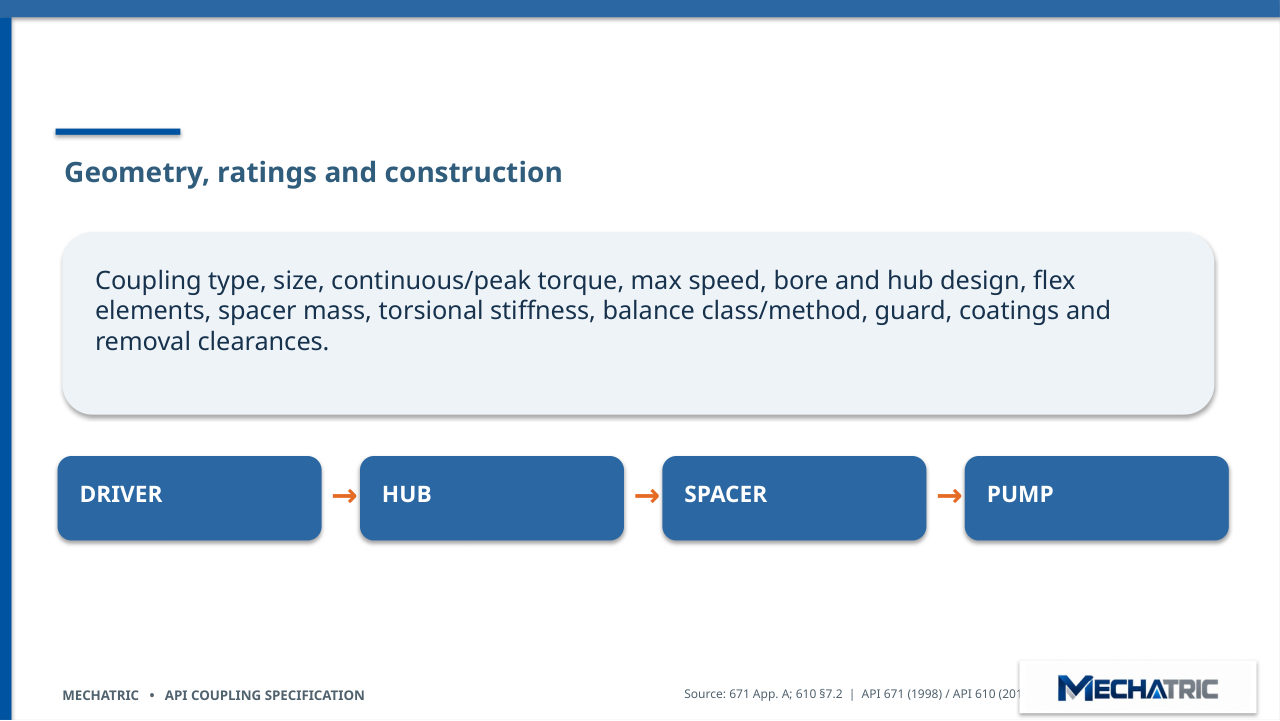
- Geometry, ratings and construction
- Coupling type, size, continuous/peak torque, max speed, bore and hub design, flex elements, spacer mass, torsional stiffness, balance class/method, guard, coatings and removal clearances.
Compliance / Deviation Matrix
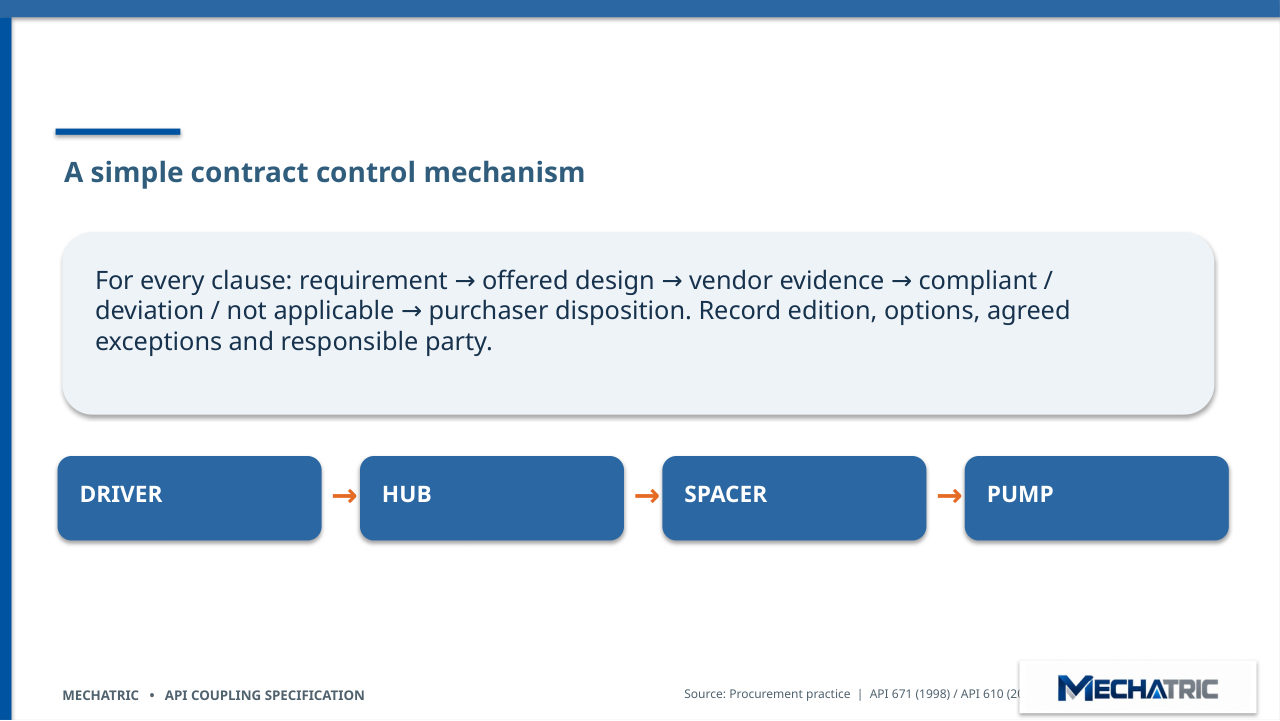
- A simple contract control mechanism
- For every clause: requirement offered design vendor evidence compliant /
Worked Pump Selection Review
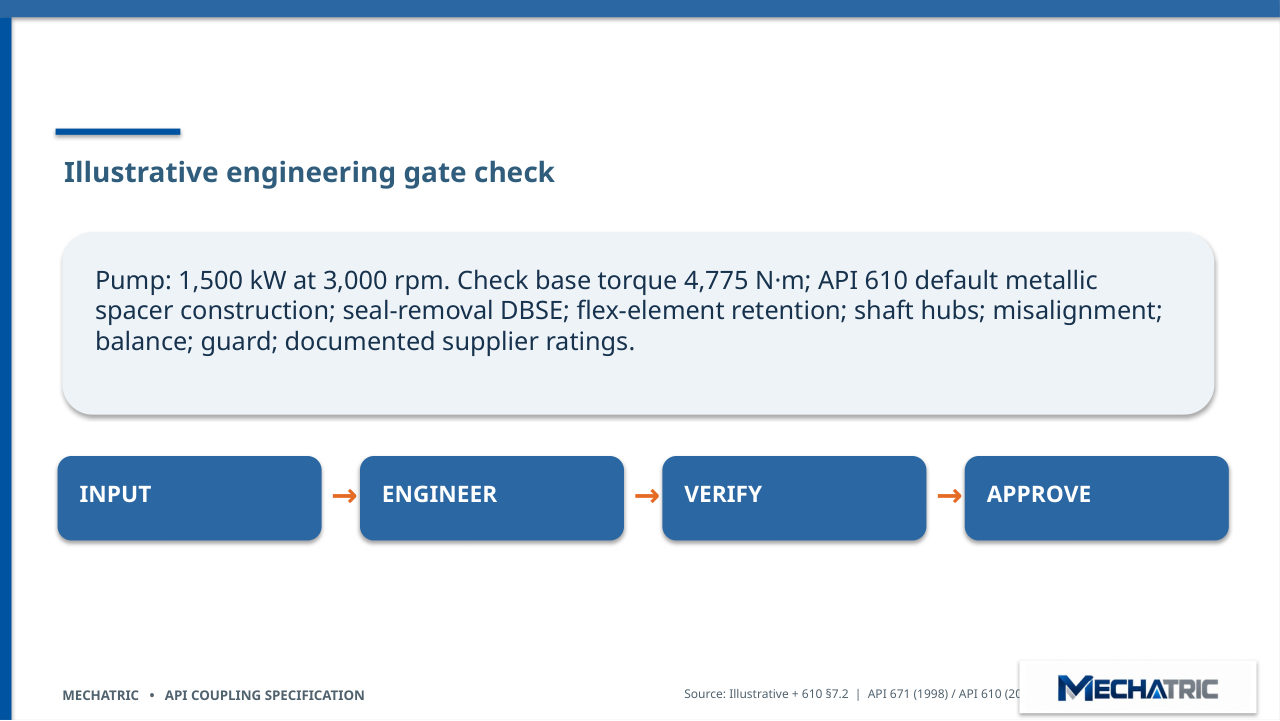
- Illustrative engineering gate check
- Pump: 1,500 kW at 3,000 rpm. Check base torque 4,775 N·m; API 610 default metallic spacer construction; seal-removal DBSE; flex-element retention; shaft hubs; misalignment; balance; guard; documented supplier ratings.
Final Engineering Acceptance Checklist
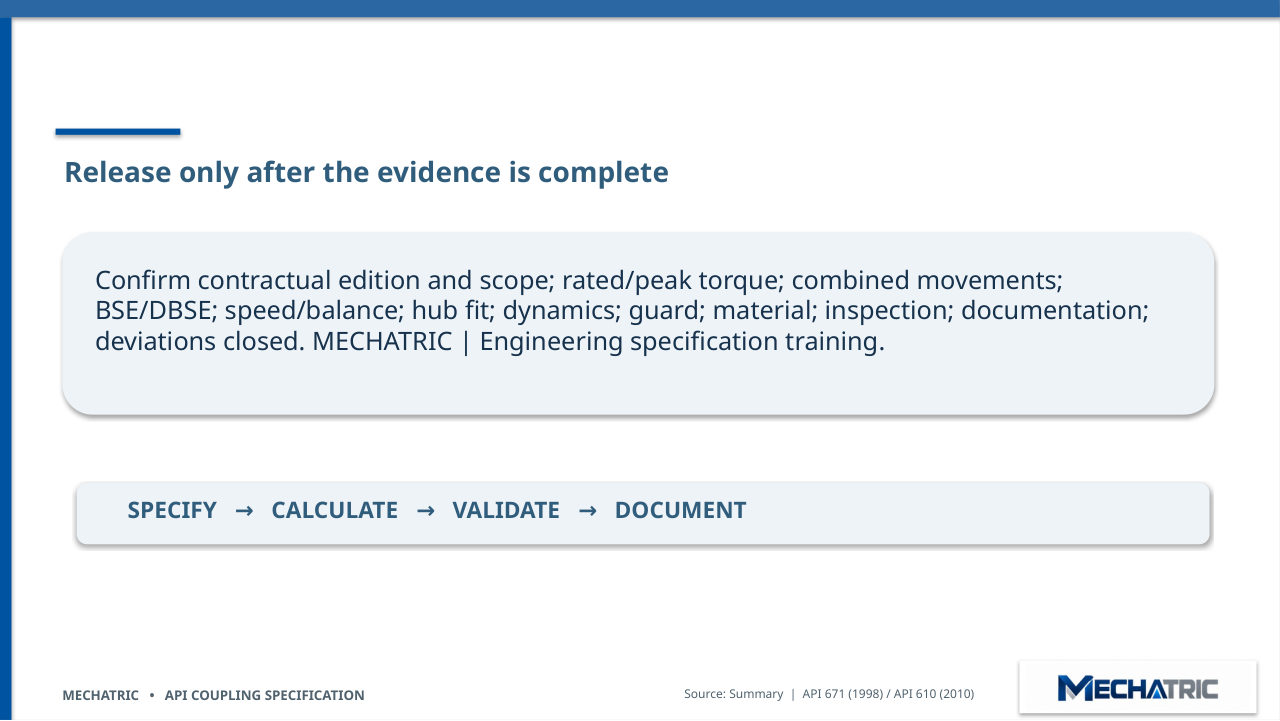
- Release only after the evidence is complete
- Confirm contractual edition and scope; rated/peak torque; combined movements; BSE/DBSE; speed/balance; hub fit; dynamics; guard; material; inspection; documentation; deviations closed. MECHATRIC | Engineering specification training.
Need engineering support?
Send your application data and the existing equipment details – MECHATRIC reviews the selection, specification or replacement and prepares the RFQ.
Training material prepared by MECHATRIC from the cited standards and manufacturer documentation. Trademarks belong to their respective owners. Confirm all requirements and ratings against the current editions and manufacturer data for each project.